
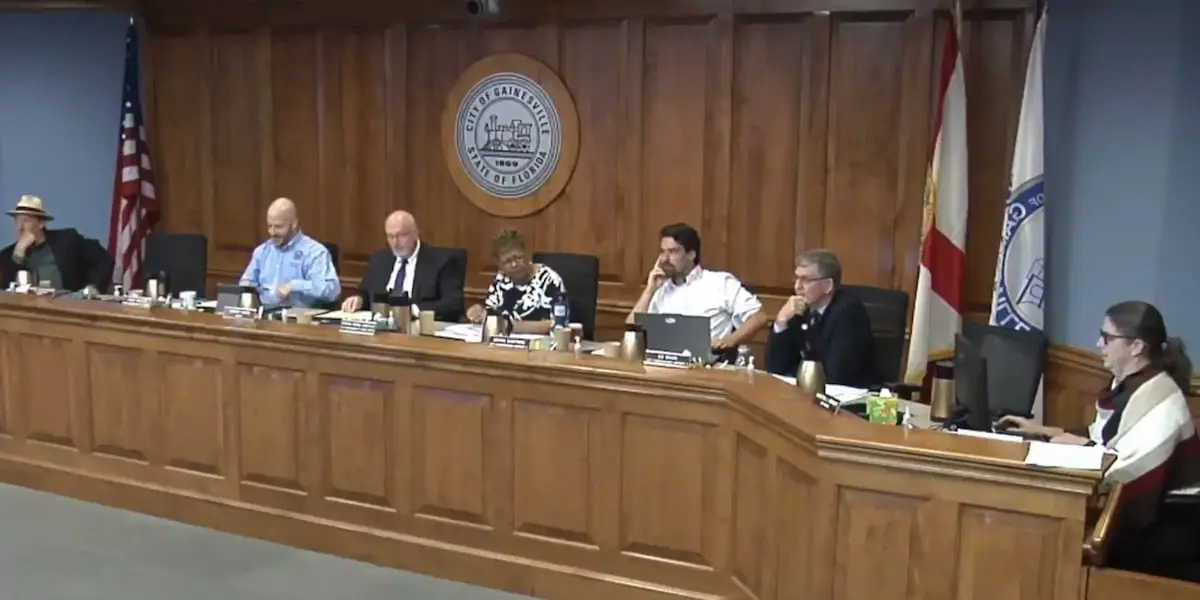

GAINESVILLE, Fla. — In a marathon session that highlighted the complex intersection of municipal zoning, public safety, and digital privacy, the Gainesville City Commission has deferred a highly anticipated vote on alcohol licensing buffer zones. After spending nearly three hours debating a series of pressing municipal issues—including controversial shifts in how stormwater and trash fees are billed to local homeowners—city leaders ran out of time, pushing the critical zoning discussion to late September.
However, the delay of the zoning item did not prevent commissioners from opening a broader, highly contentious dialogue regarding the proliferation of automated surveillance technology. Prompted by rising national anxieties and a surprising declaration of concern from Florida Governor Ron DeSantis, city leaders have scheduled a dedicated workshop for early October to scrutinize the use of Flock Safety license plate readers within city limits.
This investigative report provides an in-depth analysis of the proposed zoning overhauls, the operational reality of automated license plate readers (ALPRs) in North Central Florida, and the growing bipartisan pushback against the modern surveillance state.
Executive Overview
The Gainesville City Commission finds itself at a regulatory crossroads, balancing the demands of local economic development against community preservation and constitutional privacy rights.
The first major issue on the commission’s table is a proposed rewrite of the city’s land development regulations concerning alcoholic beverage establishments. Currently, Gainesville enforces a 400-foot buffer zone separating bars and nightclubs from schools. The proposed amendment seeks to recalibrate this spatial dynamic by extending the protective school buffer to 500 feet, while simultaneously eliminating the long-standing buffer zone requirement between alcohol-serving establishments and houses of worship. Proponents argue the shift modernizes zoning laws and encourages downtown infill development, while critics worry it could compromise the sanctity of local congregations and safety around educational facilities.
The second, and perhaps more politically charged, issue is the rapid deployment of Flock Safety license plate cameras. Once viewed by law enforcement as an indispensable tool for rapid vehicle identification and crime prevention, automated license plate readers have increasingly drawn fire from civil liberties advocates, municipal leaders, and now state executives.
In Gainesville, the debate has shifted from operational efficiency to data security and trust. With Commissioner Casey Willits raising alarm bells over the vulnerability of cloud-stored data, and Governor Ron DeSantis calling for statewide restrictions, Gainesville’s upcoming October workshop is poised to become a key battleground in the statewide debate over municipal surveillance.
Detailed Chronology of the Commission Session
A Jam-Packed Agenda and Postponed Decisions
The Gainesville City Commission convened for its late-August evening session with an agenda crowded by complex fiscal and administrative items. Much of the early evening was dominated by a granular discussion regarding municipal service billing. Commissioners ultimately approved a transition that will see local homeowners’ stormwater and trash collection fees shifted directly onto their annual property tax bills—a structural change aimed at streamlining municipal revenue collection, but one that required extensive public comment and commission debate.
By the time the commission concluded its fiscal deliberations, nearly three hours had elapsed. With the clock ticking late into the evening, Mayor Harvey Ward and the commission determined that the highly anticipated discussion on alcoholic beverage buffer zones could not receive the rigorous debate it deserved. Consequently, the item was officially tabled and rescheduled for the commission’s upcoming regular meeting on September 24.
The Surveillance Debate Takes Center Stage
Though the alcohol buffer zone discussion was postponed, the commission used the remaining portion of the meeting to address a rapidly emerging policy concern: the expansion of Flock Safety license plate readers.
[August Meeting] ──► [Sept 24 Meeting] ──────────► [Early October Workshop]
  - Fee Shift Passed    - Alcohol Buffer Vote       - Flock Camera Debate
  - Flock Intro         - 500ft School / No Church  - Privacy & Data Security
Mayor Harvey Ward acknowledged the growing volume of correspondence from concerned constituents regarding the surveillance cameras. To address these concerns comprehensively, Mayor Ward proposed that the city commission schedule a dedicated discussion on the technology during a meeting in early October.
The proposal found immediate support among commissioners, particularly Casey Willits, who expressed profound skepticism regarding the feasibility of regulating mass surveillance technology at the local level. The scheduling of the October workshop sets up a consecutive two-month policy sprint for the commission, with zoning dominating September and digital privacy taking center stage in October.
Supporting Context & Metrics
The Alcohol Buffer Zone Dilemma: Schools vs. Churches
To understand the significance of the proposed zoning changes, it is necessary to examine the spatial reality of Gainesville, a city deeply integrated with the campus of the University of Florida (UF). The relationship between commercial nightlife, student housing, public schools, and religious institutions is a delicate balancing act.
| Metric / Parameter | Current Zoning Regulation | Proposed Zoning Regulation | Potential Impact |
|---|---|---|---|
| School Buffer Zone | 400 Feet | 500 Feet | Restricts new nightlife venues near K-12 campuses; increases physical separation. |
| Church Buffer Zone | Imposed Buffer | Eliminated | Unlocks commercial real estate in downtown corridors; permits bars adjacent to houses of worship. |
| Primary Beneficiaries | Existing institutional properties | Commercial developers, hospitality groups, downtown merchants | |
| Primary Opponents | Conservative congregations, select parent-teacher associations | Local church leadership, neighborhood preservationists |
The decision to eliminate the church buffer zone altogether represents a modern trend in urban planning. Historically, "blue laws" and post-Prohibition zoning codes sought to keep alcohol sales far removed from religious institutions. However, in dense urban cores and historic districts—such as downtown Gainesville—churches are frequently located in commercial zones. The existing buffer requirements have historically restricted property owners from leasing vacant spaces to restaurants, breweries, or boutique bars. By removing the church buffer, the city aims to stimulate economic development and eliminate zoning anomalies that stifle local business growth.
Conversely, the decision to extend the school buffer from 400 to 500 feet represents a concession to public safety and family advocacy groups. This change ensures that any new establishment seeking to serve alcohol must sit further away from school properties, minimizing the potential exposure of students to the negative externalities associated with nightlife corridors.
The Proliferation of Flock Safety and the Digital Panopticon
Flock Safety has rapidly grown from a tech startup into a dominant force in American municipal policing. The company’s automatic license plate readers are designed to capture clear images of license plates, as well as unique vehicle characteristics (such as color, make, model, roof racks, and even bumper stickers), utilizing machine-learning algorithms to categorize data in real time.
[Flock Camera Capture] ──► [Machine Learning Identification] ──► [State/National Database Sharing]
                                                                      │
                                   ┌──────────────────────────────────┴──────────────────────────────────┐
                                   ▼                                                                     ▼
                      [Law Enforcement Hot-List Alert]                                    [Concerns: Data Breaches & Overreach]
While law enforcement agencies praise Flock cameras for their ability to instantly alert officers to stolen vehicles, amber alerts, or vehicles associated with active warrants, civil liberties organizations like the American Civil Liberties Union (ACLU) have raised significant alarms. The primary concerns include:
- Mass Data Retention: Unlike traditional surveillance systems that only record video, ALPRs create searchable, digital databases of law enforcement-grade tracking data, recording the movements of millions of innocent citizens who are not suspected of any crime.
- Inter-Agency Data Sharing: Flock’s network allows local police departments to share their data feeds with state and federal agencies across county and state lines. In an era of shifting national legal landscapes regarding reproductive healthcare and immigration, critics fear this data could be weaponized by out-of-state entities to track individuals seeking legal medical procedures or traveling across state borders.
- Data Security and Vulnerabilities: Because the data is hosted on cloud servers, it remains susceptible to cybersecurity breaches, unauthorized access by bad actors, or internal misuse by law enforcement personnel.
Official Statements and Political Alignment
The discussion surrounding both policy items has generated significant commentary from local commissioners and state leaders, revealing a surprising alignment of progressive local politicians and conservative state officials on the issue of technological surveillance.
Local Skepticism: Commissioner Casey Willits on Data Vulnerability
During the commission meeting, Commissioner Casey Willits voiced strong reservations regarding the city’s ability to safely manage and regulate the data generated by automated license plate readers. Willits highlighted the fundamental vulnerability of digital infrastructure, questioning whether any municipal policy could truly guarantee the privacy of Gainesville residents.
"I don’t know if we’re ever going to get enough regulations and steps and protocols and whatever to actually then… actually that’s trustable," Willits stated candidly. "Largely because when we talk about data, it’s too easy for these barriers and breaches to be breached."
Willits’ comments reflect a growing sentiment among municipal leaders that once mass surveillance data is collected and digitized, it becomes a permanent liability that no amount of bureaucratic oversight can completely secure.
State Intervention: Governor DeSantis’s Warning on Surveillance Overreach
The debate in Gainesville is occurring against a backdrop of shifting political dynamics at the state level. In a surprising development, Florida Governor Ron DeSantis publicly signaled his support for reigning in the unregulated expansion of ALPR technology. Speaking to reporters, DeSantis expressed deep concern over the ubiquity of the technology.
"The usage of these cameras has gotten out of control," Governor DeSantis stated. "We need robust state-level regulations to ensure that we are protecting the basic privacy rights of Floridians from unchecked, continuous surveillance."
DeSantis’s intervention is notable, as it marks a rare moment where a conservative state administration—which has traditionally prioritized strong "law and order" legislation—aligns with progressive municipal commissioners like Willits on the need to restrict law enforcement surveillance tools. This bipartisan skepticism suggests that the upcoming debate in Gainesville could serve as a bellwether for state-level legislative action during the next legislative session in Tallahassee.
Future Outlook: A Defining Autumn for Gainesville Policy
The coming weeks will prove pivotal for the Gainesville City Commission as it prepares to tackle these distinct yet equally impactful policy issues.
The September 24 Zoning Vote
When the commission reconvenes on September 24 to debate the alcohol buffer zones, they are expected to face a packed chamber. Local business owners, real estate developers, and representatives from the hospitality industry are expected to lobby heavily in favor of eliminating the church buffer zone, viewing it as a critical step toward unlocking prime commercial real estate in the downtown core.
On the other side, representatives from local school boards, parent-teacher associations, and conservative religious congregations are expected to demand strict adherence to protective boundaries. Commissioners will have to decide whether the proposed 100-foot extension of the school buffer is a sufficient compromise to offset the complete removal of church protections.
The October Surveillance Workshop
The scheduled October workshop on Flock Safety cameras promises to be an even more contentious affair. Gainesville city leaders will have to grapple with several key policy questions, including:
- Data Retention Limits: Will the city mandate a shorter retention period for captured license plate data (e.g., reducing it from 30 days to 24 hours for vehicles not flagged on active hot-lists)?
- Data Sharing Restrictions: Will the Gainesville Police Department be restricted from sharing license plate data with out-of-state law enforcement agencies or federal authorities?
- Independent Auditing: Will the city establish an independent oversight board to audit the use of the technology and ensure that officers are not utilizing the database for unauthorized personal or political tracking?
As Gainesville prepares for these critical debates, the decisions made by the city commission will not only shape the physical landscape of the city’s entertainment districts but will also define the boundaries of digital privacy for its residents in the years to come.

0 Comments