

Executive Overview
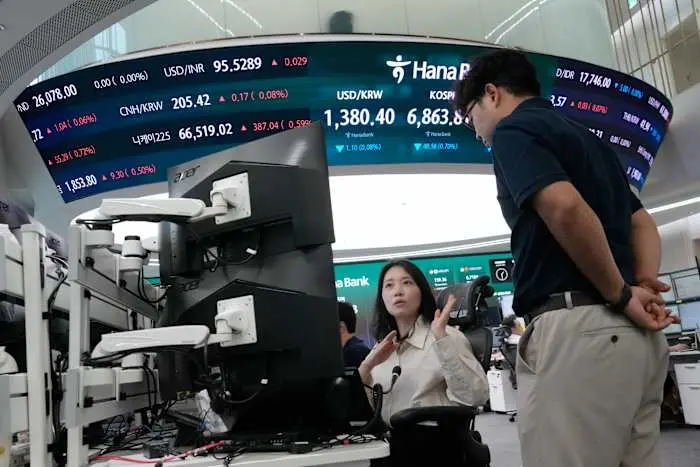
Asian equity markets exhibited a predominantly positive trajectory on Friday, following an influential late-week surge on Wall Street propelled by stellar earnings reports from artificial intelligence bellwether Nvidia and enterprise software giant Salesforce. Despite localized pullbacks—such as South Korea’s benchmark Kospi dipping 1%—investors across Tokyo, Hong Kong, Sydney, and Taipei embraced risk assets, buoyed by the reassurance that enterprise demand for specialized silicon and productivity-enhancing algorithms remains robust.
The broader market momentum follows a powerful Thursday session in the United States, where the S&P 500 climbed 0.7%, inching tantalizingly close to the all-time high watermarks established earlier in the month. The tech-heavy Nasdaq Composite led the charge with a 1.6% advance, while the Dow Jones Industrial Average added a modest 0.2%.
However, beneath the surface of the tech-led rally, market participants remain circumspect. Wall Street is steeling itself for a highly anticipated address later Friday by Federal Reserve Chairman Kevin Warsh. Amid persistent macroeconomic crosswinds—including stubborn inflationary pressures, a resilient domestic labor market, and volatile energy supplies driven by geopolitical tensions in the Middle East—investors are searching for definitive guidance on the trajectory of U.S. monetary policy. As crude oil futures slip and currency traders navigate shifting foreign exchange dynamics, the global financial ecosystem stands at a delicate crossroads between technological innovation and macro-level uncertainty.
Detailed Chronology and Regional Market Breakdown
The late-week trading session showcased a bifurcated performance across the globe, where surging technology valuations clashed with localized corrections and cautious positioning ahead of central bank commentary.
Asia-Pacific Trading Session
In Tokyo, the benchmark Nikkei 225 climbed 0.8% to settle at 66,682.88, drawing strength from exporters and semiconductor-related equities that tracked Wall Street’s tech-heavy rebound. Hong Kong’s Hang Seng index managed a 0.3% gain, closing at 25,648.40, while mainland China’s Shanghai Composite remained virtually unchanged, closing out the session near 3,956.28 amid cautious domestic sentiment.
Further south, Australia’s S&P/ASX 200 picked up 0.3% to reach 9,063.50, supported by steady commodity demand. Meanwhile, Taiwan’s Taiex surged a notable 1%, underscoring the region’s deep integration into the global high-performance computing and semiconductor supply chains.
The notable exception to the regional advance was South Korea. The Kospi slipped 1.0% to 6,841.50, as local profit-taking and sector-specific rotations overshadowed the broader optimism spilling over from international tech markets.
U.S. Wall Street Preceding Session
The Asian momentum was a direct reflection of a risk-on environment cultivated on U.S. exchanges a day prior. On Thursday, the S&P 500 advanced 0.7%, driven by strong corporate reports that alleviated some of the pervasive skepticism surrounding tech valuations. The Dow Jones Industrial Average ticked up 0.2%, while the Nasdaq Composite outperformed peers with a resounding 1.6% jump.
The centerpiece of Thursday’s rally was Nvidia, which experienced an 8.7% surge after posting quarterly earnings and revenue that effortlessly outpaced Wall Street consensus estimates. The chip manufacturer also provided forward-looking revenue guidance that comfortably surpassed analysts’ projections, effectively signaling that enterprise and hyperscale capital expenditure on artificial intelligence infrastructure shows no signs of abating.
Parallel to Nvidia’s triumph, Salesforce delivered its best single-day performance in six years, watching its shares skyrocket 22.6%. The company reported one of the most profitable quarters in its corporate history, pointing directly to artificial intelligence integrations as a core driver. Salesforce not only upgraded its full-year revenue outlook but also announced an expanded strategic partnership to incorporate Anthropic’s advanced Claude chatbot directly into its customer relationship management ecosystem.
Supporting Context & Metrics: Energy, Labor, and Retail Realities
While the upper echelons of the technology sector celebrated record-breaking margins and transformative software deployments, the broader economic landscape presented a more nuanced, friction-laden picture for consumers and traditional enterprises.
Energy Markets and Geopolitical Vulnerabilities
Crude oil prices, a primary transmission channel for global inflation, ticked lower on Friday following days of erratic swings dictated by geopolitical instability. The international benchmark, Brent crude, slipped 0.3% in early trading to $88.24 per barrel, partially correcting a 1.8% rally from the previous session. Concurrently, U.S. benchmark West Texas Intermediate (WTI) crude fell 0.4% to $83.17 per barrel.
Market sentiment in the energy pits remains inextricably linked to the ongoing military conflict involving Iran and persistent disruptions surrounding the Strait of Hormuz. Traders are anxiously monitoring developments regarding when oil tankers will be granted safe, unhindered passage through the critical maritime choke point, a variable that continues to inject a steady risk premium into global energy valuations.
Labor Market Resilience and Bond Yields
In the United States, fresh macroeconomic data released Thursday indicated that the domestic labor market remains remarkably durable. A report detailing new applications for unemployment benefits revealed that layoffs remain subdued, suggesting that corporate hiring trends are stabilizing rather than rolling over.
This sustained employment strength, however, prompted a reaction in the fixed-income market. U.S. Treasury yields ticked higher across the curve as bond traders dialed back aggressive expectations for immediate monetary easing. Higher yields reflect the lingering reality that the Federal Reserve may maintain a restrictive stance for longer if employment and wage growth refuse to cool significantly.
Consumer Discretionary and the Retail Divide
The bifurcation of the modern economy was acutely visible within the retail sector. High-end and traditional consumer discretionary firms continue to struggle as shoppers grapple with cumulative inflation and a general sense of economic weariness.
A prime example materialized in Best Buy’s quarterly update. Despite beating consensus estimates for both top-line revenue and bottom-line earnings, Best Buy shares tumbled 4.4%. Investors focused heavily on management’s cautious commentary regarding consumer purchasing power, signaling that everyday shoppers are pulling back on discretionary electronics and home goods.
Conversely, the discount retail segment presented a contrasting dynamic. Dollar General saw its shares rise 2.5% after reporting better-than-expected quarterly profits, as cash-strapped households—and potentially higher-income consumers seeking value—re-evaluated their spending habits. Rival Dollar Tree experienced a 3.9% decline despite beating profit forecasts, as analysts zeroed in on its forward-looking revenue guidance range, the midpoint of which fell short of Wall Street’s high expectations.
Official Statements and Policy Outlook
As global markets digest corporate scorecards, all eyes are locked on the impending remarks from Federal Reserve Chairman Kevin Warsh.
The central bank chief is scheduled to deliver a major address on Friday, an event that financial institutions have marked as the definitive policy catalyst for the end of the third quarter. Despite intense lobbying from market participants and political figures alike for explicit forward guidance regarding interest rate cuts and quantitative tightening trajectories, Warsh has historically favored a pragmatic, data-dependent approach. Throughout his tenure, he has deliberately offered financial markets fewer explicit clues regarding the central bank’s mechanical timeline for suppressing inflation to its targeted 2% threshold.
Analysts suggest that Warsh’s commentary will likely emphasize the resilience of the labor market and the persistent upside risks posed by commodity volatility—specifically energy fluctuations tied to Middle Eastern conflicts. By resisting calls for premature dovish signals, the Federal Reserve aims to anchor long-term inflation expectations, even if such restraint keeps borrowing costs elevated and introduces bouts of volatility into equity valuations.
On the corporate front, executive commentary has increasingly turned toward validating the tangible utility of artificial intelligence. Addressing investors following Nvidia’s blockbuster earnings release, CEO Jensen Huang delivered a definitive verdict on the technology’s commercial evolution:
"AI has reached its inflection point. It’s doing useful work. Its tokens are productive and profitable."
Huang’s remarks struck a vital chord across the financial community, serving as a direct counter-narrative to growing skepticism that the generative AI boom was morphing into an unsustainable bubble devoid of immediate return on investment.
Future Outlook
Looking ahead, the global financial landscape is poised for a period of heightened sensitivity as market actors reconcile explosive micro-level technological growth with restrictive macro-level monetary policy.
The immediate test for Wall Street and international bourses will be digesting the policy signals delivered by Federal Reserve Chairman Kevin Warsh. Should the central bank signal an unwavering commitment to higher-for-longer interest rates to combat sticky inflation, growth-oriented sectors—particularly technology and speculative equities—may face a recalibration. Conversely, any acknowledgment of easing labor market slack or moderating price pressures could provide the final catalyst required for the S&P 500 to shatter its historic resistance levels.
Simultaneously, investors will closely monitor supply chain developments in the Middle East. Any escalation in the Iran conflict or prolonged blockades in the Strait of Hormuz could rapidly reverse the recent softening in crude oil prices, injecting renewed inflationary panic into energy-dependent economies across Asia and the West.
Ultimately, while corporate powerhouses like Nvidia and Salesforce have successfully demonstrated that enterprise artificial intelligence investments can generate immediate, measurable revenue, the broader macroeconomic matrix remains complex. Retail bifurcation, shifting bond yields, and central bank calculus will dictate whether the current autumn market rally can mature into a sustained, economy-wide expansion or if it will remain an isolated triumph of the technology sector.

0 Comments