

Executive Overview
As the Florida State Seminoles prepare to kick off their highly anticipated campaign against New Mexico State, the college football landscape is undergoing its most profound structural transformation in modern history. At the epicenter of this shift is the NCAA’s newly minted "five-for-five" rule, set to take full effect for the 2026–27 athletic season. This sweeping regulatory change effectively eliminates traditional redshirt designations, reshaping roster management, game-day coaching strategies, and player development paradigms across the Power Four conferences.
For Florida State Head Coach Mike Norvell—a vocal proponent of the rule since its inception—the legislative overhaul brings long-awaited roster clarity. Gone are the days of convoluted COVID-era eligibility waivers, strategic four-game participation counts, and the agonizing calculus of whether to burn a player’s redshirt for late-season depth. Under the five-for-five framework, every athlete receives up to five years of total eligibility, but every single year counts against that maximum threshold, including seasons disrupted by injury.
For a program like FSU, which welcomed a staggering 34-player incoming freshman class alongside high-impact transfers, this regulatory freedom is a game-changer. Rather than hoarding raw talent on the bench to preserve future years of eligibility, Norvell and his coaching staff can deploy their resources immediately. As the Seminoles navigate mounting injuries and high expectations ahead of their season opener, the new rule has transformed from a theoretical piece of legislation into an active, aggressive blueprint for immediate success. From dynamic multi-sport freshmen to heavily-recruited junior college transfers, FSU is poised to test the boundaries of the five-for-five era right out of the gate.
Detailed Chronology
The Long Road to Elimination: The Demise of the Redshirt
For decades, the redshirt rule served as a foundational safety net in collegiate athletics, allowing players—particularly in football—to sit out their initial year of enrollment, preserve four years of full eligibility, and adjust to the physical and mental rigors of the collegiate game. However, the system grew increasingly bloated and contentious over the 2020s. The chaotic eligibility rulings stemming from the COVID-19 pandemic, coupled with a booming transfer portal and complex four-game participation limits, created an administrative nightmare for compliance departments and head coaches alike.
Recognizing the need for a streamlined system, the NCAA advanced the five-for-five rule framework over several years of deliberation, culminating in its implementation for the 2026–27 season. The ruling achieves two primary objectives: it provides a hard cap of five years of total participation for every athlete, and it completely abolishes the traditional redshirt. Every active season counts toward the limit, regardless of whether a player logs a single snap or starts all 12 games.
While some traditionalists expressed concern over the loss of developmental years for raw prospects, progressive coaches like Mike Norvell championed the rule for its absolute transparency and flexibility. To Norvell, the elimination of redshirts removes the artificial handcuffs that previously prevented ready players from contributing.
Fall Camp and the Crucible of Competition
As fall camp unfolded in Tallahassee, the practical applications of the five-for-five rule quickly took center stage. With a massive 34-player freshman class arriving on campus, Norvell and his staff evaluated talent through an unfiltered lens. Without the safety net of preserving a redshirt, evaluations were purely merit-based: if a first-year player was among the best options at their position, they were going to play.
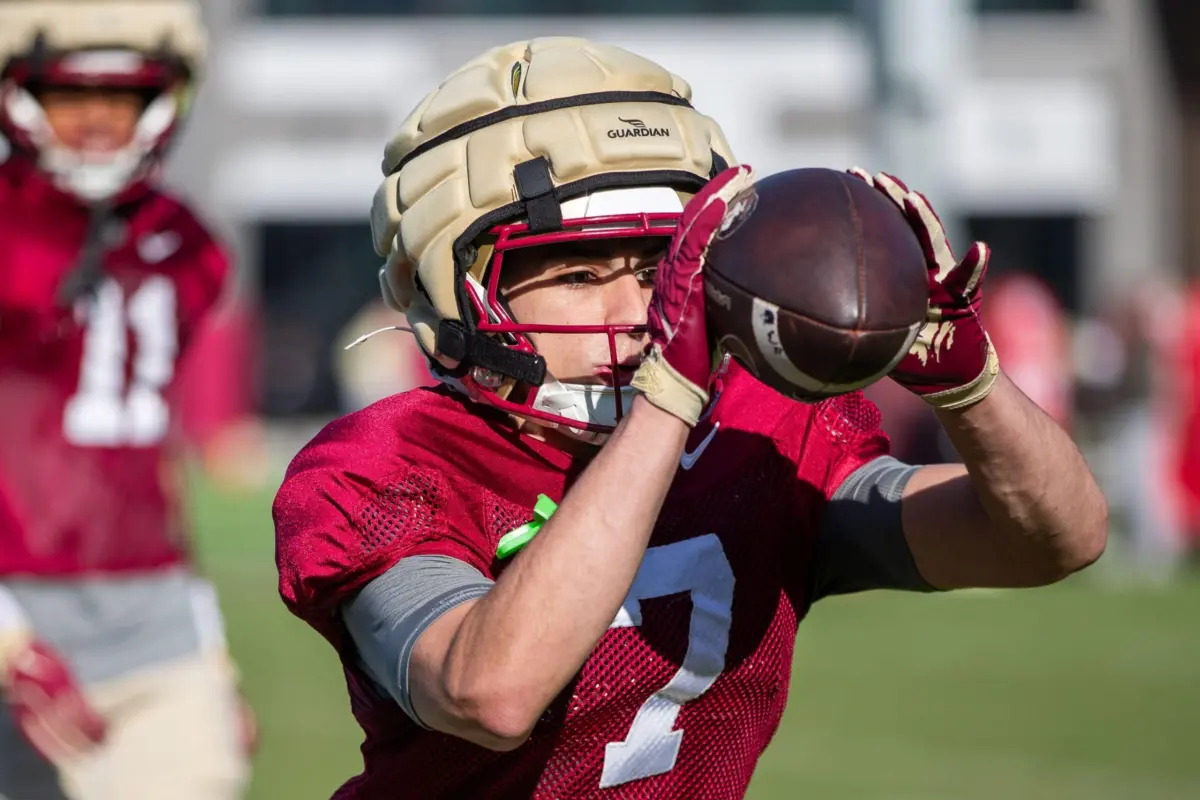
This philosophy was tested early as the Seminoles battled minor and major camp injuries. In the wide receiver room, the loss of promising freshman Devin Carter to a significant back injury dealt an early blow to FSU’s depth. However, the void was instantly filled by fellow freshman Jasen Lopez. Originally starting his 2026 calendar year competing with Luke Loucks and the men’s basketball program, Lopez made a late transition to the gridiron. Despite his unconventional timeline, Lopez displayed veteran poise, thrusting himself directly into the rotation for slot snaps alongside experienced weapons like Jayvan Boggs and Micahi Danzy.
On the defensive side, linebacker Izayia Williams emerged as a prime example of the new rule in action. Despite missing time during fall camp due to a minor injury, Williams returned with relentless momentum, immediately playing his way into meaningful defensive packages. In a linebackers room traditionally dominated by older veterans who rely heavily on instincts over pure athleticism, Williams’ explosive physical traits offered a vital injection of dynamism.
The Transfer and JUCO Equation
The five-for-five rule impacts more than just true freshmen; it fundamentally alters the calculus for junior college (JUCO) transfers and upperclassmen. Enter quarterback Malachi Marshall, the consensus JUCO Offensive Player of the Year in 2025.
Under historical redshirt guidelines, a player arriving in the summer prior to their first Division I season would be a prime candidate to sit, learn the playbook, and preserve a year of eligibility to ease the transition from junior college to Power Four football. However, under the new framework, Marshall’s destiny is tied entirely to his daily performance. Throughout fall camp, Marshall aggressively closed the gap on Kevin Sperry, solidifying his position as the primary deputy behind starting quarterback Ashton Daniels. Having already packed on 18 pounds of functional muscle since his arrival, Marshall has positioned himself as an immediate heartbeat option should FSU need to pivot under center.
Supporting Context & Metrics
To fully understand the ripple effects of the five-for-five rule on Florida State, one must examine the roster construction and the specific athletic profiles of the players poised to break through.
Roster Composition & The 34-Player Freshman Class
- Class Size: 34 incoming freshmen, representing one of the largest and most talent-dense classes in the country.
- Recruiting Pedigree: Features multiple four-star and high-tier three-star prospects across both sides of the ball.
- Key Depth Chart Impacts:
- Jasen Lopez (WR): Four-star prospect (247Sports), multi-sport background (basketball), competing for primary slot receiver reps.
- Izayia Williams (LB): Four-star prospect (247Sports), recognized for standout athleticism and immediate defensive integration.
- Jordan Crutchfield (DB): Three-star prospect (Vero Beach, FL), elite physical frame at 6’3", 218 lbs, stepping into an expanded role following a season-long injury to transfer Karson Hobbs.
- Daylen Green (LB): Three-star Florida Panhandle prospect targeted for immediate special teams contributions while developing within the linebacker rotation.
Quarterback Depth & Development Metrics
- Malachi Marshall (QB): 2025 JUCO Offensive Player of the Year.
- Physical Transformation: Gained 18 pounds of lean mass since arriving on campus in late May/June.
- Competitive Standing: Accelerated development in camp to challenge Kevin Sperry for the primary backup role behind starter Ashton Daniels.
Official Statements
Addressing the local Tallahassee media prior to FSU’s season opener against New Mexico State, Mike Norvell provided extensive insight into how the five-for-five rule dictates his coaching philosophy and roster management:
"I think it does open the door, especially earlier. If a guy shows to be the best at a position, we can have confidence to play him, knowing that those are just great opportunities for him to go out and help the team and not worrying about a time when you might pull somebody back (to preserve a redshirt)."
— Head Coach Mike Norvell
Elaborating on the unique maturity of dual-sport freshman Jasen Lopez following FSU’s second fall scrimmage, Norvell noted:
"I mean he’s a guy that doesn’t really act like a freshman. So I’m not going to put him as a freshman player until he shows me that’s how he’s going to act… I think Jasen is putting himself in a position that he’s challenging for significant opportunities."
Turning his attention to the defensive front seven and the rapid recovery of freshman linebacker Izayia Williams, Norvell expressed optimism regarding defensive rotation depth:
"I think Izayia Williams is a guy you’re definitely going to see that I’m excited about. Even coming off a slight injury, he’s just hit the ground running coming back in. What that looks like throughout the course of the game, or how many plays, we’ll get a better sense of that as it continues to unfold."
Finally, evaluating the rapid integration and physical maturation of JUCO standout quarterback Malachi Marshall, Norvell highlighted the profound impact of the new eligibility parameters:
"He’s done a great job coming in. Like anybody coming in late May or June, there is just a tidal wave of information… I’ve just been really pleased with what I’ve seen, even his physical development. He’s not the biggest guy in the world, but he’s already gained 18 pounds since being here… Now that you don’t have the redshirt and there are three years, he’s put himself in a position to play, and I’m definitely excited about his continued growth."
Future Outlook
As the Florida State Seminoles step onto the turf to open their 2026 campaign against New Mexico State, they do so as pioneers in a radically altered collegiate sports landscape. The elimination of the redshirt through the five-for-five rule is no longer an administrative talking point—it is a living, breathing component of game-day execution.
For Mike Norvell and his staff, the mandate is clear: maximize every asset, cultivate raw talent on the fly, and refuse to let elite potential rot on the bench in the name of future preservation. With key freshmen like Jasen Lopez and Izayia Williams stepping directly into high-leverage roles, and upper-tier acquisitions like Malachi Marshall pushing the envelope at the game’s most important position, FSU’s roster is more fluid, aggressive, and dangerous than ever before.
Looking ahead, the success of this season will serve as an ultimate case study for college football programs nationwide. If the Seminoles can successfully weather early injuries by deploying an army of battle-ready true freshmen and high-impact transfers, other universities will rapidly adopt Norvell’s aggressive philosophy. The five-for-five era has officially arrived in Tallahassee, and the Seminoles are wasting no time showing the college football world how to make it work.

0 Comments