

Executive Overview
Few figures in American history have bridged the gap between scientific innovation and national governance quite like Henry A. Wallace. While textbooks and agricultural historians most frequently celebrate him as the undisputed "Father of Hybrid Corn," reducing Wallace’s life’s work to plant genetics vastly understates his monumental impact on the United States. A polymath whose intellect spanned economics, journalism, genetics, and international diplomacy, Wallace was a transformative force during some of the most turbulent decades of the 20th century.
As detailed in the American Agriculture History Minute, hosted by Mark Oppold and sponsored by Image Wellness, Wallace’s trajectory took him from experimental corn plots in Iowa to the highest echelons of federal power. He served simultaneously as an influential agricultural journalist, a pioneering entrepreneur who helped lay the groundwork for Pioneer Hi-Bred, the 11th U.S. Secretary of Agriculture, the 10th U.S. Secretary of Commerce, and ultimately, the 33rd Vice President of the United States under Franklin D. Roosevelt.
This comprehensive examination explores how Wallace’s multifaceted career altered the trajectory of American food production, shaped federal economic and agricultural policy, and established a family dynasty of public service that fundamentally redirected the relationship between the American farmer and the federal government.
Detailed Chronology: The Evolution of a Statesman and Scientist
To understand Henry Agard Wallace, one must trace a timeline marked by relentless curiosity, groundbreaking scientific inquiry, and an unwavering commitment to public welfare.
Early Life and Scientific Awakening (1888–1920)
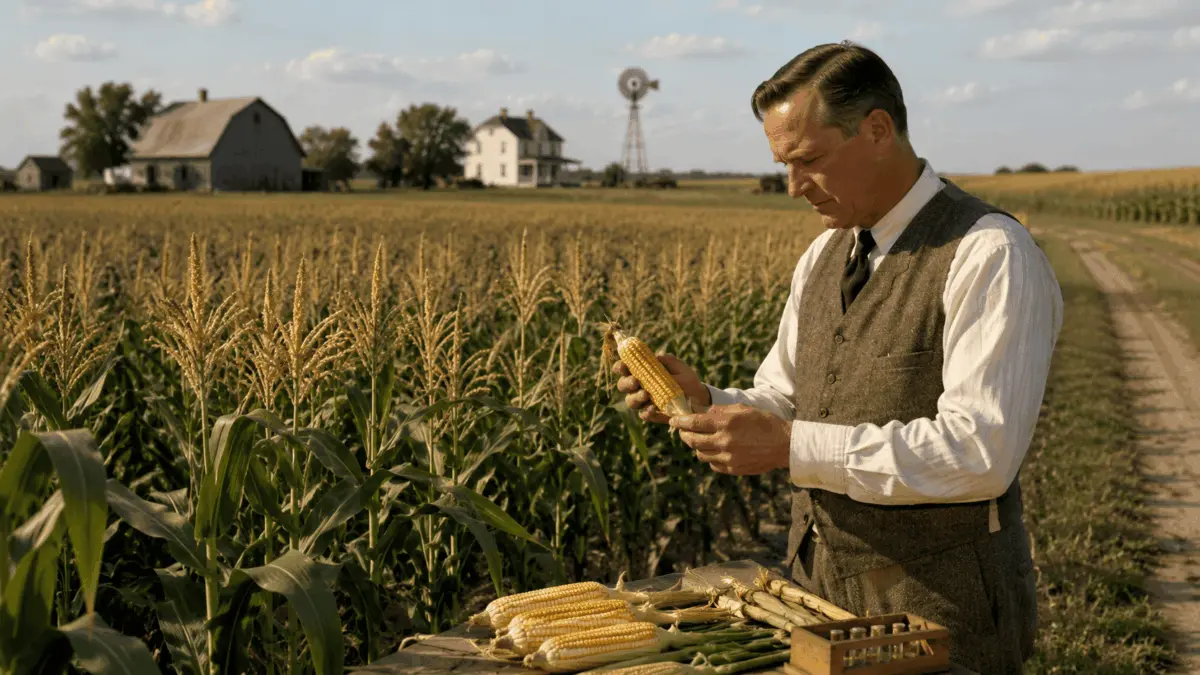
Born in 1888 on a farm near Orient, Iowa, Henry A. Wallace was immersed in agriculture from birth. His lineage was deeply tied to the land and agrarian education; his grandfather, "Uncle Henry" Wallace, founded the iconic rural publication Wallace’s Farmer, and his father, Henry Cantwell Wallace, would eventually lead the U.S. Department of Agriculture (USDA).
As a young man, Henry A. developed a deep fascination with botany, genetics, and statistical analysis. He was deeply influenced by the genetic theories of Gregor Mendel and the early corn breeding work of Edward Murray East and George Harrison Shull. Wallace began experimenting with inbreeding and crossbreeding corn varieties on his own experimental plots. Through meticulous record-keeping and field trials, he demonstrated that crossing inbred lines could produce hybrid offspring with significantly higher yields and resilience—a breakthrough that challenged traditional farming wisdom and sparked a commercial revolution.
In 1926, recognizing the immense commercial potential of his scientific breakthroughs, Wallace co-founded the Hi-Bred Corn Company (later known as Pioneer Hi-Bred). By transforming theoretical genetics into a marketable commodity, he helped invent the modern seed industry.
The Journalist and Communicator
Before entering the political arena full-time, Wallace served as the editor of Wallace’s Farmer following his father’s transition into government. Through the pages of the family publication, Wallace translated complex economic theories, weather data, and agronomic science into practical, digestible advice for Midwestern farmers.
He used his journalistic platform not only to advocate for better farming techniques but also to sound the alarm on the deep economic distress facing rural America during the agricultural depression of the 1920s—years before the broader Great Crash of 1929. This dual role as scientist-journalist cemented his reputation as a trusted voice of the American farmer.
Cabinet Leadership and the New Deal (1933–1940)
When Franklin D. Roosevelt assumed the presidency in 1933 amid the catastrophic collapse of the American economy, he appointed Henry A. Wallace as the 11th U.S. Secretary of Agriculture. It was an inspired, if unconventional, choice; Wallace was a registered Republican at the time, but his expertise was desperately needed.
Tasked with rescuing a collapsed agricultural sector, Wallace became one of the chief architects of the New Deal’s agricultural programs. Working alongside agrarian economists, he helped draft and implement the Agricultural Adjustment Act (AAA). The program sought to stabilize plummeting crop prices by managing agricultural production, paying farmers subsidies to reduce acreage and surplus. While controversial—most famously highlighted by the federally mandated plowing under of millions of acres of cotton and the slaughter of piglets to reduce supply—these measures ultimately rescued rural America from destitution and modernized federal agricultural intervention.
The Vice Presidency and the War Years (1941–1944)
Wallace’s rising political profile and alignment with the progressive wing of the Democratic Party led Roosevelt to select him as his running mate for the 1940 presidential election. Serving as the 33rd Vice President of the United States from 1941 to 1945, Wallace became a prominent voice for the global war effort, championing the concept of the "Century of the Common Man." He traveled extensively throughout Latin America, the Soviet Union, and Asia, promoting international cooperation, racial equality, and post-war peace.
However, Wallace’s outspoken advocacy for progressive social policies, labor unions, and a less confrontational stance toward the Soviet Union unnerved conservative Democrats and party bosses. At the 1944 Democratic National Convention, party leaders maneuvered to drop Wallace from the ticket, replacing him with Senator Harry S. Truman—a fateful decision that altered the course of Cold War history.
Secretary of Commerce and Final Years (1945–1965)
Following his vice presidency, Roosevelt appointed Wallace as the 10th U.S. Secretary of Commerce. He served briefly under President Truman before being dismissed in 1946 due to public disagreements over foreign policy and the burgeoning Cold War. Wallace spent his final active political years championing progressive causes, running a third-party presidential campaign in 1948 under the Progressive Party, and eventually retiring to his farm in Connecticut, where he continued his lifelong passion for agricultural experimentation, plant pathology, and breeding strawberries and chickens until his death in 1965.
Supporting Context & Metrics: Measuring Wallace’s Impact
To fully appreciate the scope of Henry A. Wallace’s contributions, one must examine the quantitative shifts in American agriculture and governance that occurred under his watch.
The Hybrid Corn Revolution: A Statistical Leap
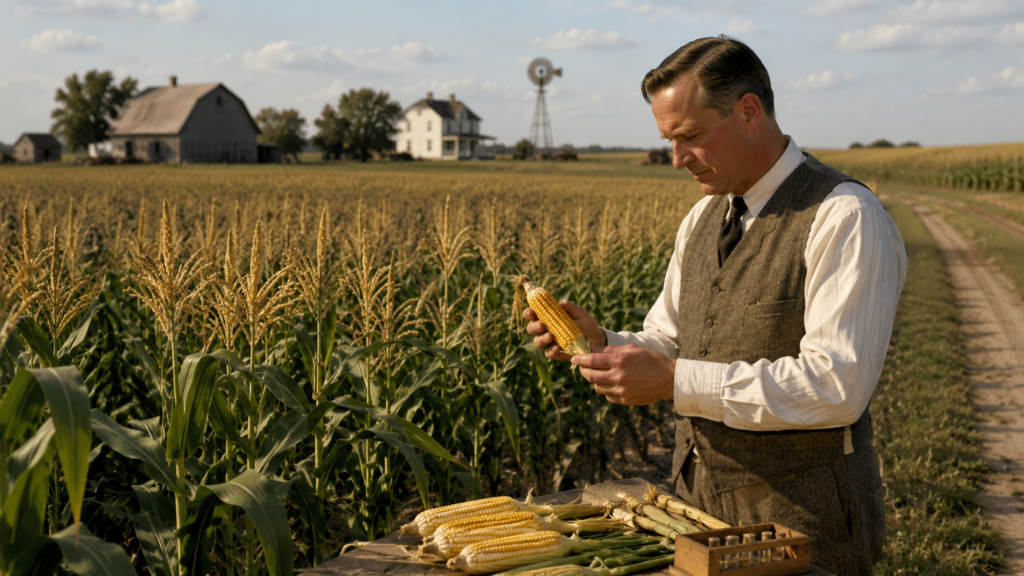
Before Wallace’s advocacy and the commercialization of hybrid seed, open-pollinated corn varieties dominated American fields. Average national corn yields stagnated around 25 to 30 bushels per acre for decades.
As hybrid corn adoption surged through the 1930s and 1940s—driven heavily by the foundational work of Wallace and companies like Pioneer—national yield averages began an unprecedented upward trajectory:
- 1930: Hybrid corn accounted for less than 1% of the U.S. corn acreage.
- 1945: Hybrid adoption surpassed 60% nationwide, pushing average yields past 35 bushels per acre.
- Modern Era: Today, thanks to the genetic groundwork laid by pioneers like Wallace, U.S. corn yields regularly exceed 170 to 180 bushels per acre, cementing corn as a foundational pillar of global food security and bioenergy production.
The Wallace Family Dynasty at the USDA
The Wallace family holds a unique and powerful distinction in the history of American governance: they are one of the few father-son duos to hold the exact same cabinet position.
- Henry Cantwell Wallace (Father): Served as the 7th U.S. Secretary of Agriculture from March 4, 1921, until his untimely death on October 25, 1924, under Presidents Warren G. Harding and Calvin Coolidge. He focused heavily on cooperative marketing and expanding agricultural research.
- Henry Agard Wallace (Son): Served as the 11th U.S. Secretary of Agriculture from March 4, 1933, to September 4, 1940, under President Franklin D. Roosevelt, fundamentally reshaping the department into a powerful agency for economic stabilization and rural welfare.
This unbroken lineage ensured that for over a decade of profound American transformation, the nation’s agricultural destiny was guided by the philosophical and scientific vision of the Wallace household.
Official Statements and Historical Perspectives
Historians, contemporary politicians, and agricultural economists have long reflected on the complex, paradoxical legacy of Henry A. Wallace.
In his historical retrospectives, agricultural commentator Mark Oppold emphasizes that Wallace cannot be neatly categorized. As noted in the American Agriculture History Minute:
"Wallace was more than the father of hybrid corn. He combined science, business, communication, and public service at a time when American agriculture was undergoing tremendous change. His career illustrates how agricultural leaders can influence far more than what happens in the field."
Reflecting on Wallace’s tenure at the Department of Agriculture, mid-century political analysts frequently pointed to his unique synthesis of populism and technocracy. Unlike many traditional politicians, Wallace spoke the language of empirical science. He famously stated that true agricultural reform required listening equally to the soil scientist, the statistician, and the dirt farmer.
Biographers have often highlighted the tragic irony of his political eclipse. Had Wallace remained on the 1944 presidential ticket, the trajectory of American foreign policy during the immediate post-World War II era might have taken a vastly different path, avoiding much of the early escalation of the Cold War. Yet, history remembers him best not for the elections he lost, but for the botanical innovations and institutional structures that continue to feed billions of people across the globe.
Future Outlook: The Enduring Relevance of Wallace’s Vision
As modern agriculture faces a new set of existential challenges—ranging from climate change and soil degradation to the need for sustainable, high-yield food production for a global population projected to approach 10 billion by 2050—the legacy of Henry A. Wallace offers both a roadmap and an inspiration.
Wallace’s life work proved that empirical research, technological adaptation, and public-private enterprise must work in tandem to secure food systems. Today, contemporary agronomists utilizing gene editing, artificial intelligence, and precision agriculture are the direct intellectual descendants of the young Wallace meticulously cross-pollinating corn stalks in his Iowa plots.
Furthermore, his holistic view of public service—linking the economic health of the rural farmer directly to the financial stability of the entire nation—remains a guiding principle for modern agricultural policy. As farming communities navigate economic consolidation, supply chain volatility, and environmental mandates, policymakers frequently look back to the New Deal era principles championed by the Wallace family to design safety nets that protect the stewards of the land.
Ultimately, Henry A. Wallace stands as a towering testament to the idea that agricultural innovation is not merely a localized endeavor, but a vital cornerstone of national strength, economic resilience, and global human progress.
The American Agriculture History Minute is proudly brought to you by Image Wellness. Reminding listeners that "Your health is your greatest wealth," Image Wellness encourages individuals to connect with certified health and wellness coaches to optimize their personal well-being. For more information, reach out via email at [email protected].

0 Comments