
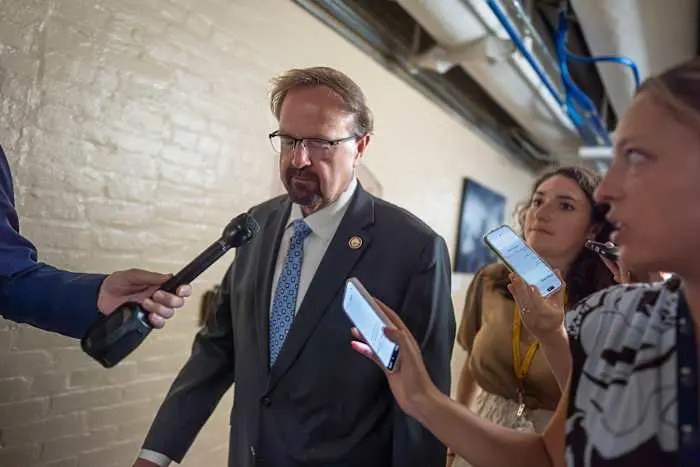

WASHINGTON, D.C. — In a rare and solemn display of bipartisan consensus, the United States House of Representatives voted overwhelmingly on Tuesday, September 1, 2026, to censure Representative Chuck Edwards (R-N.C.). The historic 413–2 vote followed a grueling, four-month investigation by the House Ethics Committee, which concluded that the sophomore lawmaker had engaged in a persistent, highly inappropriate, and unprofessional pattern of conduct toward two young female subordinates in his congressional office.
While the censure stop short of expulsion, it represents the most severe form of public reprimand the House can administer to one of its own members. The action cements a swift and stunning fall from grace for Edwards, a lawmaker who originally campaigned as a stabilizing force for his Western North Carolina district. Under the weight of the committee’s findings, Edwards had already announced he would not seek reelection in November, leaving his political career in ruins and his district preparing for an abrupt transition.
Executive Overview
The House Ethics Committee’s investigation into Representative Chuck Edwards culminated in a damning report detailing how the North Carolina Republican abused the power dynamics of his office to target two young female staffers with unwanted attention, lavish gifts, and emotional pressure. Although the committee found no evidence of physical sexual contact or explicit "quid pro quo" demands, it concluded that Edwards systematically fostered a hostile, uncomfortable, and deeply unprofessional work environment.
The lopsided 413–2 vote on the House floor reflects a chamber increasingly unwilling to tolerate behavior that was once quietly swept under the rug. The decision to censure Edwards is not an isolated disciplinary action; rather, it is the latest flashpoint in a broader, bipartisan effort during the 119th Congress to reform the workplace culture of Capitol Hill. Amid rising scrutiny over the treatment of female staffers, House leadership has launched a comprehensive review of congressional workplace safety, signaling that the era of treating lawmakers’ offices as untouchable personal fiefdoms may be drawing to a close.
Detailed Chronology of the Investigation
The disciplinary proceedings against Representative Edwards did not occur overnight. They were the result of a meticulous, multi-month inquiry that began in the spring of 2026 after formal complaints were filed by former employees of his Washington office.
[May 2026] Initial complaints filed by former female staffers
       │
       ▼
[May–August 2026] House Ethics Committee conducts 4-month investigation
       │  • 16 witness interviews
       │  • Review of 1,500 pages of text messages, emails, and logs
       │
       ▼
[Late August 2026] Ethics Committee releases damning investigative report
       │  • Edwards announces he will not seek reelection
       │
       ▼
[September 1, 2026] House floor debate and historic 413–2 censure vote
The Catalyst and the Inquiry
The House Ethics Committee, led by Chairman Michael Guest (R-Miss.) and Ranking Member Mark DeSaulnier (D-Calif.), initiated its formal investigation in May 2026. Over the course of more than four months, investigators constructed a comprehensive timeline of Edwards’ behavior.
The scope of the investigation was vast:
- Witness Testimony: Investigators interviewed 16 individuals, including current and former congressional staffers, administrative personnel, and Edwards himself.
- Documentary Evidence: The committee reviewed nearly 1,500 pages of documents, including personal correspondence, text messages, office schedules, financial receipts, and official House voting logs.
Uncovering the Pattern
The evidence compiled by investigators painted a portrait of a lawmaker who routinely blurred the lines between professional mentorship and romantic pursuit. Among the most egregious details revealed in the report was an incident in which Edwards skipped a critical series of official House votes in Washington to travel to the private residence of one of the staffers to help her decorate her Christmas tree—an extraordinary abandonment of his legislative duties.
Furthermore, the chronology established by the committee showed that Edwards’ unwanted attention persisted despite clear, documented signals from the two young women that his behavior made them uncomfortable. When the committee presented its final report to the full House in late August, the findings made Edwards’ political survival untenable, prompting his immediate announcement that he would withdraw from the upcoming 2026 congressional race.
Behind Closed Doors: The Nature of the Misconduct
The core of the House Ethics Committee’s findings rested on the distinct power asymmetry between a member of Congress and junior staffers, many of whom are in their early twenties and reliant on their employers for career advancement in the highly competitive environment of Washington politics.
Luxury Gifts and Lavish Attentions
According to the investigative report, Edwards utilized his position of authority to shower the two female aides with expensive, highly personal gifts. These items included:
- High-end jewelry;
- Designer purses;
- Luxury shoes;
- Frequent deliveries of flowers to their residences.
In addition to physical gifts, Edwards frequently commented on the women’s physical appearance, wardrobe choices, and personal lives. He sent them deeply personal, handwritten notes expressing his affection and repeatedly invited them to accompany him on intimate dinners and private vacations.
The Hostile Work Environment
While Edwards maintained that his actions were merely gestures of "friendship" and mentorship, the committee rejected this defense. Under House Rules and federal workplace guidelines, the standard for harassment is based on how a "reasonable person" would perceive the behavior.
The committee noted that because of the immense professional power Edwards held over the staffers—including the ability to terminate their employment or derail their careers—the women felt compelled to endure the behavior, creating a textbook hostile work environment.
| Conduct Category | Edwards’ Stated Intent | Committee’s Finding | Impact on Staffers |
|---|---|---|---|
| Lavish Gift-Giving | Mentorship & Friendship | Unprofessional & Inappropriate | Created feelings of obligation and discomfort |
| Personal Letters & Notes | Warm Professional Regard | "Thinly Veiled Advances" | Blurred professional boundaries |
| Intimate Invitations | Office Camaraderie | Exploitation of Power Dynamics | Induced anxiety and fear of retaliation |
Supporting Context: The History of Censure and a Systemic Reckoning
To understand the gravity of Tuesday’s vote, it is necessary to examine the historical weight of a congressional censure and the broader environment in which this investigation took place.
The Mechanism of Censure
A House censure is a rare constitutional disciplinary tool. Unlike a simple reprimand, a censure requires the disciplined member to stand in the well of the House chamber while the Speaker of the House reads the resolution of censure aloud. It is designed to inflict maximum public embarrassment and carry a lasting historical stigma. In the history of the United States, fewer than 30 representatives have ever been censured, with the vast majority of cases occurring in the 19th century.
The 119th Congress: A Turning Point
The action against Edwards is part of a broader, systemic reckoning regarding sexual harassment and workplace misconduct on Capitol Hill. For decades, congressional offices operated with minimal external oversight, shielded by the separation of powers and weak internal accountability mechanisms. However, the 119th Congress has seen a marked shift toward zero tolerance.
Edwards is the third lawmaker to face severe consequences for ethical lapses in 2026 alone:
- Representative Eric Swalwell (D-Calif.): Resigned from office earlier this year following intense pressure and calls for expulsion over undisclosed personal conduct.
- Representative Tony Gonzales (R-Tex.): Stepped down from his seat in the face of an impending ethics probe into an extramarital affair with a subordinate.
- Representative Jimmy Gomez (D-Calif.): Currently under active investigation by the House Ethics Committee regarding allegations of inappropriate sexual contact with a staffer. Gomez has claimed the relationship was consensual but has publicly apologized to his family and constituents.
In response to these cascading scandals, House leaders launched a comprehensive, bipartisan review of Capitol Hill workplace culture. This initiative aims to reform the Office of Congressional Workplace Rights (OCWR) and establish more robust protections for junior employees, interns, and fellows who are particularly vulnerable to exploitation.
Official Statements and Floor Debate
The debate on the House floor prior to the vote was quiet and solemn, reflecting the gravity of the proceedings. Members from both parties spoke of the necessity of protecting the integrity of the institution and the safety of its workers.
The Committee’s Case
Chairman Michael Guest (R-Miss.) delivered a clinical but devastating summary of the committee’s findings, emphasizing that physical contact is not a prerequisite for harassment:
"While Representative Edwards denies that his conduct was intended to be sexual or romantic, his pattern of behavior would lead a reasonable person to interpret it as such. This was not a case of quid pro quo sexual harassment, but rather conduct and behavior that created a hostile work environment. Representative Edwards was fully aware that these women were uncomfortable with his behavior, yet he persisted."
Ranking Member Mark DeSaulnier (D-Calif.) echoed these sentiments, dismantling any defense that the incidents were merely misunderstandings:
"These are not innocuous, isolated instances. They are part of a sustained, unprofessional, and inappropriate conduct by Representative Edwards toward two young women he employed. Skipping votes to decorate a Christmas tree, purchasing designer shoes and jewelry—this is not how a member of Congress conducts professional relationships with staff."
Representative Teresa Leger Fernandez (D-N.M.) took to the podium to emphasize the moral obligation of the chamber:
"Representative Edwards’ behavior was outlandish and disturbing. If we don’t take action today, there is no opportunity for these women to receive justice. We must send a clear message that the halls of Congress are not a playground for predatory behavior."
Edwards’ Defense
Representative Edwards stood in the chamber to deliver his own remarks. While he offered an apology to his former staffers and his family, his speech was marked by a defiant rejection of the "sexual harassment" label:
"I am imperfect. I have made mistakes, but I do not believe I committed sexual harassment. The factual findings of this investigation do not justify branding me as though I did. My intentions were only grounded in what I understood our friendship to be… I apologize to my wife and my family, who have carried a burden they did not create or deserve."
Despite his protestations, Edwards’ arguments failed to sway his colleagues. The final tally of 413 to 2 demonstrated a near-total rejection of his defense, with only two members voting against the resolution.
Future Outlook
The political fallout from the censure will have immediate and lasting ramifications both in Washington and in Edwards’ home state of North Carolina.
The Battle for North Carolina’s 11th District
Edwards represents North Carolina’s 11th Congressional District, a historically volatile but currently Republican-leaning seat in the mountainous western region of the state. The district has a recent history of political turbulence; Edwards originally won the seat after defeating the controversial and scandal-plagued Representative Madison Cawthorn in a bitter 2022 Republican primary.
Edwards had positioned himself as the "adult in the room"—a traditional, business-friendly conservative who would restore dignity to the district. His downfall in an ethics scandal of his own creation has left local Republican leaders reeling. With Edwards out of the race, the 11th District primary has been thrown into chaos, opening the door for both hard-right candidates and energized Democrats who view the seat as a potential pickup opportunity in November.
Institutional Reforms
Beyond the borders of North Carolina, the Edwards censure is expected to accelerate legislative reforms aimed at congressional workplaces. Lawmakers involved in the bipartisan safety review have indicated they will use the findings of the Edwards report to draft new legislation.
Anticipated reforms include:
- Mandatory Disclosure of Gift-Giving: Implementing strict limits and mandatory disclosure requirements for any gifts exchanged between members of Congress and their staff.
- Independent Reporting Channels: Creating a fully independent, third-party reporting mechanism for staffers to file harassment complaints without fear of professional retaliation or interference from party leadership.
- Standardized Disciplinary Measures: Establishing clear, non-negotiable penalties for hostile work environment violations, reducing the discretionary power of the Ethics Committee.
As Representative Edwards prepares to exit public life in disgrace, the House of Representatives faces the daunting task of rebuilding public trust. Tuesday’s historic censure vote serves as a stark reminder that the culture of Capitol Hill is undergoing a fundamental transformation, and that the abuse of power, no matter how veiled, will no longer be tolerated.

0 Comments