

Executive Overview
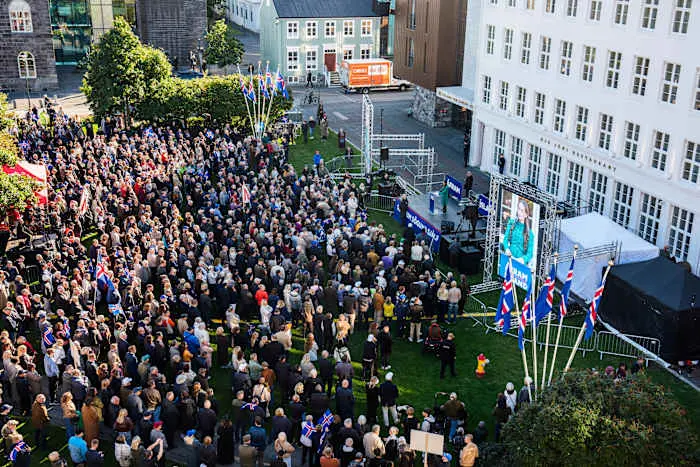
REYKJAVIK — In a pivotal moment that could redefine its place in the global order, Iceland heads to the polls for a high-stakes, nation-defining referendum. Approximately 265,000 eligible voters are tasked with answering a deceptively simple yet profoundly complex question: Should Iceland resume long-stalled accession negotiations to become a member of the European Union?
This critical ballot is not merely an economic update or an administrative pivot; it is unfolding under the heavy, disruptive shadow of shifting global superpowers. Most notably, renewed security anxieties driven by United States President Donald Trump’s aggressive rhetoric regarding nearby Greenland have sent shockwaves across the North Atlantic. For many Icelanders, the calculus of isolation versus alliance has fundamentally transformed.
While Iceland already enjoys deep integration with Europe through the European Economic Area (EEA) and the Schengen free-travel zone, full membership carries immense weight. The debate pits a left-leaning coalition government warning of an unpredictable and untrustworthy global security environment against fiercely protective traditionalists. Opponents argue that surrendering control over the nation’s fiercely guarded fishing grounds—the literal and figurative lifeblood of the Icelandic economy and cultural identity—is a price far too high to pay.
With a rejection likely closing the door on European integration for a generation, and a "yes" vote opening a complex, multi-year negotiation marathon with Brussels, the world is watching Reykjavik. This comprehensive report explores the geopolitical catalysts, historical economic hurdles, fierce domestic debates, and future implications of Iceland’s historic weekend vote.
Detailed Chronology: From 2015 Freeze to the 2026 Emergency Referendum
To understand how Iceland arrived at this critical juncture, it is essential to trace the modern history of its relationship with the European Union—a narrative defined by pragmatism, protectionism, and sudden geopolitical shocks.
The 2008 Financial Crash and Initial Application
Following the catastrophic collapse of Iceland’s banking sector in 2008, which crippled the nation’s economy, public sentiment temporarily shifted toward the perceived safety and stability of the eurozone. In 2009, a center-left government formally applied for EU membership, initiating accession talks that eventually spanned 35 distinct policy chapters.
The 2015 Withdrawal
As the economy recovered on the back of a booming tourism industry and resilient fisheries, enthusiasm for EU membership waned. Fearing the loss of sovereign control over its rich North Atlantic fishing grounds and facing intense public and political pushback, Iceland officially suspended its accession talks in 2013, followed by a formal withdrawal of its application in 2015. For over a decade, the consensus among political elites was that the "EEA-plus" model—maintaining access to the EU single market without full political membership—was the optimal arrangement for the island nation.
The 2024 Shift in Reykjavik
The political landscape shifted once more with the election of a new left-leaning coalition government in 2024. Led by Prime Minister Kristrún Frostadóttir, the administration began quietly reassessing the country’s vulnerability in an increasingly volatile multipolar world. Originally slated for a later date, plans for an EU referendum were aggressively accelerated following a dramatic escalation in Arctic geopolitics.
Early 2026: The Greenland Catalyst and the Rush to the Ballot
The true catalyst for the 2026 referendum emerged early in the year, when U.S. President Donald Trump renewed public ambitions regarding the territorial acquisition or strategic control of Greenland. Situated just 180 miles (290 km) from Iceland, Greenland—a self-governing territory of Denmark—became the epicenter of a diplomatic deep freeze. Although Washington signaled it would not use military force, the psychological impact in Reykjavik was profound.
The underlying fear crystallized among the Icelandic public and leadership: If Greenland is viewed as negotiable or vulnerable to superpower pressure, is Iceland next?
Faced with a rapidly deteriorating traditional security umbrella, Prime Minister Frostadóttir’s government moved to bring the EU referendum forward, framing European integration not merely as an economic choice, but as a vital geopolitical bulwark.
Supporting Context & Metrics: The Geopolitical and Economic Landscape
The debate dividing Iceland is underpinned by stark economic data, geographic realities, and centuries-old cultural values.
The Security and Geographic Calculus
- Proximity to Power: Iceland occupies a uniquely strategic geographic position in the North Atlantic gap between North America and mainland Europe. Its geopolitical value has historically made it a cornerstone of NATO’s northern flank.
- The Greenland Factor: Located merely 290 kilometers (180 miles) from Greenland, Icelanders watched with mounting alarm as Washington openly strategized over Arctic dominance. The erosion of trust in traditional transatlantic security guarantees has fundamentally rewritten the pro-EU argument.
- Current EU Integration: It is vital to note that Iceland is not entirely estranged from Europe. It is already a member of the Schengen Area (allowing passport-free travel) and participates fully in the EU’s internal market via the European Economic Area (EEA) agreement.
The Fisheries Dilemma: Economy vs. Identity
No discussion of Iceland can occur without addressing the sea. The North Atlantic waters surrounding the island are among the richest fishing grounds on earth, yielding prized catches of cod, haddock, and mackerel.
- The Economic Pillar: The fishing industry accounts for a massive share of Iceland’s export revenues and underpins regional coastal communities.
- The EU Common Fisheries Policy (CFP): Full EU membership would legally obligate Iceland to join the CFP, potentially opening its pristine, meticulously managed waters to trawlers from Spain, France, and the Netherlands. For a nation that famously fought and won the "Cod Wars" against Great Britain in the 1970s to protect its maritime borders, ceding control of its fish is viewed by many as an existential threat.
- Proposed Workarounds: Prime Minister Frostadóttir’s government has floated the possibility of securing a permanent or extended opt-out from the CFP during negotiations, though EU officials have historically resisted bespoke carve-outs for major policy pillars.
Official Statements and Stakeholder Perspectives
As voters cast their ballots, the nation is sharply polarized between those who see the EU as an indispensable shield and those who view it as an existential threat to national sovereignty.
The Pro-EU Perspective: A Changing World Requires New Shields
Proponents of resuming negotiations argue that the post-World War II security architecture is fracturing, and small nations cannot afford to stand alone.
"We can’t really trust the U.S. anymore," said Hildur Knútsdóttir, a prominent Icelandic horror fiction writer and vocal advocate for EU membership, summarizing the anxieties of a populace rattled by shifting American foreign policy.
Prime Minister Kristrún Frostadóttir has worked tirelessly in the final days of the campaign to reassure voters that a "yes" vote is not an immediate surrender of sovereignty, but rather the opening salvo of a long, democratic vetting process.
"This is not an election about membership and not about adaptation, as there will be another referendum on an accession agreement if the result is yes," Frostadóttir emphasized during a high-energy rally in Reykjavik.
Pro-EU voices also point out that joining the bloc would give Iceland a direct vote at the table in shaping pan-European policies addressing borderless crises, such as climate change in the fragile Arctic ecosystem.
The Anti-EU Perspective: Safeguarding Independence and Fisheries
Conversely, the "Forward, Iceland" (Áfram Ísland) movement—backed heavily by traditionalists, rural communities, and nationalists—argues that Iceland already enjoys the best of both worlds.
Former Prime Minister and former Left-Green Movement leader Katrín Jakobsdóttir offered a measured, resolute defense of the status quo in an interview with The Associated Press.
"I think Iceland is better off outside of the EU, within the close collaboration with the EU," Jakobsdóttir stated, reflecting the deeply ingrained cultural aversion to foreign oversight.
Opponents emphasize that Iceland gained its full independence from Denmark as recently as 1944. For a population fiercely proud of its Viking heritage and self-reliance, submitting to Brussels-mandated regulations on monetary policy, agriculture, and fisheries is viewed as an unacceptable compromise of national identity. Furthermore, critics argue that using U.S. rhetoric over Greenland as a catalyst for a permanent institutional realignment is an emotional overreaction to temporary political posturing.
Future Outlook: What Happens Next?
The ramifications of Saturday’s referendum will reverberate across Northern Europe and the transatlantic alliance for decades to come, depending entirely on the outcome at the ballot box.
Scenario A: A "No" Vote (The Status Quo Persists)
If voters reject the resumption of talks, the issue of EU accession will likely be shelved for a generation.
- Domestic Impact: The left-leaning coalition government will face intense political fallout, having staked significant capital on the referendum.
- Geopolitical Impact: Iceland will remain tethered to its current EEA/Schengen arrangement. It will be forced to navigate an increasingly unstable Arctic security environment through bilateral defense agreements—primarily with NATO, the United Kingdom, and Nordic neighbors—rather than through EU structures.
Scenario B: A "Yes" Vote (The Long Road to Brussels)
Should the electorate vote in favor, the journey has only just begun.
- The Negotiation Phase: The European Commission will formally initiate talks across 35 chapters. This process is notoriously grueling, expected to take years as negotiators wrangle over highly contentious issues, chief among them fisheries quotas and agricultural subsidies.
- The Final Hurdle: Prime Minister Frostadóttir has repeatedly promised that even if accession talks yield a finalized treaty, the resulting membership agreement must pass a second, binding national referendum.
- Long-Term Realignment: A successful full accession would fundamentally alter the geopolitical balance of the North Atlantic, cementing a closer political and economic union between the Nordic island nation and continental Europe, while creating a unified European bloc directly bordering contested Arctic trade routes.
As the ballots are tallied in Reykjavik, Iceland stands at a historic crossroads, forced to weigh the timeless pride of maritime independence against the cold, uncertain realities of a turbulent twenty-first-century geopolitical landscape.

0 Comments