
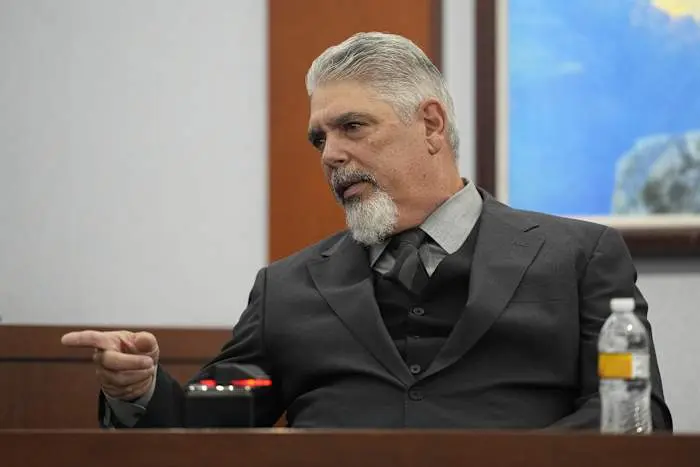

LAS VEGAS — Nearly three decades after a drive-by shooting in Las Vegas cut short the life of legendary hip-hop icon Tupac Shakur, the legal proceedings seeking justice for the fallen artist are drawing to a dramatic close.
In a pivotal courtroom session on Tuesday, August 25, 2026, at the Clark County District Court Regional Justice Center, prosecutors presented testimony from a veteran law enforcement officer uniquely positioned to decode the strict hierarchy of Southern California street gangs. Robert Ladd, a retired Compton police officer and former gang unit detective, took the stand as the state’s 23rd witness. His testimony aimed to solidify a central pillar of the prosecution’s case: that Duane "Keffe D" Davis was not merely a passive passenger in a white Cadillac on the night of September 7, 1996, but the high-ranking "shot caller" who orchestrated the fatal attack.
As the trial hurtles toward its final phases—with the prosecution expected to rest its case, the defense slated to present its arguments, and closing statements looming—the testimony highlights the complex web of street politics, retaliatory violence, and high-profile confessions that have defined the legal journey of the Shakur murder case.
Executive Overview
The trial of Duane Davis represents a historic, albeit belated, chapter in American criminal justice. Davis, now an aging figure fighting the charges against him, is the only person ever criminally indicted in connection with the 1996 killing of Shakur, which sent shockwaves through the global music community and forever altered the trajectory of West Coast hip-hop.
While prosecutors do not allege that Davis pulled the trigger, they are leveraging Nevada’s aiding-and-abetting statutes. Under state law, an individual who facilitates, plans, or commands a crime can be held equally criminally liable as the person who executes it. The state’s theory hinges on the argument that Davis provided the weapon, coordinated the pursuit, and—by virtue of his supreme rank within the South Side Compton Crips—sanctioned the deadly response to an earlier casino brawl.
During Tuesday’s proceedings, Ladd’s expert testimony cut to the core of this legal strategy. By establishing Davis’s absolute authority over the younger occupants of the vehicle—including his nephew, the late Orlando "Baby Lane" Anderson—the prosecution sought to dismantle any narrative suggesting Davis was powerless to stop the bloodshed. Instead, the state painted a picture of a calculated execution ordered by a senior gang leader seeking retribution for a perceived slight in a Las Vegas hotel lobby.
Detailed Chronology: From the MGM Grand to the Las Vegas Strip
To fully understand the gravity of the testimony delivered by Robert Ladd, the court has continually revisited the sequence of events that unfurled on the night of September 7, 1996—a timeline that prosecutors argue directly links the casino floor to the fatal bullets fired on East Flamingo Road.
The Casino Confrontation
Hours before the shooting, Tupac Shakur and members of Death Row Records—including co-founder Marion "Suge" Knight—attended a Mike Tyson boxing match at the MGM Grand casino in Las Vegas. Following the bout, a violent altercation erupted near a bank of elevators.
During the scuffle, Orlando Anderson, an affiliated member of the South Side Compton Crips, was targeted and beaten by Shakur and his associates. The brawl was captured in part by hotel security cameras. According to investigators and past statements made by Davis, Anderson felt deeply humiliated by the public assault, setting off a frantic chain of retaliatory plotting.
The Pursuit and Shooting
Later that evening, Shakur and Knight were traveling in a black BMW along the Las Vegas Strip, heading to a nightclub owned by Death Row Records. According to confessions and interviews given by Davis over the years, he, Anderson, and two other men piled into a white Cadillac to track down the rapper.
When the white Cadillac pulled up alongside the passenger side of Shakur’s BMW at a red light, gunfire erupted from the back seat. Shakur was struck multiple times, sustaining catastrophic injuries. He succumbed to his wounds nearly a week later on September 13, 1996, at the University Medical Center of Southern Nevada. Anderson, who was long suspected by law enforcement as the actual shooter, was never charged with the murder; he died in an unrelated gang shooting in Compton in 1998.
Supporting Context & Metrics: The Gang Dynamics of Compton and Las Vegas
Robert Ladd’s testimony provided jurors with a sociological and tactical breakdown of Los Angeles street gangs during the height of the 1990s rap rivalry between Death Row Records (associated with West Coast acts like Shakur and Snoop Dogg) and Bad Boy Records (representing East Coast artists like The Notorious B.I.G.).
The "Shot Caller" Hierarchy
Ladd explained to Chief Deputy District Attorney Binu Palal that within organizations like the South Side Compton Crips, rank and respect dictate operational reality. When asked who held ultimate authority among the four men inside the white Cadillac that night, Ladd unhesitatingly answered, "Mr. Davis."
Elaborating on this dynamic, Ladd testified that Orlando Anderson—who was younger and occupied a lower tier in the gang’s structure—did not possess the autonomy to initiate a hit of this magnitude without explicit clearance from a superior.
"If Mr. Davis had told the others to handle the dispute later," Ladd testified, "there wouldn’t have been a shooting."
The Immediate Fallout: A 10-Day War
The reverberations of Shakur’s murder extended far beyond the Las Vegas Strip, igniting a wave of hyper-local violence in Southern California. Ladd testified that Shakur’s killing immediately triggered a brutal, 10-day gang war in Compton between the South Side Crips and their rivals, the Mob Piru. The retaliatory bloodshed resulted in a grim tally:
- Total Killings: 3 homicides directly linked to the inter-gang conflict.
- Attempted Murders: 10 separate shooting incidents investigated by local authorities.
This statistical evidence was introduced by the prosecution to underscore the far-reaching consequences of Davis’s alleged orders and to demonstrate the high-stakes environment in which these gang factions operated.
Official Statements and Legal Arguments
As the trial nears its conclusion, the courtroom battle lines have been sharply drawn between the State of Nevada and the defense team representing Duane Davis.
The Prosecution’s Case: Words as Evidence
The state’s case heavily relies on the public and private statements Davis made in the years leading up to his arrest. Most notably, prosecutors played a recording of a 2008 police interview in which Davis explicitly detailed his role in the conspiracy, admitting that he acquired the firearm used in the shooting and handed it to Anderson.
Prosecutors maintain that these admissions, combined with corroborating accounts from former associates and expert gang testimony like Ladd’s, form an airtight circumstantial and direct case proving Davis orchestrated the murder.
The Defense’s Position: Fabricated Bravado
Defense attorney Michael Sanft has aggressively challenged the state’s reliance on historical interviews, arguing that his client’s past boasts were exaggerated tales told for financial gain in a lucrative true-crime media market. Sanft has continuously emphasized a critical vulnerability in the prosecution’s evidentiary portfolio: the glaring lack of physical and forensic evidence.
During cross-examination, Sanft pressed Robert Ladd regarding tangible proof. Ladd was forced to acknowledge that, aside from Davis’s own recorded statements, law enforcement possesses:
- No physical evidence directly placing Davis in Las Vegas on the night of the murder.
- No forensic DNA or fingerprint matches linking Davis to the crime scene.
- No phone records, surveillance footage, or digital trails proving Davis gave a direct order to fire.
Furthermore, law enforcement witnesses admitted that while historical searches of Anderson’s and Davis’s residences uncovered bills and letters from Las Vegas hotels, investigators could not definitively date them or account for the current whereabouts of those physical documents. Sanft has framed this evidentiary void as a failure of police work, urging jurors to reject a case built primarily on decades-old, uncorroborated storytelling.
Future Outlook and Trial Timeline
The grueling legal battle over the 1996 murder of Tupac Shakur is entering its final, decisive hours.
With Robert Ladd serving as the prosecution’s 23rd witness, the state is widely expected to rest its case. Following the conclusion of the prosecution’s arguments, the defense will take center stage, with expectations that their presentation will wrap up by Friday.
If the current schedule holds, both legal teams will deliver their closing arguments to the jury on Monday, handing over the fate of Duane Davis to a panel of peers who must decide whether a decades-old confession, analyzed through the lens of gang hierarchy and expert testimony, is enough to secure a historic conviction in one of music history’s most infamous tragedies.

0 Comments