

Executive Overview
NEW YORK — The turbulent waters of professional tennis were whipped into a frenzy once again on Monday, August 31, 2026, when Greek tennis star Stefanos Tsitsipas pulled back the curtain on the sport’s worst-kept secret. Speaking to a packed press corps following a stellar first-round upset victory over 10th-seeded Arthur Fils at the U.S. Open in New York, Tsitsipas addressed the seismic suspension of Australian firebrand Nick Kyrgios.
Far from expressing shock, the Greek champion delivered a candid, unfiltered assessment that has sent shockwaves through the locker rooms of the Association of Tennis Professionals (ATP). Tsitsipas revealed not only that he anticipated Kyrgios’s dramatic fall from grace, but that whispers of off-court substance use had been circulating among players long before the official disciplinary announcement dropped earlier this month.
Kyrgios, who shocked the sporting world by publicly revealing he tested positive for cocaine during a tournament stint in Spain last June, now faces a potential four-year ban—though legal and sporting experts anticipate a more lenient mitigation. For Tsitsipas, whose history with the Australian is fraught with high-stakes tension and personal animosity, the suspension was not a tragedy of unforeseen proportions, but rather an inevitable collision between reckless off-court behavior and the uncompromising reality of anti-doping regulations.
This expository feature explores the anatomy of the Kyrgios doping scandal, the long-standing rivalry between two of tennis’s most polarizing figures, the whispers that echoed through the tour corridors, and what this watershed moment means for the integrity, future, and regulatory enforcement of professional men’s tennis.
Detailed Chronology: From Spanish Courts to New York Revelations
To fully grasp the magnitude of Stefanos Tsitsipas’s remarks, one must trace the timeline of events that culminated in the Flushing Meadows press conference. The scandal unfolded across several key milestones, highlighting a systemic failure in proactive communication and the eventual collapse of a talented athlete’s career momentum.
June 2025: The Catalyst in Spain
While competing at a clay-court event in Spain, Nick Kyrgios provided a routine sample for anti-doping authorities. At the time, Kyrgios was struggling to regain his footing on the professional circuit following a multi-year hiatus defined by a string of persistent knee, wrist, and foot injuries. Unbeknownst to the public, the sample returned a positive result for cocaine, a stimulant and recreational substance prohibited under the World Anti-Doping Agency (WADA) code when consumed in-competition.
The Whispers on Tour
Despite the confidentiality protocols standard to international sports arbitrations, word travels fast in the insular world of elite tennis. According to Tsitsipas, the locker-room grapevine was already hyper-active. Players, coaches, and staff members whispered about Kyrgios’s struggles away from the camera flashes. While the general public remained oblivious, peers who shared flight itineraries, locker rooms, and practice courts with the Australian began piecing together an alarming narrative.
Early August 2026: The Public Confession and Suspension
The shoe finally dropped earlier this month when the International Tennis Integrity Agency (ITIA) officially slapped Kyrgios with a provisional suspension. Rather than hiding behind a wall of corporate PR statements, Kyrgios opted for radical transparency. He took to social media and public forums to confess to the positive test, attributing his downward spiral to feelings of isolation, profound injury-induced depression, and a crippling sense of helplessness. Yet, even as he bared his soul, Kyrgios admitted that his psychological battles could not excuse his actions.
August 31, 2026: The U.S. Open Aftermath
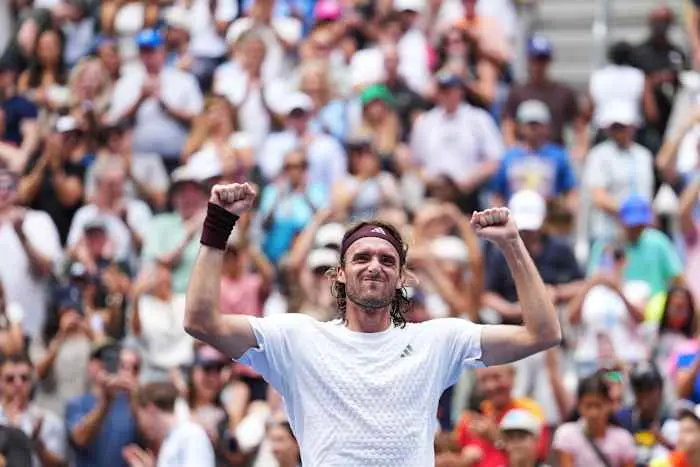
Flash forward to the opening Monday of the 2026 U.S. Open. Stefanos Tsitsipas had just carved out a brilliant, momentum-building victory over France’s Arthur Fils, overcoming the 10th seed in an electrifying display of baseline grit. Yet, when microphones were thrust in his direction, the narrative swiftly pivoted from forehands and volleys to morality and misconduct.
When asked about Kyrgios’s suspension, Tsitsipas did not mince words. "Pretty much expected, to be honest," he told reporters. "I am surprised it came so late, though. I mean, to be entirely honest with you, I knew about this before the announcement. Myself, I knew about it."
Supporting Context & Metrics: The Anatomy of a Bitter Rivalry
The tension between Stefanos Tsitsipas and Nick Kyrgios is no ordinary sports rivalry. It is a clash of distinct tennis philosophies, temperaments, and deeply personal grievances that boiled over on one of the sport’s grandest stages.
The Infamous 2022 Wimbledon Clash
To understand the lack of sympathy in Tsitsipas’s voice, one must look back to their legendary, chaotic third-round encounter at Wimbledon in 2022. That tournament saw Kyrgios play some of the best tennis of his life on route to his maiden—and thus far only—Grand Slam singles final. However, his match against Tsitsipas degenerated into a psychological theater of the absurd.
- On-Court Altercations: Kyrgios relentlessly badgered the chair umpire, argued with fans, and utilized his signature underarm serves with theatrical flair.
- The Escalation: Pushed to his absolute breaking point, Tsitsipas cracked under the psychological warfare. At one point, the Greek player smashed a ball out of the court in sheer frustration, narrowly missing a spectator.
- The Retaliation: Later in the match, Tsitsipas drilled a ball directly at Kyrgios’s body, drawing a code violation and widespread condemnation.
Post-Match Fallout: The "Bully" Label
In the fiery post-match press conferences, Tsitsipas did not hold back. He openly labeled Kyrgios a "bully" with an "evil side," accusing him of creating a circus-like atmosphere that poisoned the competitive integrity of the match. Kyrgios fired back with characteristic sarcasm, questioning Tsitsipas’s ability to handle the mental pressures of the sport.
Given this explosive history, it is unsurprising that Tsitsipas refused to play the role of the sympathetic colleague. While acknowledging that Kyrgios faced severe mental health battles during his injury layoffs, Tsitsipas drew a firm line between struggling with personal demons and violating anti-doping protocols.
The Injury Epidemic and Isolation
For the past three years, Kyrgios’s career has been an intermittent series of false starts. Plagued by knee surgeries and wrist reconstructions, the Australian spent long stretches away from the tour. In his suspension statement, Kyrgios confessed to feeling "helpless and alone."
Sports psychologists note that elite athletes stripped of their primary identity—competition, physical fitness, and adulation—frequently fall into severe depression, occasionally turning to self-destructive coping mechanisms. Nonetheless, the regulatory bodies of professional tennis operate on strict codes of conduct that leave little room for emotional mitigation, regardless of how isolated an athlete feels.
Official Statements and Institutional Impact
The revelations made by Tsitsipas in New York have opened a Pandora’s box for tennis governing bodies, raising uncomfortable questions about information leakage, tour gossip culture, and the consistency of disciplinary timelines.
The Player Perspective: Truth vs. Cover-Up
Tsitsipas defended his decision to speak openly about his prior knowledge of the situation, framing it as an issue of absolute honesty versus artificial camaraderie.
"I knew that those were things that were happening away from the tennis courts," Tsitsipas explained to the press. "I’m not going to try and cover up someone that I know the truth for. I’ll consider myself a nice person with everyone, but these were behaviors that I personally heard on the tour and heard other people in that same environment saying those sort of things to me."
This statement exposes a profound undercurrent within the professional tennis circuit: the vast chasm between what players discuss among themselves in private locker rooms and what is officially acknowledged by the governing bodies. While the ITIA and ATP operate under strict legal frameworks and confidentiality mandates during active investigations, players are often left navigating an echo chamber of rumors and half-truths.
Regulatory Scrutiny on the ITIA
The timeline of Kyrgios’s case—testing positive in June 2025 in Spain, yet remaining a subject of behind-the-scenes speculation for over a year before a formal suspension was levied in August 2026—has drawn sharp criticism from sports analysts.
- The Speed of Justice: Critics argue that prolonged investigative processes harm the credibility of the sport. When athletes like Tsitsipas claim they "knew about it" long before public notification, it fosters a perception that the administrative gears of tennis justice grind far too slowly.
- Consistency in Sanctioning: While Kyrgios faces a maximum four-year ban, legal experts anticipate that his cooperation, combined with the recreational context of the substance rather than a performance-enhancing masking agent, could result in a substantially reduced sentence. However, the exact parameters of his potential return remain shrouded in uncertainty.
Future Outlook: What Lies Ahead for Tsitsipas and Kyrgios
As the 2026 U.S. Open progresses, the shadow of the Kyrgios scandal hangs heavy over the hard courts of Flushing Meadows. The implications of this episode extend far beyond a single suspended player, touching upon the psychological pressures of modern tennis and the evolving relationship between tour competitors.
Tsitsipas’s U.S. Open Campaign
For Stefanos Tsitsipas, the immediate priority remains athletic redemption. Having secured a morale-boosting victory over Arthur Fils, the Greek star is looking to shake off years of early-round disappointments at Flushing Meadows. Known for his elegant one-handed backhand and tactical depth, Tsitsipas enters the remainder of the tournament with a hardened mental resolve. By addressing the Kyrgios controversy head-on, he has signaled that he refuses to be distracted by the media circus, channeling his intense focus back into his quest for a maiden Grand Slam title.
The Uncertain Future of Nick Kyrgios
For Nick Kyrgios, the horizon is remarkably bleak. At over 30 years of age, confronting a multi-year suspension on top of chronic, degenerative physical injuries, the prospect of a professional tennis comeback grows increasingly distant. Even if his ban is reduced upon appeal or legal review, the physical demands of modern tennis—coupled with the reputational damage of a high-profile drug suspension—will create an uphill battle of monumental proportions.
Kyrgios’s career may well be remembered as one of the great "what-ifs" of modern sporting history: a prodigious, generational talent blessed with sublime hand-eye coordination and tactical brilliance, ultimately undone by a volatile temperament, physical fragility, and off-court turbulence.
A Turning Point for Tour Culture
Ultimately, Tsitsipas’s frank disclosures in New York may serve as a watershed moment for transparency in professional tennis. As players become increasingly vocal about the realities of locker-room culture, mental health struggles, and anti-doping enforcement, the governing bodies will face mounting pressure to streamline their disciplinary processes and bridge the communication gap between administrators and competitors.
Until then, the circuit moves forward—carrying the heavy baggage of rivalry, scandal, and the relentless pursuit of glory under the bright lights of New York.

0 Comments