
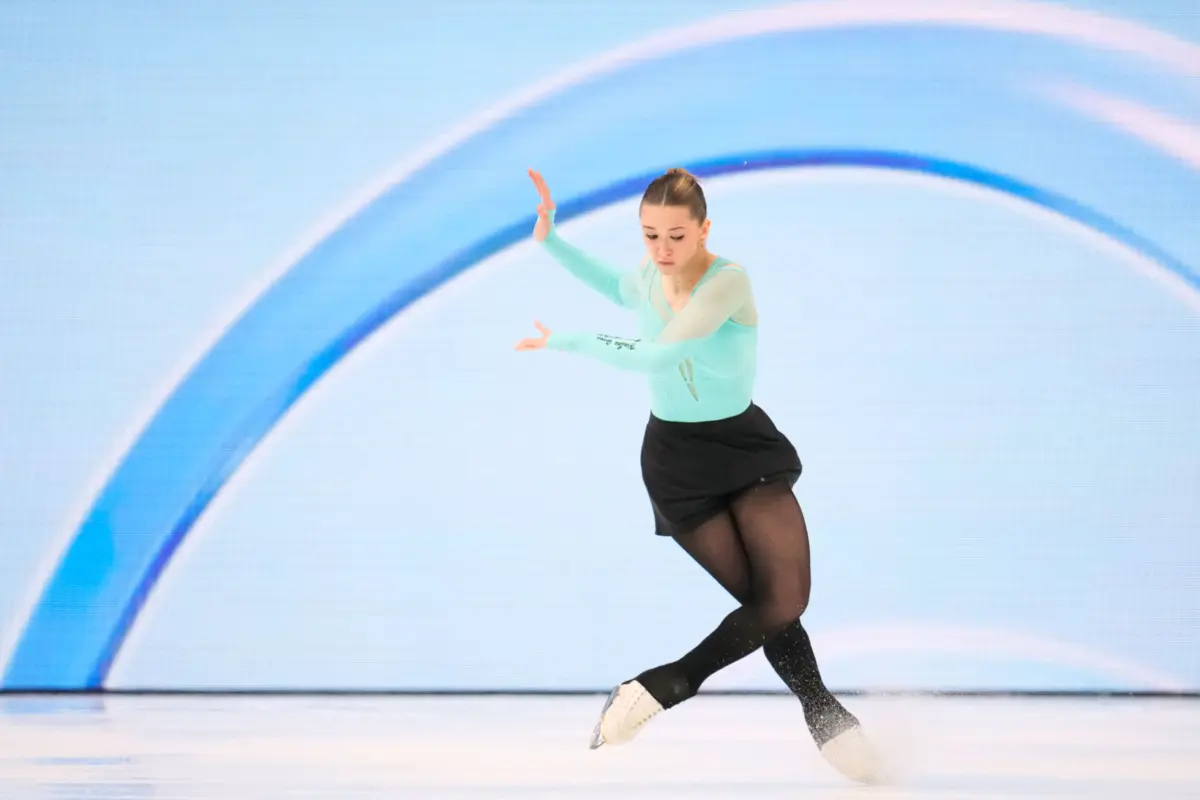

DÜSSELDORF — In a development that reverberates across the global figure skating community, Russian figure skating star Kamila Valieva has once again found herself at the epicenter of an international athletic controversy. According to sources familiar with the confidential proceedings, the International Skating Union (ISU) has revoked Valieva’s permission to compete internationally as a neutral athlete.
The decision represents a severe blow to the embattled 19-year-old skater, whose professional career has been defined by high-profile legal battles, doping scandals, and geopolitical fallout. Alongside Valieva, fellow Russian men’s skater Mark Kondratiuk—a teammate from the 2022 Beijing Olympic Games—has also had his neutral athlete status stripped by the governing body.
The revocation stems from growing concerns within the ISU that both athletes may have violated eligibility criteria prohibiting neutral competitors from expressing support for Russia’s ongoing military invasion of Ukraine. With appeals currently pending before the federation, the ruling threatens to permanently derail Valieva’s attempted international comeback following the expiration of her doping ban.
Executive Overview
The sweeping decision by the ISU highlights the complex intersection of elite athletics, geopolitics, and international sports governance. Following the outbreak of the war in Ukraine in February 2002, the global sports ecosystem swiftly moved to isolate Russian and Belarusian competitors, banning them from international competitions. However, as sports federations gradually shifted toward reintegration models under the banner of "neutrality," new criteria were established to filter out athletes with ties to military forces or those who publicly endorsed the Kremlin’s military actions.
Under a recently introduced ISU framework for the current season, Russian and Belarusian skaters were initially "presumed eligible unless they fell within the disqualifying criteria." Valieva and Kondratiuk initially slipped through this bureaucratic threshold, securing the requisite neutral status to contemplate a return to global competition. That clearance has now been rescinded.
According to insiders who spoke on the condition of anonymity due to the sensitive nature of the proceedings, the ISU acted upon receiving intelligence and evidence suggesting potential breaches of the strict anti-war-support mandates. The development underscores the precarious tightrope Russian athletes must walk if they wish to compete on the world stage under neutral flags, remaining subject to relentless international scrutiny regarding their political stances and public profiles.
Detailed Chronology: From Beijing to Düsseldorf
To understand the weight of the ISU’s latest ruling, one must examine the turbulent timeline that has characterized Kamila Valieva’s meteoric and controversial career.
The 2022 Beijing Winter Olympics
Valieva burst onto the global senior stage as a generational talent, heavily favored to capture individual gold at the 2022 Beijing Winter Olympics. At just 15 years old, she was the centerpiece of the Russian Olympic Committee (ROC) team that secured gold in the figure skating team event.
However, euphoria quickly turned to chaos when it was revealed that Valieva had returned a positive sample for trimetazidine—a banned metabolic modulator—collected months prior at the Russian national championships. The ensuing legal labyrinth thrust the young skater into an international media storm, overshadowing the remainder of the Olympic Games. Despite being permitted to skate in the individual women’s event following a hastily convened Court of Arbitration for Sport (CAS) ruling, a visibly overwhelmed Valieva faltered under the pressure, finishing in fourth place. She was famously met with harsh, icy criticism rink-side by her controversial coach, Eteri Tutberidze.
The Doping Sanctions and Expiration
The legal fallout from the positive drug test dragged on for years. Eventually, the Court of Arbitration for Sport handed Valieva a backdated four-year ban, which officially stripped her of the 2022 team gold medal—upgrading the United States to first place—and erased her competitive results during the suspension window.
Valieva’s period of ineligibility finally expired in December 2025. Upon serving her sentence, she immediately returned to domestic competition within Russia, testing the waters for a potential international revival.
The Milan-Cortina Games and the Rule Shift
As the international skating community pivoted toward the Milan-Cortina Olympics, the ISU maintained strict bans before implementing a modified pathway for a limited number of Russian athletes to return via qualifying events. Skaters Adeliia Petrosian and Petr Gumennik managed to compete at the Games under neutral status, though neither secured a podium finish. Notably, the international minimum age for senior skaters had been raised from 15 to 17 in the wake of the Valieva scandal, permanently altering the eligibility landscape for young prodigies.
For the current post-Olympic season, the ISU liberalized its approach slightly by removing caps on the number of neutral athletes and establishing a "presumption of eligibility." This paved the way for Valieva and Kondratiuk to apply. However, the safety net was short-lived; independent oversight and mounting scrutiny over the skaters’ domestic activities and public statements ultimately triggered the revocation of their neutral clearances.
Supporting Context and Regulatory Framework
The ISU’s eligibility guidelines for neutral athletes are explicit, leaving little room for ambiguity regarding political neutrality and military affiliations. Under the governing body’s current bylaws, an athlete from Russia or Belarus can be summarily disqualified from obtaining or retaining neutral status if they meet any of the following disqualifying conditions:
- Active Military Service: The individual is currently serving as a member of the Russian or Belarusian military forces or national security agencies.
- Participation in Operations: The individual has previously participated directly or indirectly in military operations against Ukraine.
- Public Advocacy: The individual has "actively and publicly supported that war" or endorsed the geopolitical actions of the Russian state in Ukraine since the invasion began in February 2022.
While the specific evidence regarding Valieva and Kondratiuk has not been publicly detailed by the ISU due to privacy regulations and ongoing legal protocols, sources indicate that investigators flagged conduct or associations that run afoul of the third provision.
The inclusion of Mark Kondratiuk in the ruling further compounds the crisis for Russian figure skating leadership. Kondratiuk, the 2022 European champion and a core member of the Olympic team alongside Valieva, now shares her uncertain international future.
Official Statements and Legal Recourse
Neither Kamila Valieva nor Mark Kondratiuk has issued a public statement addressing the revocation of their neutral status. Russian state media outlets were the first to break the story, reflecting the intense domestic interest in the athletic futures of two of the country’s most prominent skaters.
According to insiders, the legal battle is far from over. The ISU is scheduled to formally review appeals filed by both athletes by the middle of next week. Should the governing body uphold its decision to strip their neutral status—a likely outcome given the initial firmness of the ruling—both skaters retain the right to escalate their cases to the Court of Arbitration for Sport (CAS) in Lausanne, Switzerland.
A CAS appeal would trigger yet another high-stakes legal showdown, pitting the athletes against the stringent compliance divisions of international winter sports federations. Given the precedent set by previous CAS rulings involving Russian sports bodies, any appeal would likely center on the interpretation of "active support" and whether the evidentiary threshold used by the ISU was met fairly.
Future Outlook
The revocation of neutral status for Kamila Valieva and Mark Kondratiuk casts a long shadow over the future of Russian figure skating on the global stage. For Valieva, whose career has been a lightning rod for controversies ranging from pharmacokinetics to geopolitical warfare, the path back to the Olympic podium appears increasingly narrow and fraught with insurmountable institutional hurdles.
As the ISU prepares to deliver its final verdict on the athletes’ appeals next week, the broader sports world is watching closely. The case serves as a definitive litmus test for international sports federations attempting to balance the principles of athletic inclusivity with stringent geopolitical accountability. Whether Valieva will ever be permitted to grace an international ice rink again now rests entirely in the hands of appellate arbitrators—leaving the once-unbeatable prodigy waiting in political and competitive limbo.

0 Comments