
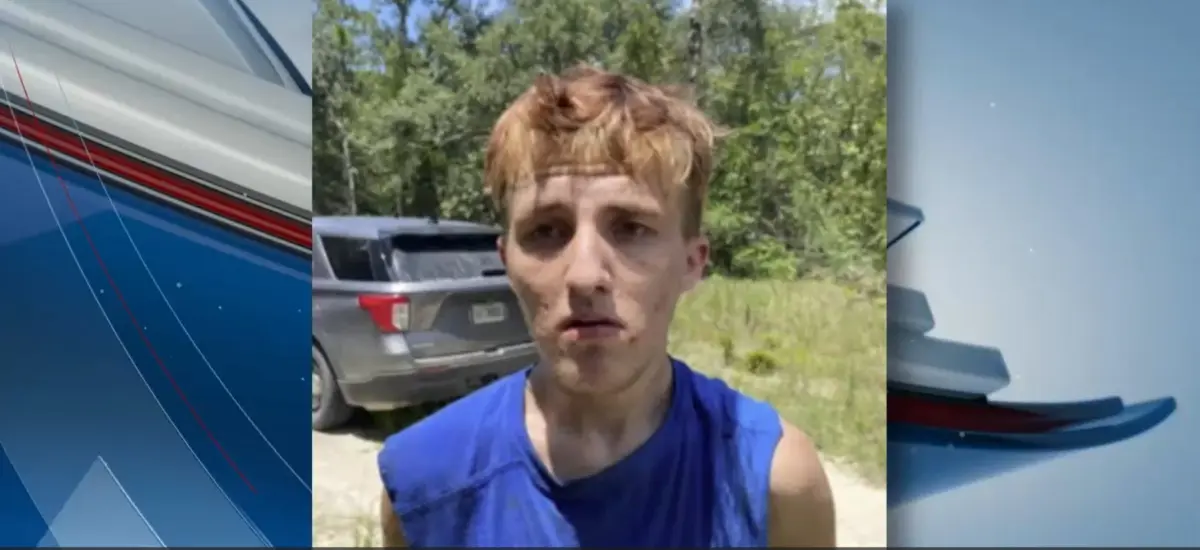

BRONSON, Fla. — A multi-agency manhunt in Levy County culminated in the high-stakes capture of a wanted fugitive, thanks in large part to the decisive actions of an off-duty law enforcement officer and a specialized K-9 tracking unit. Jonas Smith, an individual with a history of active warrants spanning various drug-related offenses and additional criminal charges, was taken into custody late last week following a foot pursuit that ended in a dense wooded area near a local residential subdivision.
The operation highlights the critical role that canine units play in modern rural law enforcement, particularly when suspects attempt to evade apprehension by fleeing into difficult terrain. Authorities have confirmed that Smith is now facing a significantly altered legal landscape, having accumulated a substantial bond and an additional felony-level charge for resisting arrest without violence following his tactical extraction from the brush.
Executive Overview
The arrest of Jonas Smith on Friday afternoon brings a temporary close to an intensive localized search that mobilized resources within the Levy County Sheriff’s Office (LCSO). The incident began when an off-duty deputy, exercising situational awareness outside of standard operational hours, positively identified Smith riding a bicycle in the vicinity of the Oak Ridge Estates subdivision. Recognizing the immediate threat posed by an at-large fugitive with active warrants, the deputy initiated protocol, which rapidly escalated into a foot pursuit when Smith refused to surrender.
Recognizing the tactical disadvantages of pursuing a fleeing suspect on foot through dense Florida acreage, responding units deployed K-9 Ellzey, a premier tracking asset within the sheriff’s canine division. K-9 Ellzey successfully established a scent trail, navigated the complex terrain of the woodland canopy, and located Smith, who was attempting to conceal himself from authorities.
The successful conclusion of this manhunt underscores several vital components of modern policing in North-Central Florida:
- Inter-Agency Preparedness: The seamless transition from off-duty observation to active tactical deployment.
- Specialized K-9 Assets: The irreplaceable value of tracking canines in rural and semi-rural jurisdictions.
- Escalated Legal Consequences: How an attempted flight exponentially increases a suspect’s financial and penal liability, evidenced by Smith’s mounting $275,000 bond.
Detailed Chronology of Events
Phase 1: The Incidental Spotting
The sequence of events that led to Smith’s capture unfolded on a Friday afternoon near the Oak Ridge Estates subdivision in Bronson, Florida. According to preliminary incident reports released by the Levy County Sheriff’s Office, an off-duty deputy was transiting the area when they observed a male subject operating a bicycle.
Despite being off the clock, the deputy maintained professional vigilance and instantly recognized the bicyclist as Jonas Smith. Smith was well-known to local law enforcement due to an array of outstanding, active warrants encompassing serious drug charges and ancillary offenses. Understanding that allowing a known fugitive to pass unhindered posed an inherent risk to public safety, the off-duty deputy immediately initiated communication with on-duty units, providing real-time geographical updates regarding Smith’s trajectory, speed, and direction of travel toward the residential subdivision.
Phase 2: The Foot Pursuit and Evasion Tactics
Upon the arrival of marked patrol units responding to the off-duty deputy’s dispatch, Smith realized he had been compromised. Abandoning his bicycle—a common tactic utilized to transition into terrain impassable by standard patrol cruisers—Smith bolted on foot.
The suspect directed his flight toward a thick patch of woods bordering the Oak Ridge Estates subdivision. This specific geographic feature presented immediate tactical hurdles for the pursuing deputies. Thick underbrush, dense pine flatwoods, and limited visibility make traditional visual tracking virtually impossible without compromising officer safety. Recognizing that a disorganized grid search through heavy timber would give the suspect a significant advantage, field commanders made the tactical decision to request the deployment of the LCSO K-9 Unit.
Phase 3: The Canine Track and Capture
K-9 Ellzey and his handler arrived at the staging area shortly after the initial perimeter was established. After securing a last-seen-moving point of origin, the handler deployed K-9 Ellzey to acquire Smith’s scent.
Utilizing superior olfactory capabilities, K-9 Ellzey bypassed the visual obstacles that hindered human deputies. The canine tracked the fugitive’s exact path through the dense foliage, cutting directly through the wooded labyrinth where Smith was attempting to elude capture. Within a relatively short window of time, K-9 Ellzey located Smith, who was actively hiding within the thicket.
Faced with the presence of the highly trained service animal and the closing perimeter of tactical deputies, Smith abandoned his efforts to remain hidden. He surrendered without further physical confrontation. Deputies moved in, secured the suspect in handcuffs, and transported him from the woodline to a waiting patrol transport vehicle, effectively concluding the hours-long tension surrounding the Oak Ridge Estates neighborhood.
Supporting Context & Metrics
The arrest of Jonas Smith sheds light on the broader operational metrics and challenges facing law enforcement agencies operating in Levy County and the wider Nature Coast region. Rural and semi-rural counties often present unique geographic profiles characterized by vast tracts of undeveloped land, dense forests, and rural residential pockets. These landscapes, while aesthetically pleasing, offer fugitives abundant opportunities to evade capture if law enforcement lacks the appropriate tracking infrastructure.
The Financial and Legal Toll of Flight
When Smith chose to run from law enforcement, he fundamentally altered his pre-trial release calculus. Prior to his Friday afternoon encounter, Smith was already wanted on pre-existing warrants for drug charges and other unspecified offenses. In the criminal justice system, fleeing from lawful apprehension is rarely viewed as a minor misstep; rather, it is aggressively prosecuted as an independent criminal act.
Upon being booked into the Levy County Detention Facility, Smith’s cumulative legal burden was formalized with the issuance of a staggering $275,000 bond. Furthermore, he was formally charged with resisting an officer without violence, a misdemeanor or potential felony enhancement depending on the precise statutory interpretation and the nature of the interference. This high bond amount reflects several judicial considerations:
- Flight Risk: Smith’s physical attempt to evade deputies directly demonstrates an unwillingness to submit to legal authority, certifying him as an acute flight risk.
- Public Safety Threat: Given the combination of active drug warrants and active resistance, the presiding magistrate deemed a high financial barrier necessary to protect the community upon potential release.
- Prior Criminal History: Warrants for drug offenses typically indicate systemic involvement in illicit narcotics distribution or possession, which traditionally carries heavier judicial scrutiny in Florida courts.
The Operational Economics of K-9 Units
The successful deployment of K-9 Ellzey serves as a practical case study in the cost-effectiveness and safety dividends of police canine programs. Manhunts conducted entirely by human officers in wooded terrain require substantial personnel—often pulling deputies away from shift coverage across the entire county—and exponentially increase the risk of ambush or accidental injury.
Canines reduce the duration of searches drastically. By shortening the operational window, agencies minimize overtime expenditures, reduce resource strain, and—most importantly—mitigate the risk of lethal force encounters. When a tracking dog locates a suspect, the psychological and physical deterrent of the animal frequently forces a peaceful surrender that might not otherwise occur if a human officer stumbled upon an armed suspect in the dark or heavy brush.
Official Statements and Institutional Perspectives
While formal, direct press conferences regarding the tactical nuances of the Oak Ridge Estates operation are frequently consolidated into official department summaries, spokespersons for the Levy County Sheriff’s Office have consistently emphasized the indispensable nature of their specialized units.
In public briefings following the arrest, LCSO leadership publicly commended the sharp observational skills of the off-duty deputy whose vigilance initiated the chain of events. Officials noted that law enforcement officers carry their oath beyond the confines of their scheduled shifts, and the ability to recognize a wanted felon while off-duty exemplifies the core dedication required in modern policing.
Furthermore, the agency directed considerable praise toward the K-9 division. Law enforcement administrators across Florida frequently advocate for increased funding and community support for canine programs, pointing to incidents like the Bronson manhunt as definitive proof of their utility. A statement released by the department emphasized:
"The integration of our specialized K-9 units into daily patrol operations ensures that individuals attempting to circumvent the law through flight and concealment cannot outrun our tracking capabilities. K-9 Ellzey’s performance today directly protected our community and brought a wanted offender to justice safely and efficiently."
Legal analysts observing the case note that the clear-cut nature of the arrest—combining off-duty identification, perimeter containment, positive canine tracking, and physical apprehension—leaves little room for defense counsel to challenge the integrity of the initial stop or the validity of the subsequent resisting charge, barring any unforeseen constitutional anomalies during the foot pursuit.
Future Outlook: Judicial Proceedings and Community Impact
As Jonas Smith remains detained at the Levy County Detention Facility under the substantial $275,000 bond, the case now transitions from the tactical realm of law enforcement operations to the deliberate, methodical pace of the judicial system.
Upcoming Legal Milestones
- First Appearance and Arraignment: Smith will face formal reading of his charges, including the pre-existing drug warrants and the newly minted charge of resisting arrest. During these initial hearings, his defense representation may petition the court for a bond reduction, though prosecutors are expected to vigorously oppose any lowering of the bail given his demonstrated propensity for flight.
- Discovery and Pre-Trial Motions: Defense attorneys are expected to review the body-worn camera footage of the responding deputies, the off-duty deputy’s initial report, and the specific logs detailing K-9 Ellzey’s tracking deployment.
- Plea Negotiations versus Trial: Given the direct nature of the apprehension—being found hiding in the woods by a tracking dog—legal experts suggest that the evidentiary burden heavily favors the state, potentially steering the case toward structured plea negotiations addressing the underlying drug charges alongside the enhancement for resisting arrest.
Community Reassurance in Bronson
For the residents of the Oak Ridge Estates subdivision and the broader Bronson community, the swift resolution of Friday’s manhunt offers a measure of localized security. The sudden appearance of law enforcement vehicles, perimeter lock-downs, and canine units can be deeply unsettling for suburban neighborhoods. However, the efficient neutralization of the threat within a relatively compressed timeframe demonstrates the preparedness of the Levy County Sheriff’s Office to handle critical incidents in residential-rural interfaces.
As rural developments continue to expand into historically wooded regions across Central and North Florida, local law enforcement agencies will undoubtedly face similar tactical scenarios where suspects attempt to utilize natural terrain to escape accountability. The success of K-9 Ellzey in Bronson establishes a clear benchmark for operational readiness, proving that woodland cover is no longer a viable shield against the specialized tracking capabilities of modern county sheriff’s offices.

0 Comments