

Executive Overview
The landscape of collegiate athletics continues to be reshaped by the courts, with the latest legal salvo fired by former Florida State University basketball standout Alex Steen. In an emergency civil action filed on August 14 in the Circuit Court of the Second Judicial Circuit in and for Leon County, Florida, Steen has formally initiated litigation against the National Collegiate Athletic Association (NCAA). At the heart of the lawsuit is the governing body’s contentious eligibility framework, specifically the rule known colloquially as the "5-in-5" policy.
Steen is seeking judicial intervention to secure a fifth year of collegiate eligibility for the 2026–27 season. The lawsuit targets a structural loophole in the NCAA’s implementation of its eligibility clock, which Steen’s legal team argues unfairly penalizes student-athletes who graduated from high school in 2022 and managed to continuously compete without redshirting.
The emergency filing requests both a temporary restraining order and a preliminary injunction to bar the NCAA from enforcing rules that currently deem Steen ineligible for the upcoming 2026–27 campaign. Furthermore, the litigation seeks to protect any prospective member institution from severe retaliatory penalties under the NCAA’s "Rule of Restitution" and "Ghost Transfer" doctrines—provisions that have historically deterred schools from playing athletes protected by preliminary court orders.
This high-stakes legal challenge arrives amid a broader nationwide reckoning regarding NCAA amateurism, eligibility windows, and the intersection of antitrust law with collegiate sports governance. With roster composition, scholarship allocations, direct institutional revenue-sharing models, and lucrative Name, Image, and Likeness (NIL) valuations operating on accelerated timelines, Steen’s legal representatives argue that immediate judicial relief is imperative. An athletic season lost, the complaint emphasizes, is an irreparable harm that can never be restored.
Detailed Chronology: From Division II Standout to ACC Starter
To understand the foundations of Alex Steen’s legal challenge, one must examine the trajectory of his collegiate career—a journey marked by resilience, breakout performances, and administrative roadblocks imposed by the nation’s premier collegiate athletic association.
The Division II Foundations: Florida Southern Years
Steen’s collegiate basketball career commenced during the 2022–23 season at Division II Florida Southern. Entering the collegiate ranks as a member of the high school graduating class of 2022, Steen did not utilize a redshirt year during his initial campaign, instantly contributing on the floor and laying the groundwork for a productive career.
He would spend three foundational seasons at Florida Southern, developing into an interior force. However, his sophomore campaign was severely disrupted by adversity. In late January, Steen suffered a severe fracture to his foot, threatening to derail his development. Displaying significant grit, he worked through rigorous rehabilitation protocols to return to the hardwood ahead of the postseason.
Steen’s return proved vital for Florida Southern, as he spearheaded a deep postseason run that culminated in an appearance at the NCAA Regional Championship. Tragically, the physical demands of the run caught up to him; shortly after returning, Steen re-fractured the exact same foot, prematurely shutting down his sophomore season and presenting him with his first major career-altering hurdle.
The Division I Breakout: Florida State University
Following three productive seasons at the Division II level, Steen entered the NCAA transfer portal and secured an opportunity at the Division I level, committing to Florida State University for the 2025–26 season. Making the leap from Division II to the Atlantic Coast Conference (ACC) is historically daunting, but Steen transitioned seamlessly into a major-conference environment.
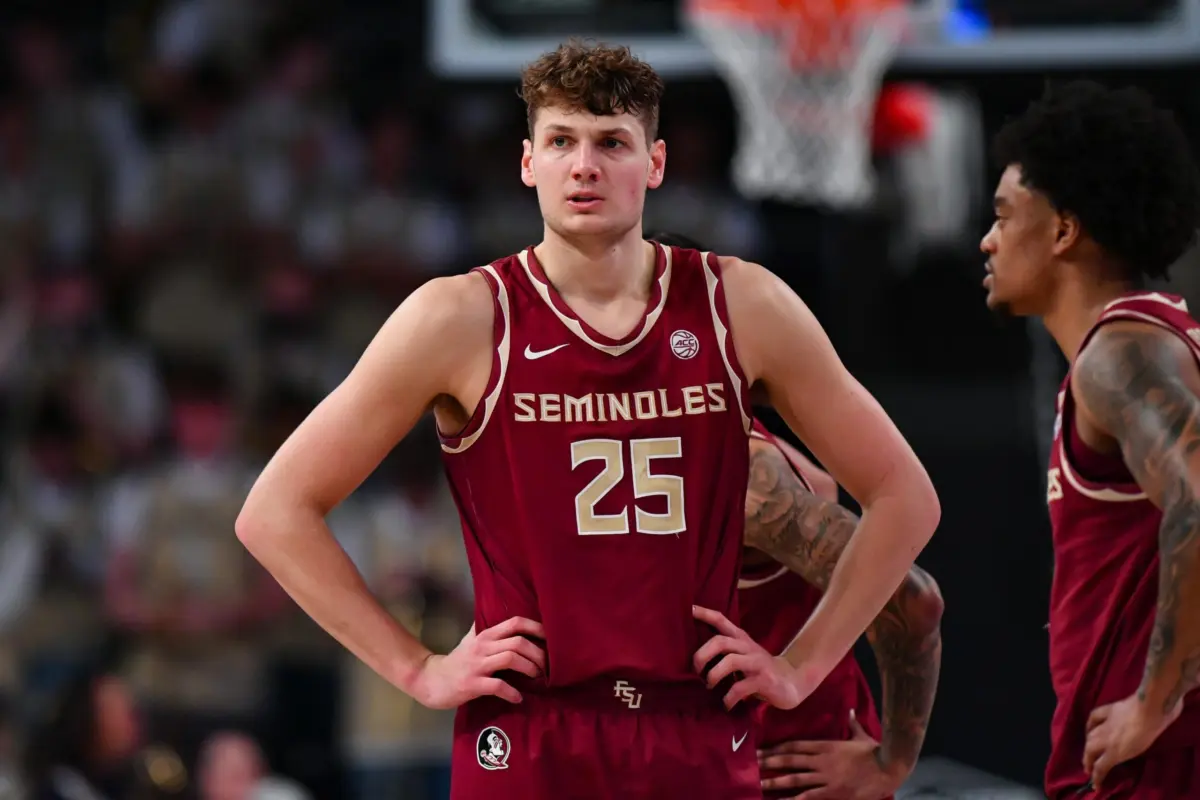
Over the course of the 2025–26 season, Steen established himself as an indispensable component of the Seminoles’ rotation. He logged 633 minutes of high-intensity playing time, tallying 218 points, 28 blocks, 28 assists, and 22 steals. Elevating his game to match the physicality of the ACC, Steen emerged as a full-time starter and led the Florida State Seminoles in rebounding.
The Administrative Impasse
Despite his stellar on-court production, Steen’s trajectory hit a bureaucratic wall. Because he competed in each of his first four college seasons (three at Florida Southern and one at Florida State) without ever taking a redshirt year, the NCAA’s current interpretation of its eligibility rules dictates that he has fully exhausted his four seasons of competition within a four-year chronological window.
When the NCAA communicated to Florida State University that Steen was ineligible to compete for a fifth year in 2026–27, it triggered the events leading directly to the Leon County courtroom. According to the complaint, this ruling was not a distant abstract policy decision, but rather an administrative blow delivered directly to a Leon County institution, denying Florida-based athletic and economic opportunities.
Supporting Context & Metrics: The Class of 2022 Battleground
Alex Steen’s lawsuit does not exist in a vacuum; it is part of an escalating, multi-front legal war over the eligibility rights of student-athletes who entered higher education amid the post-pandemic collegiate sports landscape—specifically the high school graduating Class of 2022.
The "5-in-5" Rule Explained
The NCAA enforces what it terms the "5-in-5" rule. This regulation permits student-athletes to compete in up to five full seasons, but mandates that these seasons must be completed within a strict five-year eligibility window. While designed to provide flexibility for athletes who sit out seasons due to injury, academic redshirting, or personal hardship, the enforcement mechanism has created systemic exclusions.
Steen’s complaint asserts that the NCAA purposefully or inadvertently carved out an exclusionary category: athletes who graduated from high school in 2022, matriculated immediately into college, and never sat out a full season during their first four years. Because Steen checked every box of continuous enrollment and participation without redshirting, he fell squarely into the demographic excluded from receiving standard chronological relief under current administrative guidelines.
Parallels in Federal Court: The Sweeney Injunction
Steen’s legal team is capitalizing on a growing judicial consensus that questions the fairness and legality of the NCAA’s arbitrary eligibility limitations. Notably, this lawsuit mirrors broader legal fights concerning the very same demographic.
U.S. District Judge Charlotte Sweeney previously granted preliminary relief to members of the high school Class of 2022 who sought a fifth season of competition for the 2026–27 academic year in a separate federal action. Judge Sweeney’s ruling established a vital legal precedent: that the NCAA’s blanket denial of eligibility extensions for this specific cohort may violate principles of fairness and competitive equity, opening the door for state-level actions like Steen’s filing in Leon County.
The Financial Urgency: Roster Spots, Revenue-Sharing, and NIL
The legal filings underscore that collegiate athletics is no longer governed solely by amateur ideals, but operates within a multi-billion-dollar commercial ecosystem. The urgency behind Steen’s motion for a temporary restraining order and preliminary injunction is tied directly to the hyper-accelerated timelines of modern roster management.
For the 2026–27 season, athletic departments are currently locking in:
- Roster Spots: Coaches are finalizing scholarship distributions and player retention lists months in advance.
- Direct Revenue-Sharing: Under newly minted House v. NCAA settlement frameworks, power-conference athletic departments are beginning direct revenue-sharing distributions with athletes, making roster positioning a high-stakes financial matter.
- Name, Image, and Likeness (NIL): Collective valuations and brand endorsements are negotiated well ahead of tip-off.
Steen’s legal team made this economic reality clear in the complaint:
"This is an emergency action to prevent the NCAA from barring Alex Steen – an elite college basketball player – from competing in the 2026–27 season. Emergency relief is necessary because the 2026–27 season is imminent, roster spots and the scholarship, revenue-sharing, and name, image, and likeness (‘NIL’) opportunities tied to them are being filled now, and a season of competition – once lost – can never be restored."
Official Statements and Legal Arguments
The legal arguments presented by Steen’s counsel paint a picture of an organization caught in deep contradiction—simultaneously fighting athletes in court while lobbying Congress to pass legislation that would grant those very same athletes the rights they are currently being denied.
The Florida State Connection and Institutional Chilling
A key nuance of the Leon County filing is the localized nature of the injury suffered by Steen. While the NCAA operates as a national governing body headquartered in Indianapolis, its communications directly impact member institutions across every state.
The complaint outlines how the NCAA’s administrative edicts hamstrung Florida State University:
"The NCAA’s exclusion of Mr. Steen is not an abstract national policy dispute; it caused injury in Florida. Florida State University is an NCAA member institution in Leon County, and the NCAA issued communications to Florida State rendering Mr. Steen and the high-school class of 2022 as ineligible. Those communications are what rendered Mr. Steen ineligible at Florida State and prevented the Florida-based opportunities he seeks to protect."
Furthermore, Steen’s camp reveals that a return to Tallahassee was heavily desired by both parties. The litigation notes that Steen’s coaching staff at Florida State explicitly communicated their desire to retain his services, while his agent fielded lucrative inquiries from multiple other major programs ready to offer substantial revenue-sharing packages and NIL deals.
The "Ghost Transfer" and Rule of Restitution Threat
A major hurdle for any athlete suing the NCAA is the fear of institutional retaliation. If a player takes the field under a temporary restraining order that is later overturned on appeal, the NCAA’s "Rule of Restitution" can penalize the participating school, forcing forfeiture of games, financial penalties, or the retroactive stripping of team records.
To counter this, Steen is specifically asking the court to enjoin the NCAA from punishing any university that places him on its roster pursuant to a judicial order. His attorneys argue that without this specific protective injunction, the chilling effect of the Rule of Restitution and associated "Ghost Transfer" penalties would effectively blacklist Steen from the market, rendering any temporary legal victory hollow as schools refuse to assume regulatory risk.
The Congressional Lobbying Hypocrisy
Perhaps the most striking argument in the court filing targets the NCAA’s legislative lobbying efforts in Washington, D.C. The complaint highlights a glaring double standard: the NCAA is actively lobbying Congress to pass the Protect College Sports Act, a federal bill designed to regulate collegiate athletics. Crucially, the provisions of this proposed legislation would explicitly codify the right for athletes in Steen’s position—specifically those impacted by pandemic-era disruptions and classification anomalies—to play a fifth season.
The complaint points out this administrative contradiction with sharp rhetoric:
"Currently, the NCAA is lobbying Congress to pass the Protect College Sports Act, which would permit Mr. Steen to play his fifth season in the upcoming 2026–27 season. The NCAA is arbitrarily and actively denying Mr. Steen’s ability to play next season, while simultaneously vehemently lobbying Congress to pass a statute that would allow Mr. Steen to play next season."
Future Outlook: What Lies Ahead for Steen and NCAA Governance
As the Circuit Court of the Second Judicial Circuit in Leon County reviews Alex Steen’s emergency motion, the implications extend far beyond a single roster spot in Tallahassee.
Immediate Legal Milestones
In the coming weeks, Judge Charlotte Sweeney’s federal precedent in Colorado combined with the Leon County arguments will place immense pressure on the NCAA’s legal defense team. Should the Florida state court grant the temporary restraining order and preliminary injunction, Steen will immediately become eligible to participate in team workouts, sign binding financial agreements, and secure his spot on a 2026–27 roster—whether at Florida State or elsewhere.
Conversely, if the court denies the emergency action, Steen faces an uphill battle to preserve his collegiate career before roster spots for the upcoming cycle are permanently sealed. Given the irreversible nature of athletic eligibility windows, an expedited appellate process would likely follow any adverse ruling.
Broader Implications for College Basketball
Steen’s case is another symptom of a governance model struggling to adapt to the realities of modern player mobility, the transfer portal, and the professionalization of collegiate sports. As federal judges increasingly look past NCAA amateurism defenses in favor of antitrust and fairness principles, the association’s ability to unilaterally enforce strict chronological cutoffs is diminishing.
For Alex Steen, the fight is intensely personal: a battle to reclaim a stolen year on the hardwood, secure his financial future through newly available revenue-sharing and NIL opportunities, and finish his collegiate basketball journey on his own terms. For the NCAA, it represents yet another cautionary tale of a governing body caught between its historical ruleset and a rapidly transforming legal reality.

0 Comments