

Executive Overview
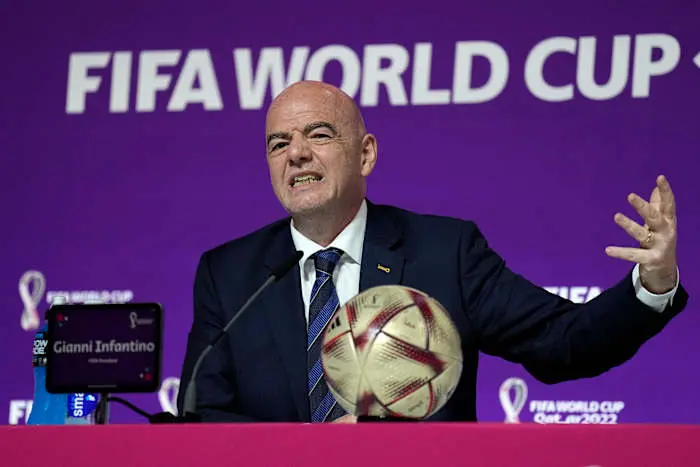
The governance of global association football has plunged into a transcontinental legal and political crisis. FIFA has formally accused its European counterpart, UEFA, of orchestrating a calculated "smear campaign" designed to damage the reputation of FIFA President Gianni Infantino and destabilize global football administration.
The fiery accusation, submitted via a motion to intervene in a U.S. District Court in Colorado on Thursday, represents a dramatic escalation in an ongoing battle over a failed $4.2 billion proposal. That initiative—known as the FIFA Forward Enterprise (FFE) project—sought to sell lucrative equity stakes in the prestigious FIFA World Cup and other premier competitions to private equity firms.
The plan imploded on August 1, collapsing under the weight of immediate, fierce opposition from European stakeholders just days after its public debut. In the weeks following the withdrawal, the dispute migrated from the boardroom into international courtrooms. UEFA has initiated aggressive discovery requests across three separate U.S. jurisdictions to unearth internal documents regarding the deal, targeting high-profile figures such as investor Josh Kushner and media executive Greg Maffei.
Furthermore, European football’s governing body has signaled its intent to pursue criminal complaints in Switzerland against Infantino for alleged financial mismanagement. FIFA’s latest legal filings reject these maneuvers out of hand, framing them as publicity stunts and a coordinated campaign of coercion aimed at undermining Infantino’s leadership and expanding European hegemony over international soccer politics.
Detailed Chronology of the Crisis
To understand the current courtroom showdown, it is necessary to trace the rapid acceleration of events that brought the highest echelons of international sport to the brink of open warfare.
The Genesis of the FFE Proposal
For months, FIFA leadership under Gianni Infantino explored ways to dramatically accelerate the commercial growth of its marquee tournaments. The strategy crystallized into the FIFA Forward Enterprise (FFE) plan. Backed by private equity interest—most notably from Thrive Capital Management, spearheaded by Josh Kushner—the proposal intended to secure a massive influx of capital. In exchange, private equity investors would acquire permanent or semi-permanent commercial stakes in FIFA’s most valuable properties, headlined by the men’s and women’s World Cups.
Infantino and his inner circle framed the initiative as a bold, necessary step to "unleash the commercial potential and opportunity that FIFA has," aiming to distribute revenues more broadly across global football associations that historically operated in the shadow of Europe’s hyper-wealthy domestic leagues.
The Public Unveiling and Sudden Collapse
The proposal broke into public view in late July, triggering instant and overwhelming shockwaves throughout the global soccer ecosystem. European federations, led closely by UEFA, viewed the plan as an existential threat to the integrity and financial sovereignty of the international game. Critics argued that privatizing the sport’s crown jewels would prioritize short-term private equity returns over long-term developmental reinvestment.
Faced with mounting internal dissent, sudden public scrutiny, and the threat of a full-scale institutional revolt, FIFA abruptly withdrew the $4.2 billion proposal on August 1—mere days after it had been officially introduced.
U.S. Courtroom Maneuvers and Discovery Requests
Rather than letting the issue die with the withdrawal of the proposal, UEFA escalated the conflict across the Atlantic. Utilizing U.S. federal procedures designed to assist foreign legal proceedings, UEFA filed targeted discovery requests in three separate jurisdictions:
- The Southern District of New York: Seeking the production of internal communications, emails, and financial documents from Josh Kushner and Thrive Capital Management.
- Florida: Targeting operational documentation stemming from FIFA’s 2026 World Cup regional base.
- Colorado: Directing legal discovery efforts against Greg Maffei, a close Infantino adviser and former CEO of Liberty Media.
FIFA’s Counter-Offensive in Colorado
On Thursday, FIFA fired back decisively. In a motion filed in U.S. District Court in Colorado, FIFA’s legal team asked the court to defer or outright dismiss UEFA’s discovery applications. The filing argued that the requests are fundamentally defective, noting that they are designed to support a foreign criminal proceeding in Switzerland that does not currently exist—and one which UEFA, as an entity, lacks the legal authority to formally initiate.
Supporting Context & Metrics: The Players and the Stakes
The fallout from the collapsed FFE plan involves elite financiers, media moguls, and the two most powerful administrative bodies in global sports.
The Financial Architecture and Thrive Capital’s Role
At the center of the private equity partnership was Thrive Capital Management. Josh Kushner, the firm’s founder and younger brother of Presidential son-in-law Jared Kushner, found himself unexpectedly thrust into the crossfire of international sports politics.
Thrive had envisioned the FFE as a progressive commercial alignment. However, the firm severely miscalculated the intense political tribalism characteristic of global football governance. The entanglement has proven uniquely ill-timed for Kushner, who made headlines concurrently by agreeing to partner with Disney CEO Bob Iger in a multi-billion-dollar bid to purchase the NBA’s Los Angeles Lakers.
The Stakes of World Cup Commercialization
The metrics driving this battle are staggering:
- $4.2 Billion: The proposed valuation of the private equity injection that sparked the initial crisis.
- The Crown Jewel: The FIFA World Cup remains the most-watched sporting event on Earth, generating billions in television rights, corporate sponsorships, and ticketing revenue every four-year cycle.
- Governance Dominance: For decades, European clubs and UEFA have commanded the lion’s share of global football’s wealth, talent, and political influence. Infantino’s strategy was interpreted by many analysts as an attempt to dilute European leverage by creating independent, direct revenue streams managed via global private equity partnerships.
Official Statements and Legal Positions
The war of words between Zurich (FIFA’s headquarters) and Nyon (UEFA’s headquarters) has played out through sharp public statements and highly combative legal filings.
FIFA’s Position: A "Smear Campaign"
In its Colorado court filing, FIFA did not mince words regarding UEFA’s motives:
"While these applications are styled as legal pleadings with captions and docket numbers, they are little more than press releases in further support of UEFA’s smear campaign against FIFA and its leadership."
FIFA further accused UEFA of utilizing coercive tactics behind closed doors, alleging that European leadership systematically pressured continental federations to manufacture unified opposition against the financial proposal.
UEFA’s Allegations: Financial Mismanagement
UEFA’s legal representation has painted a starkly different picture of the FFE initiative, characterizing it as an opaque power grab designed to benefit a select few at the expense of the global game:
"Infantino claimed that the plan would ‘unleash the commercial potential and opportunity that FIFA has,’" UEFA lawyers noted in court documents. "In truth, it was a vehicle for Infantino and that small circle to acquire a permanent stake in and otherwise profit from FIFA’s most valuable assets to the detriment of FIFA, its members, and other parties within the football family."
Josh Kushner’s Post-Mortem
Reflecting on the debacle in an exclusive statement to media outlet Axios, Josh Kushner expressed regret over his firm’s involvement while defending the underlying economic philosophy of the proposal:
"While we stand behind the motivations of FFE, we failed to appreciate the political dynamics of global football, and the lengths some would go to. Thrive has a long track record of being a partner to all constituents. Had we known what this would devolve into, we would not have gotten involved."
Future Outlook: What Lies Ahead for FIFA and UEFA?
As autumn approaches, the legal and political fallout from the collapsed World Cup equity deal shows no signs of abating. Several critical trajectories will shape the immediate future of global football administration:
- The U.S. Discovery Battles: Federal judges in New York, Florida, and Colorado must now decide whether to grant UEFA’s sweeping requests for documents or uphold FIFA’s motions to dismiss. The outcome will determine whether internal communications between FIFA executives and private equity partners become public record.
- The Threat of Swiss Criminal Proceedings: All eyes will remain on Swiss prosecutorial authorities. Should UEFA or independent Swiss bodies formally open criminal investigations into Gianni Infantino or his inner circle regarding financial mismanagement, Infantino’s leadership tenure could face an unprecedented crisis.
- Internal Governance and the 2026 World Cup: With the expanded 48-team 2026 FIFA World Cup rapidly approaching—co-hosted by the United States, Canada, and Mexico—FIFA cannot afford prolonged institutional paralysis. The fractured relationship between FIFA and UEFA threatens to complicate tournament logistics, commercial partnerships, and broader regulatory harmony within the sport.
Ultimately, the war over the $4.2 billion equity plan has exposed deep ideological fractures over who should control the immense wealth generated by international football. Whether through federal courtrooms in America or judicial inquiries in Switzerland, this bitter institutional conflict will reverberate across the global sports landscape for years to come.

0 Comments