
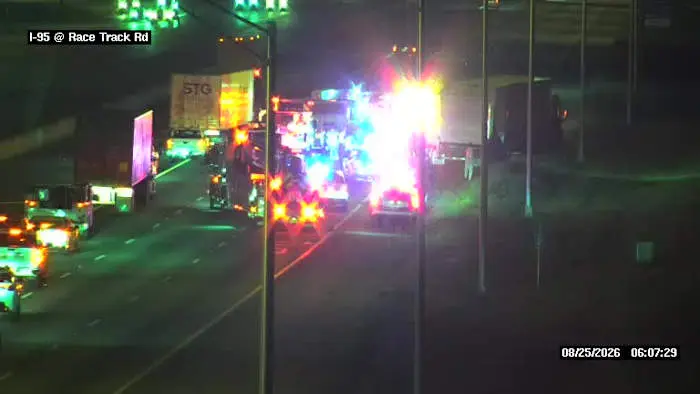

JACKSONVILLE, Fla. — A catastrophic early-morning motor vehicle collision on Tuesday, August 25, 2026, brought a vital section of Northeast Florida’s transportation grid to a complete standstill. The multi-vehicle incident, which occurred on northbound Interstate 95 near State Road 9B and Race Track Road, resulted in at least one fatality and triggered an extensive emergency response.
The ensuing operational paralysis shut down all northbound travel lanes for hours, forcing thousands of morning commuters, commercial freight haulers, and long-distance travelers to seek alternate routes. The incident has once again highlighted the extreme vulnerability of Jacksonville’s major highway corridors to sudden, high-impact disruptions, placing intense scrutiny on regional emergency response protocols, highway safety infrastructure, and the socioeconomic costs of major interstate shutdowns.
Executive Overview
At approximately 5:41 a.m. on Tuesday, emergency dispatchers received the first wave of frantic calls reporting a severe collision on northbound Interstate 95 near mile marker 333, just south of the State Road 9B interchange in Jacksonville. First responders from the Jacksonville Fire and Rescue Department (JFRD) and troopers with the Florida Highway Patrol (FHP) arrived at the scene to find a chaotic environment characterized by heavy vehicular damage and compromised traffic lanes.
The impact of the crash was immediate and absolute. Within minutes of the initial collision, FHP commanders ordered the complete closure of all northbound lanes on I-95 to preserve the integrity of the crash scene, facilitate critical life-saving operations, and clear dangerous debris from the roadway.
[I-95 Northbound Incident Profile]
--------------------------------------------------
Date of Incident:     August 25, 2026
Time of Initial Call: 5:41 a.m. EST
Location:             I-95 Northbound near Mile Marker 333 (SR 9B / Race Track Road)
Primary Agency:       Florida Highway Patrol (FHP)
Assisting Agencies:   Jacksonville Fire and Rescue Department (JFRD), FDOT
Current Status:       Active Investigation / Lane Closures and Delays
While law enforcement and Florida Department of Transportation (FDOT) crews worked expeditiously to process the scene, the shutdown coincided directly with the peak of the morning rush hour. The resulting gridlock rippled backward for miles, snarling traffic on feeder roads, local thoroughfares, and alternate highway corridors such as U.S. 1.
This comprehensive report examines the chronology of the incident, the broader context of corridor safety and logistics, the evolving statements from public safety officials, and the long-term outlook for commuters navigating this critical artery of Florida’s transportation network.
Detailed Chronology of Events
The Primes Hours: Pre-Dawn to Initial Response (5:00 a.m. – 6:30 a.m.)
The sequence of events began well before dawn on August 25, 2026. Weather conditions across Duval County at the time were characteristic of late summer mornings: dark, humid, and subject to localized visibility variations.
At 5:41 a.m., the Florida Highway Patrol’s regional communications center flagged multiple emergency calls reporting a major collision on northbound I-95 in the vicinity of mile marker 333. The exact configuration of the vehicles involved and the precise trigger of the initial impact remain under active investigation by FHP traffic homicide investigators.
JFRD units dispatched multiple engines, heavy rescue vehicles, and advanced life support ambulances to the scene. Upon arrival, medical personnel confirmed that at least one individual had sustained fatal injuries as a direct result of the crash. The severity of the incident necessitated an immediate freezing of the corridor to allow investigators to map the debris field, document skid marks, and analyze the positions of the impacted vehicles.
Traffic Management and Shoulder Routing (6:30 a.m. – 9:00 a.m.)
By 6:00 a.m., as dawn broke over Northeast Florida, the logistical nightmare of a total interstate shutdown became apparent. Northbound I-95 serves as one of the primary lifelines for commuters traveling from St. Johns County into the urban core of Jacksonville. With all standard northbound lanes blocked by emergency vehicles and wreckage, traffic ground to an absolute halt behind the crash site.
Recognizing the potential for secondary collisions and compounding delays, FHP and FDOT field personnel implemented a managed bottleneck relief strategy. Law enforcement officers began selectively guiding stranded motorists around the accident site by utilizing the paved outer shoulder of the interstate.
[Traffic Flow Management Strategy]
Standard Lanes (1, 2, 3, 4): COMPLETELY BLOCKED (Emergency/Investigation Zone)
Outer Paved Shoulder:         CONTROLLED RELEASE (Slow-speed alternative route past scene)
While this shoulder-routing procedure prevented a complete physical standstill, its low throughput capacity meant that vehicles crawled past the wreckage at walking speeds. Motorists reported delays stretching well beyond 90 minutes for commutes that typically required only a fraction of that time. Commercial freight trucks, delivery vans, and commuter vehicles formed a massive, serpentine queue stretching back past the County Road 210 and International Parkway exits in neighboring St. Johns County.
Investigation and Scene Clearance (9:00 a.m. Onward)
Throughout the morning, FHP’s Traffic Homicide Unit executed a meticulous forensic examination of the scene. The investigation required the use of laser mapping technology and drone surveillance to record the physical evidence before any wreckage could be towed or lanes could be reopened.
FDOT heavy-duty recovery assets were staged nearby, awaiting clearance from investigative commanders to remove compromised vehicles, clear shattered glass, and inspect the asphalt surface for structural damage caused by fluid spills or heavy impact. Because of the fatality involved, state protocols dictate a rigorous and unhurried investigative process to ensure that all potential contributing factors—ranging from mechanical failure and driver impairment to environmental conditions and infrastructure defects—are thoroughly documented.
Supporting Context & Metrics
The Strategic Importance of the I-95 Corridor in Northeast Florida
To fully understand the impact of the August 25 crash, one must examine the critical role that Interstate 95 plays in the regional economy and daily mobility of Northeast Florida. The stretch of I-95 running through Duval and St. Johns counties is one of the fastest-growing highway corridors in the southeastern United States.
[Key Corridor Demographics & Traffic Metrics]
Average Daily Traffic (ADT):  120,000+ vehicles per day (estimated segment volume)
Primary Connectors:          State Road 9B, Race Track Road, I-295 East Beltway
Economic Impact:             Critical freight artery linking Port Jacksonville to Southeast markets
The interchange at State Road 9B serves as a massive regional valve. SR 9B connects I-95 directly to the East Beltway (I-295) and the rapidly expanding residential and commercial zones of northern St. Johns County and southern Duval County (such as Durbin Park). Consequently, any disruption at the I-95 and SR 9B junction does not merely stall local traffic; it severs a primary economic umbilical cord.
The Economic and Logistical Cost of Highway Gridlock
When a vital commercial artery like I-95 is blocked for hours, the ripple effects extend far beyond frustrated commuters. Northeast Florida is a booming logistics hub, supported by proximity to JaxPort, rail yards, and major distribution centers operated by national retailers.
- Supply Chain Disruptions: Freight carriers operating "just-in-time" delivery models experienced severe schedule disruptions. Trucks hauling perishable goods, manufacturing components, and consumer retail inventory were trapped in the backup or forced onto congested secondary roads unsuited for heavy commercial axle weights.
- Productivity Losses: Tens of thousands of workers arriving late to professional, medical, educational, and service sector jobs resulted in measurable economic loss for the Jacksonville metropolitan area.
- Emergency Response Impairment: Although emergency lanes and shoulders were utilized to bypass the crash, secondary incidents on surrounding roads (such as U.S. 1 and Philips Highway) tested the limits of local police, fire, and EMS resources as they responded to fender-benders caused by rubbernecking and sudden congestion.
Comparative Safety Analysis of the I-95 / SR 9B Junction
Transportation planners and safety advocates have long scrutinized the I-95 corridor south of Jacksonville for its high traffic density and complex weaving patterns. The convergence of high-speed long-distance interstate traffic with heavy commuter volumes entering and exiting via State Road 9B creates inherent friction points.
While FDOT has invested heavily in widening projects, intelligent transportation systems (ITS), and variable message signs across the region, high-speed multi-lane highways remain susceptible to catastrophic incidents when driver error, mechanical failure, or adverse conditions intersect. Tuesday’s fatal crash underscores the ongoing challenge highway administrators face in balancing rapid regional growth with road safety engineering.
Official Statements
As the situation developed throughout the morning, public safety agencies utilized traditional media briefings and digital alert systems to keep the public informed while managing the operational theater of the crash scene.
Florida Highway Patrol (FHP)
In preliminary statements released to media outlets and broadcast via regional traffic alert feeds, FHP confirmed the fundamental details of the incident:
"The Florida Highway Patrol is currently on the scene of a fatal traffic crash on northbound Interstate 95 near mile marker 333, in the vicinity of State Road 9B and Race Track Road. All northbound lanes are currently blocked to allow for emergency response and a thorough traffic homicide investigation. Motorists are strongly urged to avoid the area, seek alternate routes, and anticipate significant delays. Further updates regarding lane re-openings will be provided as the investigation progresses."
FHP spokespersons emphasized that investigators are pursuing all leads regarding the sequence of events that led to the fatal impact. Troopers reiterated calls for public patience and strict adherence to directional instructions issued by officers managing traffic checkpoints miles upstream from the crash site.
Florida Department of Transportation (FDOT)
FDOT District 2 operations center activated its network of electronic overhead message boards across Duval and St. Johns counties as early as 6:00 a.m. Messages warned motorists of the total closure ahead, suggested diversion routes via U.S. 1 and I-295, and displayed estimated delay times.
In an operational briefing, FDOT engineers highlighted the coordination between state maintenance crews, tow operators, and highway patrol troopers:
- Asset Deployment: Heavy-duty wreckers and hazardous material cleanup units were prepositioned to expedite the clearing process the moment FHP investigators authorized the removal of vehicles.
- Traffic Diversion Support: FDOT traffic management engineers actively manipulated signal timings on parallel arterial roads to help absorb the influx of diverted interstate traffic, though acknowledging that local infrastructure has finite capacity.
Future Outlook & Preventative Measures
As normal traffic operations gradually resume following the clearance of the crash scene, attention among civic leaders, transportation planners, and safety advocates will inevitably turn toward the future. Incidents of this magnitude prompt critical questions regarding how Northeast Florida can enhance corridor resilience, improve incident management speed, and mitigate the risk of fatal collisions on its primary highways.
Accelerated Clearing Protocols and Technology
One of the primary lessons reinforced by major interstate shutdowns is the necessity of reducing the time required to investigate and clear fatal crash scenes. While thoroughness in a homicide or fatal traffic investigation is non-negotiable for legal and justice purposes, transportation agencies nationwide are increasingly adopting advanced technologies to streamline the process:
- Unmanned Aerial Systems (Drones): The increased deployment of specialized drone mapping teams allows FHP to capture 3D spatial data of crash scenes in a fraction of the time traditionally required by manual ground-surveying methods.
- Rapid-Clearance Legislation and Agreements: Continued coordination between state police, insurance adjusters, and commercial towing cartels helps ensure that disabled or wrecked commercial vehicles can be moved off active travel lanes more swiftly without compromising evidence collection.
Infrastructure and Intelligent Transportation Systems (ITS) Enhancements
To mitigate the impact of future disruptions along the I-95 corridor between St. Johns County and downtown Jacksonville, FDOT continues to expand its Intelligent Transportation Systems footprint:
- Dynamic Lane Control: Expansion of real-time overhead variable speed limit signs and lane-control signals can help zipper traffic smoothly out of blocked lanes long before motorists encounter physical gridlock.
- Expanded Shoulder Utilization: Permanent or semi-permanent hard-shoulder running infrastructure—already utilized in select high-congestion metropolitan corridors across the country—is frequently evaluated by traffic engineers as a method to maintain baseline throughput during emergency incidents.
Public Awareness and Commuter Preparedness
Finally, public safety officials continue to stress the vital importance of commuter preparedness. In a region experiencing explosive population growth, the baseline volume of traffic on I-95 leaves virtually zero margin for error.
Authorities urge drivers to:
- Utilize Real-Time Navigation Tools: Integrate dynamic routing applications that sync with FDOT feeds to detect accidents and route around congestion before entering gridlocked corridors.
- Maintain Safe Following Distances: A significant percentage of secondary accidents occurring during major highway shutdowns are rear-end collisions caused by distracted driving or failure to observe sudden slowdowns.
- Exercise Extreme Caution Near Emergency Zones: Adhering strictly to Florida’s "Move Over" law protects not only stranded motorists but also the police officers, firefighters, and road workers who risk their lives daily on the state’s high-speed roadways.
This is a developing news story. Updates regarding the identity of the victim, the formal cause of the crash, and the official clearance time of northbound I-95 will be provided by WJXT News4JAX as official information becomes available from the Florida Highway Patrol.

0 Comments