
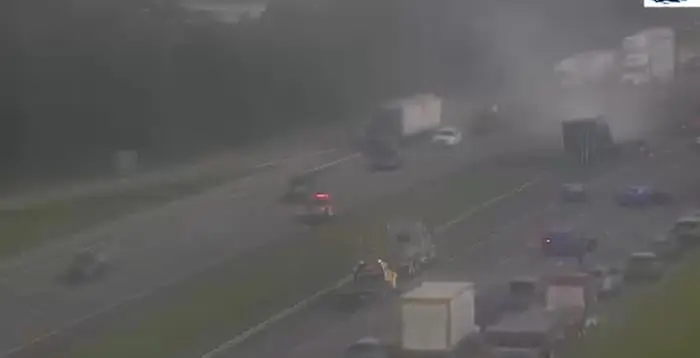

CAMDEN COUNTY, Ga. — A severe vehicular fire involving a commercial transport vehicle triggered catastrophic morning traffic delays on Interstate 95 in Camden County, Georgia, prompting emergency management officials to shut down all southbound lanes near the 7-mile marker. The incident, which occurred just south of the Harrietts Bluff Road interchange, sent plumes of dense black smoke billowing across the interstate corridor, severely compromising visibility and compelling an immediate, multi-agency emergency response.
As local, county, and state transportation authorities scrambled to contain the blaze and clear the wreckage, the artery connecting Florida and Georgia through the Southeast became a bottleneck, stranding thousands of motorists and commercial freight haulers for hours. The disruption highlights the ongoing vulnerabilities of heavily traveled freight corridors in the region and underscores the rapid response protocols required when hazardous incidents strike critical infrastructure.
Executive Overview
The crisis unfolded during peak morning transit hours just north of the Florida-Georgia state line. According to the Georgia Department of Transportation (GDOT) and local public safety logs, a vehicle—subsequently identified as a commercial heavy-duty truck—ignited along the southbound lanes of Interstate 95 near mile marker 7.
The exact catalyst of the fire remains under active investigation by state fire marshals and transportation safety boards, but the immediate impacts were absolute. GDOT operations centers confirmed a complete shutdown of all southbound lanes to accommodate fire suppression efforts, hazardous material assessments, and heavy-towing operations. Northbound traffic was also heavily restricted, with crews closing one of the two available lanes to establish a safety buffer for emergency responders and equipment staging.
Traffic cameras operated by GDOT captured thick, toxic-looking columns of smoke rising from the burning chassis, visible for miles across the flat coastal terrain of southeast Georgia. With commuter traffic and long-haul commercial transport deadlocked, regional emergency management agencies activated contingency protocols, issuing urgent travel advisories through social media, emergency broadcast networks, and digital highway messaging boards.
Drivers were strongly advised to bypass the region entirely, utilizing alternative routes such as U.S. Route 17 to navigate around the blockage. While initial reports indicated no immediate fatalities, the scale of the infrastructure disruption, combined with the potential environmental and economic fallout, positions this incident as one of the most significant traffic-halting events in Camden County for the early months of 2026.
Detailed Chronology of Events
Phase One: Detection and Initial Dispatch
At approximately 08:15 EST, the Camden County 911 dispatch center received multiple emergency calls reporting a heavy-duty vehicle engulfed in flames on the shoulder and extending into the active lanes of Interstate 95 South. Callers described explosive sounds—likely caused by exploding tires or pressurized vehicle components—and rapidly spreading fire that threatened to consume the entire cargo payload.
Camden County Fire and Rescue units, alongside Georgia State Patrol (GSP) troopers stationed in the area, were dispatched immediately. The first responding units arrived on the scene within minutes, reporting a fully involved commercial vehicle producing intense radiant heat and heavy smoke that severely impaired southbound visibility.
Phase Two: Tactical Containment and Lane Closures
Recognizing the immediate threat to public safety and the potential for secondary collisions, command staff on the scene ordered a total shutdown of the southbound corridor at mile marker 7. Traffic enforcement units rushed upstream to divert unsuspecting motorists off the interstate at the preceding exits, while fire suppression crews deployed foam and water tenders to combat the stubborn blaze.
Northbound traffic was simultaneously throttled. Recognizing that rubbernecking and smoke drift posed severe hazards to northbound motorists, GDOT and GSP restricted northbound transit to a single open lane, choking down traffic capacity by 50 percent in that direction as well.
Phase Three: Mitigation, Smoldering, and Wreckage Extraction
By mid-morning, firefighters succeeded in bringing the primary blaze under control, transitioning from aggressive suppression to cooling hot spots and mitigating potential fuel and fluid runoff. Because the incident involved a commercial vehicle, hazardous materials teams were called to inspect the roadway for spilled diesel fuel, motor oil, and potential cargo contaminants.
Heavy-duty recovery wreckers were subsequently deployed to upright and tow the burned-out shell of the vehicle. This phase required painstaking precision, as structural compromises to the vehicle and potential debris scatter across all lanes demanded a meticulous sweep of the asphalt before any thought could be given to reopening the roadway.
Supporting Context & Metrics
The Critical Role of the I-95 Corridor
Interstate 95 is the primary north-south artery along the United States Eastern Seaboard, serving as a vital economic lifeline that connects major metropolitan centers from Miami to Maine. The stretch of I-95 running through Camden County, Georgia—situated just north of the Florida border—carries an exceptionally high volume of long-haul commercial freight, tourism traffic, and local commuters.
According to historical data from the Federal Highway Administration (FHWA) and GDOT, this specific corridor handles tens of thousands of vehicles daily, a significant percentage of which are Class 7 and Class 8 commercial trucks. Any disruption to this vital link creates immediate ripple effects across the entire supply chain, delaying the delivery of time-sensitive goods, agricultural products, and retail inventory destined for distribution hubs throughout the Southeast.
Camden County Geographic Vulnerabilities
Camden County represents the southernmost tier of coastal Georgia, bordered by the Satilla River to the north, the St. Marys River and Florida to the south, and the Atlantic Ocean to the east. The geography of the region limits the number of parallel alternative routes. While U.S. Route 17 serves as the primary coastal alternative, its capacity is vastly inferior to the multi-lane divided interstate.
When a major incident closes I-95 in Camden County, secondary roads quickly become saturated beyond their design limits. Local infrastructure struggles to absorb diverted heavy-truck traffic, leading to localized gridlock in communities such as Kingsland, St. Marys, and Woodbine.
Economic and Logistical Impacts
The financial cost of a multi-hour shutdown on a major interstate is immense. Transportation economists note that commercial vehicle downtime can cost logistics firms upwards of $100 per hour per truck in lost productivity, driver wages, and fuel inefficiencies. When multiplied by hundreds of stalled commercial carriers, the economic toll of the Camden County fire climbs rapidly into the hundreds of thousands of dollars. Furthermore, the incident serves as a stark reminder of the fragility of modern just-in-time supply chains, where unexpected highway closures can disrupt manufacturing schedules and retail replenishment hundreds of miles away.
Official Statements and Agency Responses
Georgia Department of Transportation (GDOT)
In official statements released via digital media channels and press briefings, GDOT representatives emphasized the necessity of the complete lane closures. "Safety is our absolute priority," a GDOT spokesperson noted during the height of the incident. "When a commercial vehicle fire of this magnitude occurs, we must ensure that the structural integrity of the roadway is assessed, hazardous materials are neutralized, and emergency personnel have a secure workspace before we can safely restore traffic flow."
GDOT utilized its extensive network of overhead electronic message boards across southeast Georgia and northeast Florida to warn motorists miles in advance, urging them to delay travel or seek alternate routes through inland corridors.
Georgia State Patrol (GSP)
The Georgia State Patrol coordinated traffic diversion efforts and spearheaded the collision investigation. GSP officials commended motorists for largely adhering to emergency instructions, though they reiterated ongoing frustrations regarding distracted driving and rubbernecking near crash scenes.
"Our troopers work in extremely dangerous conditions when managing high-speed interstate incidents," a GSP representative stated. "We implore drivers to put down their phones, reduce their speed when approaching emergency zones, and strictly follow the directions of law enforcement personnel on the scene."
Local Emergency Services
Camden County Fire and Rescue commanders highlighted the complex nature of battling commercial vehicle fires, noting that modern transport vehicles often contain complex electronic systems, alternative fuel sources, or mixed cargo payloads that require specialized firefighting techniques. Fire personnel remained on the scene for hours following the knockdown to ensure that thermal flare-ups did not occur within the wreckage.
Future Outlook & Preventative Infrastructure Strategies
Infrastructure Resilience and Rapid-Clearance Protocols
Incidents like the Camden County vehicle fire reignite discussions among transportation planners regarding the resilience of coastal evacuation and freight corridors. State and federal agencies are increasingly investing in Intelligent Transportation Systems (ITS), including advanced traffic monitoring cameras, automated incident detection software, and dynamic message signing, to reduce response times and clear blockages more efficiently.
Moreover, Georgia’s State Road and Tollway Authority (SRTA) and GDOT continue to refine their Highway Emergency Response Operator (HERO) and equivalent regional programs, which are designed to arrive rapidly at accident scenes, establish secure perimeters, and expedite the removal of disabled or burning vehicles.
Recommendations for Commercial Fleet Operators and Commuters
In the wake of this disruptive event, transportation safety advocates are urging both commercial fleet operators and daily commuters to adopt proactive preparedness measures:
- Route Planning and Telematics: Logistics managers are encouraged to utilize real-time telematics and navigation software that dynamically routes trucks around unexpected closures before they become trapped in primary bottleneck zones.
- Vehicle Maintenance Standards: Commercial carriers must maintain rigorous preventative maintenance schedules, focusing heavily on brake systems, electrical wiring hubs, and wheel bearings—common ignition sources for commercial truck fires.
- Driver Education: Regular training for commercial drivers on emergency fire suppression, hazard signaling, and rapid evacuation protocols can mitigate the severity of roadside incidents before emergency responders arrive.
Conclusion
As recovery crews finalized the clearing of the wreckage and GDOT engineers completed their structural assessments of the asphalt at mile marker 7, traffic slowly began to normalize along the southbound corridor of Interstate 95 in Camden County. While the physical remnants of the fire were swept away, the incident leaves a lasting impression on the vital importance of robust emergency response networks, resilient infrastructure, and constant vigilance on America’s heavily burdened highway systems.

0 Comments