

Executive Overview
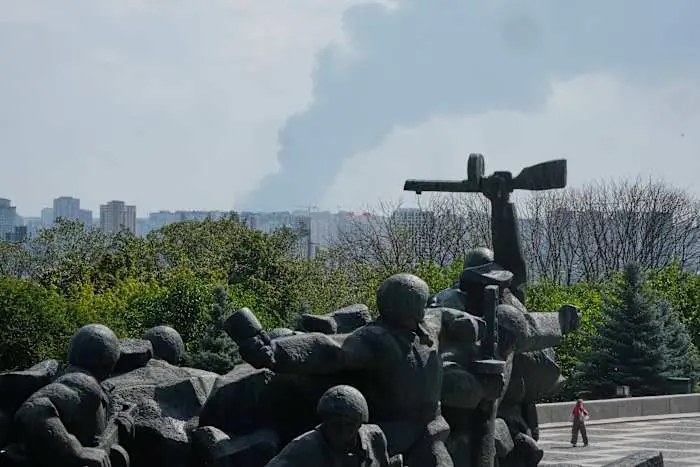
As the war enters a perilous fifth year, the conflict between Russia and Ukraine has escalated into a brutal war of attrition characterized by relentless mutual destruction. A massive coordinated onslaught of Russian missiles and explosive drones struck cities and critical infrastructure across nine Ukrainian regions late Wednesday and into Thursday, August 27, 2026. The devastating series of attacks sent residents scrambling into underground metro stations for shelter, ignited massive fires in urban centers, and left infrastructure severely damaged.
The latest bombardment underscores a deliberate Russian strategy: systematically exhausting Ukraine’s depleted air defense stockpiles through overwhelming numerical superiority, while simultaneously targeting industrial hubs, energy grids, and grain export facilities. In response, Ukraine has ramped up its asymmetric counter-offensive, unleashing hundreds of long-range drones deep inside Russian territory to target economic infrastructure, including major e-commerce logistics centers.
The escalating cross-border violence has amplified anxieties far beyond the immediate front lines. During the height of the bombardment, neighboring Moldova reported multiple drone airspace violations, highlighting the growing regional spillover risks. Ukrainian President Volodymyr Zelenskyy has issued urgent appeals to Western allies, stressing that while recent European pledges of assistance are welcome, the critical shortage of U.S.-made Patriot ballistic missile interceptors leaves civilian populations dangerously exposed to Moscow’s increasingly sophisticated aerial arsenal.
Detailed Chronology of the Assault
The latest wave of aerial violence began shortly after nightfall on Wednesday, quickly snowballing into a multi-directional onslaught that continued well into daylight hours on Thursday.
The Night-Time Campaign and Air Raid Sirens in Kyiv
As air raid sirens wailed across the Ukrainian capital, residents of Kyiv sought refuge in subterranean metro stations such as Palats Sportu and Maidan, enduring hours of uncertainty. According to Kyiv city police, four distinct districts of the capital were struck during the overnight hours. The explosions caused significant structural damage to residential apartment blocks, a local school building, and a medical facility. Miraculously, initial reports indicated no fatalities within the city limits, though the psychological toll on civilians sheltering below ground remained profound.
Regional Devastation: Poltava, Zaporizhzhia, and Odesa
While the capital bore the brunt of the political shockwaves, regional industrial and agricultural centers absorbed the physical devastation of the strikes:
- Poltava Region: Vitalii Diakivnych, head of the Poltava regional military administration, reported direct hits on critical industrial facilities and localized energy infrastructure, further straining the region’s power grid.
- Zaporizhzhia Region: Tragically, civilian casualties could not be avoided entirely. Ukrainian officials confirmed that a 78-year-old woman was killed during the barrage in the southern region, with at least nine other individuals sustaining varying degrees of injuries across the targeted zones.
- Odesa Region: The southern port hub faced what regional military administration head Oleh Kiper described as a "massive" assault lasting more than seven hours. The prolonged bombardment heavily damaged a 16-story residential building, two educational facilities, and a critical grain elevator. Because Odesa remains an indispensable lifeline for Ukraine’s agricultural exports to global markets, the targeting of grain storage facilities signaled a continued effort by Moscow to cripple the Ukrainian economy.
Spillover into Moldova
The kinetic fallout of the overnight air raids extended beyond Ukraine’s borders. Moldova’s Ministry of Defense officially reported that five unidentified drones breached Moldovan airspace overnight. The incursions coincided with President Zelenskyy’s scheduled official visit to the neighboring nation to mark its national day, commemorating its 1991 declaration of independence from the Soviet Union—a historical milestone shared with Ukraine. The airspace violations injected immediate jitters into Eastern European capitals already on edge over the possibility of the war widening.
Ukraine’s Retaliatory Drone Campaign
While Ukrainian air defenses—bolstered by electronic suppression and interceptor units—managed to neutralize or intercept seven Russian ballistic missiles and numerous drones, Kyiv continued its reciprocal strategy of striking deep within Russia.
The Russian Ministry of Defense claimed its air defense networks successfully intercepted 267 Ukrainian drones across 14 separate Russian regions, the illegally annexed Crimean Peninsula, the Sea of Azov, and the Black Sea. Following a series of high-profile operations that targeted and heavily damaged massive distribution warehouses belonging to Wildberries—Russia’s largest online retailer—Ukrainian long-range drones expanded their economic target set to Ozon, Russia’s second-largest e-commerce giant. Ozon representatives confirmed that logistics facilities located in the cities of Orenburg and Ufa were targeted during the wave of drone attacks, though company officials noted that the premises avoided catastrophic fires.
Supporting Context & Metrics
To fully understand the current trajectory of the 2026 conflict, one must examine the metrics of attrition and the technological evolution shaping the battlefield.
The Missile and Drone Exhaustion Strategy
Military analysts note that Moscow has adapted its procurement and deployment schedules, steadily accumulating missile stocks to orchestrate high-intensity, concentrated attacks every few days. By combining slow-moving, jet-powered loitering munitions with high-speed ballistic and cruise missiles, Russia forces Ukrainian air defense commanders into an impossible calculus: expending scarce, high-cost interceptors on low-value drones, or risking catastrophic impacts on vital infrastructure.
+--------------------------------------------------------------------------+
|                     THE CYCLE OF MUTUAL ATTRITION                        |
+------------------------------------+-------------------------------------+
|          RUSSIA'S STRATEGY         |          UKRAINE'S STRATEGY         |
+------------------------------------+-------------------------------------+
| • Stockpile ballistic & cruise     | • Deploy asymmetric long-range      |
|   missiles for periodic heavy      |   drones nightly across Russian     |
|   barrages.                        |   territory.                        |
| • Overwhelm air defense density    | • Target domestic e-commerce        |
|   using mixed swarms (drones +     |   logistics (Wildberries, Ozon) to  |
|   missiles).                       |   disrupt the Russian war economy.  |
| • Target logistics, energy grids,  | • Intercept incoming threats via    |
|   and grain export terminals.      |   limited Western air defenses.     |
+------------------------------------+-------------------------------------+
The Air Defense Deficit
Ukraine’s most acute vulnerability remains its critically low inventory of U.S.-manufactured Patriot air defense missile systems and associated interceptors. Developed to counter sophisticated ballistic and supersonic threats, Patriots are the gold standard for intercepting incoming Russian ballistic missiles. However, supply chain constraints, political delays, and immense global demand have left Kyiv rationing its remaining stock.
Without a predictable, expanded pipeline of advanced air defense packages, major urban centers like Kyiv, Odesa, and Kharkiv remain highly susceptible to heavy civilian and structural losses, regardless of the bravery and skill of Ukrainian air defense crews.
Official Statements and Diplomatic Reactions
The human and physical toll of the August 27 strikes drew immediate condemnation and urgent political appeals from the highest levels of Ukrainian leadership.
Taking to social media platform X (formerly Twitter), Ukrainian President Volodymyr Zelenskyy did not mince words regarding the urgency of the situation:
"Russia continues to invest in missiles and in expanding its war, and that means more countermeasures are needed."
Zelenskyy acknowledged positive diplomatic overtures made earlier in the week by various European partners, who pledged to step up their military and logistical backing. However, he emphasized that these commitments must translate into concrete capabilities immediately:
"It is important that these [measures] are also supplemented by additional ballistic missile defense packages through European purchases of weapons from the United States."
On the Russian side, the Ministry of Defense framed the overnight blitz not as an assault on civilians, but as a precision operation aimed squarely at degrading Ukraine’s war-fighting capacity. In an official briefing, military spokespersons asserted that the "massive" multi-region strike successfully achieved its objectives by hitting military-related industrial enterprises, oil refineries, logistics hubs, and strategic port infrastructure. Independent observers, however, point to the extensive damage inflicted on residential apartment complexes, educational facilities, and civilian medical buildings as evidence of widespread collateral devastation characteristic of indiscriminate saturation bombing.
Future Outlook and Strategic Implications
As the conflict grinds through its fifth year, the events of late August 27, 2026, illustrate a grim stalemate defined by technological adaptation and mutual economic warfare.
- The Air Defense Dilemma: The coming months will likely hinge on whether Western nations can accelerate the procurement and delivery of advanced missile defense systems to Ukraine. If the deficit of Patriot interceptors persists, Ukraine will face increasingly difficult choices regarding which population centers and critical nodes to protect, leaving vast swaths of the country vulnerable to Russian aerial supremacy.
- Expansion of the Asymmetric Economic War: Kyiv’s pivot toward targeting critical domestic Russian supply chains—such as the logistics networks of e-commerce giants Ozon and Wildberries—signals an intent to bring the economic discomfort of the war home to the Russian populace. This tit-for-tat dynamic ensures that non-military, commercial infrastructure in both nations will remain prime targets.
- Regional Spillover Risks: The unauthorized entry of drones into Moldovan airspace serves as a sobering reminder that the war cannot be indefinitely contained within current front lines. As long as large-scale aerial engagements occur near Western borders, neighboring states face heightened risks of stray munitions, miscalculations, and wider regional destabilization.
Ultimately, until a credible diplomatic framework emerges to halt hostilities, the populations of Ukraine and the borderlands of Eastern Europe will continue to bear the brunt of a high-tech war of attrition with no immediate end in sight.

0 Comments