

Executive Overview
In the late-night hours of Sunday, September 27, a high-stakes law enforcement intervention unfolded in the rapidly growing suburban corridors of St. Johns County, Florida. What began as a routine patrol observation quickly escalated into a high-speed vehicle pursuit, culminating in a tactical collision, property damage, and the arrest of two 16-year-old juveniles. The incident has once again trained a spotlight on the persistent challenges of cross-jurisdictional property crime, juvenile delinquency, and the tactical measures employed by local law enforcement to mitigate threats to public safety.
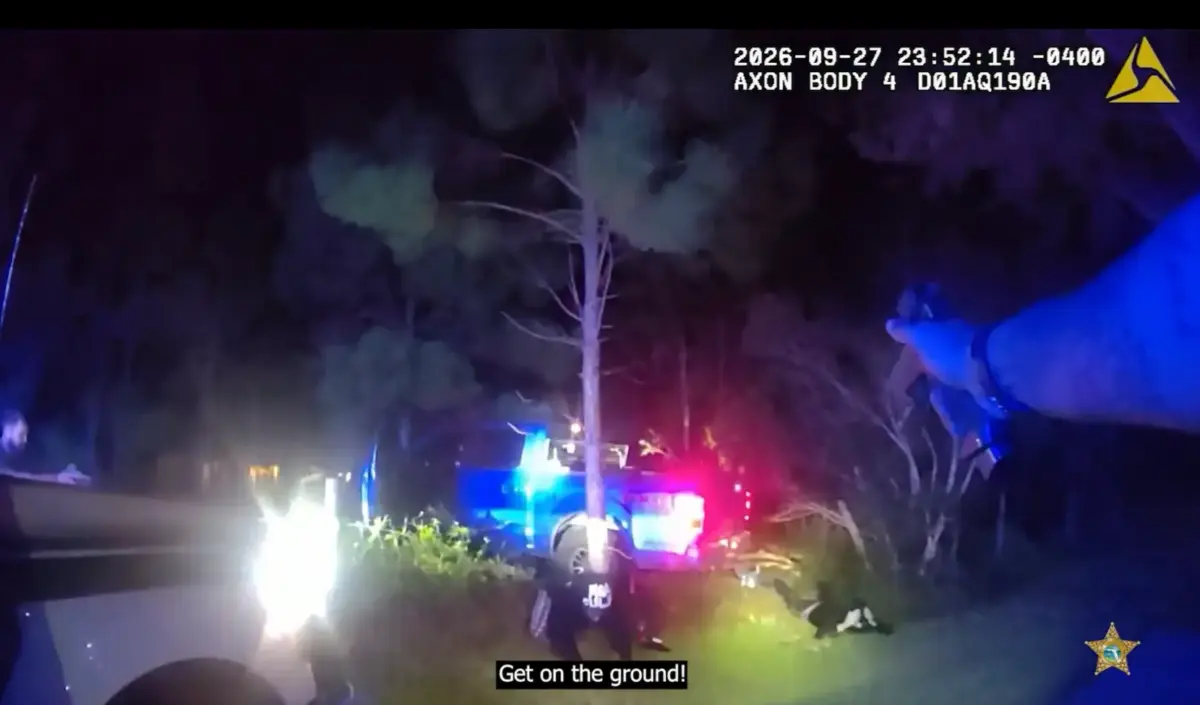
According to official reports from the St. Johns County Sheriff’s Office (SJCSO), deputies identified a blue Ford pickup truck that had been previously reported stolen from neighboring Jacksonville (Duval County). When deputies attempted to initiate a traffic stop near International Golf Parkway, the driver of the stolen vehicle chose to flee, initiating a reckless pursuit through local roadways. The chase reached a critical juncture when the fleeing truck struck a parked vehicle, prompting pursuing deputies to execute a Precision Immobilization Technique (PIT) maneuver to forcibly terminate the pursuit.
Following the successful disablement of the vehicle, both teenage occupants were taken into custody without further incident. A subsequent inventory search of the stolen truck revealed a cache of suspected stolen property, linking the suspects to an ongoing string of regional burglaries. The driver, operating the vehicle without a license, faces a litany of severe felony charges, while the passenger faces charges related to trespassing in a conveyance. This incident underscores a growing regional trend of juvenile offenders utilizing stolen vehicles as mobile platforms to conduct multi-jurisdictional property crimes.
Detailed Chronology of the Midnight Pursuit
The quiet of a Sunday evening in St. Johns County was abruptly shattered just before midnight on September 27. The chronological progression of the incident reveals a rapid escalation from a felony vehicle detection to a high-speed tactical intervention.
[11:50 PM] Deputies spot stolen blue Ford truck near International Golf Parkway.
     │
     ▼
[11:52 PM] Attempted traffic stop initiated; suspect driver accelerates and flees.
     │
     ▼
[11:55 PM] Suspect vehicle strikes a parked car during a reckless escape attempt.
     │
     ▼
[11:57 PM] SJCSO deputies execute a PIT maneuver, disabling the stolen truck.
     │
     ▼
[Midnight] Both 16-year-old suspects apprehended; burglary loot recovered inside vehicle.
The Initial Contact near International Golf Parkway
At approximately 11:50 p.m., an alert SJCSO patrol deputy observed a blue Ford pickup truck traveling in the vicinity of International Golf Parkway—a major arterial road serving residential communities, commercial hubs, and golf courses near the World Golf Village. A rapid database query of the vehicle’s license plate revealed that the truck had been flagged as active stolen property out of the Jacksonville area.
Positioning their patrol units to conduct a felony traffic stop, deputies activated their emergency lights and sirens. Rather than complying with the law enforcement commands, the 16-year-old driver depressed the accelerator, driving the heavy pickup truck away at high speed and demonstrating a complete disregard for traffic laws and public safety.
Escalation, Collision, and the PIT Maneuver
As the stolen truck fled, it navigated local roads with extreme recklessness. In its bid to evade capture, the vehicle veered off its course and struck an unoccupied, parked vehicle. Despite the impact and the resulting damage, the driver refused to halt, continuing to flee from the pursuing deputies.
Recognizing that the driver’s erratic behavior posed an immediate and escalating threat to the public, pursuing deputies made the tactical decision to terminate the chase. Utilizing a standard law enforcement intervention method, a deputy positioned their patrol vehicle to execute a Precision Immobilization Technique (PIT). By applying targeted force to the rear quarter panel of the fleeing truck, the deputy induced a controlled spin, effectively neutralizing the truck’s forward momentum and bringing it to a safe stop.
Apprehension and Investigation
With the vehicle disabled, deputies conducted a high-risk felony stop, ordering the occupants out of the truck. Both the 16-year-old driver and the 16-year-old passenger were secured in handcuffs without further physical resistance.
Upon securing the scene, deputies conducted an inventory search of the recovered Ford truck. Inside the cab and bed of the vehicle, investigators discovered numerous items—including electronics, personal documents, and tools—that did not belong to the suspects. Investigators quickly determined that these items matched the descriptions of property reported stolen in a recent string of residential and vehicular burglaries spanning the region.
Supporting Context, Crime Metrics, and Tactical Analysis
To fully comprehend the significance of this arrest, it is essential to examine the broader socioeconomic and tactical patterns that define contemporary law enforcement in Northeast Florida.
The Duval-St. Johns Property Crime Corridor
St. Johns County consistently ranks as one of the wealthiest and fastest-growing counties in the state of Florida. This rapid suburban development, characterized by affluent master-planned communities, has increasingly made the county a lucrative target for property crimes. Conversely, Duval County, with its larger urban population and higher baseline crime rates, frequently acts as a point of origin for stolen vehicles.
Criminal justice data indicates a persistent "crime migration" pattern along the Interstate 95 and US-1 corridors. Crews of juvenile offenders frequently steal vehicles in Jacksonville and travel south into St. Johns County to conduct "car-hopping" operations—systematically checking car door handles in quiet suburban neighborhoods to steal firearms, electronics, and cash. The stolen vehicles themselves are often viewed by these crews as disposable assets, used for transportation during crime sprees and abandoned once they run out of fuel or attract law enforcement attention.
| Metric / Detail | Statistical & Operational Context |
|---|---|
| Primary Vehicle Involved | Blue Ford Pickup Truck (Stolen out of Jacksonville, Duval County) |
| Suspect Demographics | Two males, both aged 16 (Juvenile status under Florida Law) |
| Primary Tactical Intervention | Precision Immobilization Technique (PIT) |
| Associated Crimes | Multi-jurisdictional residential and vehicle burglaries |
| Geographic Focus | International Golf Parkway / World Golf Village corridor |
The Physics and Policy of the PIT Maneuver
The execution of a PIT maneuver is a highly regulated tactical decision. Under SJCSO policy, deputies must weigh the immediate danger posed by the fleeing suspect against the inherent risks of executing a forced vehicle rotation.
The PIT maneuver is designed to be executed at controlled speeds, typically under 50 miles per hour, though exceptional circumstances can dictate otherwise. By making contact with the rear bumper area of the fleeing vehicle, the patrol car temporarily breaks the traction of the fleeing vehicle’s rear tires. This causes the vehicle to spin 180 degrees, stalling the engine and leaving the vehicle immobilized.
In this specific incident, the suspect driver had already proven a willingness to damage property by striking a parked car. This collision served as a critical indicator to command staff and pursuing deputies that the driver was operating with a heightened level of desperation, justifying the use of force to terminate the pursuit before innocent motorists or pedestrians could be injured.
Official Statements and Legal Analysis
Following the arrests, the legal machinery of the Seventh Judicial Circuit of Florida was initiated to address the serious felony charges leveled against the two juveniles.
Detailed Breakdown of Charges
The charges filed against the two teenagers reflect the varying degrees of active participation in the night’s criminal activities:
The Driver (16-Year-Old Male):
- Grand Theft of a Motor Vehicle (Florida Statute § 812.014): A third-degree felony, carrying penalties of up to five years in prison if prosecuted as an adult. This charge stems from the unauthorized possession and operation of the stolen Ford truck.
- Aggravated Fleeing with Injury or Damage (Florida Statute § 316.1935(4)): A highly serious second-degree felony. Under Florida law, fleeing from a law enforcement officer with lights and sirens activated, and subsequently causing property damage or injury, elevates the charge to an aggravated status, carrying mandatory minimum sentencing guidelines.
- Leaving the Scene of a Crash Involving Damage to Property (Florida Statute § 316.061): A second-degree misdemeanor, applied due to the driver striking a parked vehicle and continuing to flee.
- Operating a Motor Vehicle Without a Valid License (Florida Statute § 322.03): A misdemeanor reflecting the juvenile’s lack of legal driving credentials.
The Passenger (16-Year-Old Male):
- Trespassing in a Structure or Conveyance (Florida Statute § 810.08): Typically classified as a misdemeanor, this charge indicates that while the passenger may not have actively operated or stolen the vehicle, they knowingly entered or remained in a stolen conveyance without the owner’s consent.
Law Enforcement Philosophy on Juvenile Accountability
The St. Johns County Sheriff’s Office has consistently maintained a firm stance on property crime and fleeing suspects. In public briefings, Sheriff Rob Hardwick has repeatedly emphasized that youth does not exempt individuals from the consequences of actions that threaten public safety.
An SJCSO spokesperson reiterated this sentiment following the Sunday night arrests:
"Our deputies are trained to make split-second decisions to protect this community. When individuals—regardless of their age—choose to flee in stolen vehicles and endanger our citizens, we will use every tactical resource at our disposal to stop them. We will continue to work closely with our partners in Jacksonville to track down those who cross county lines to commit crimes."
Future Outlook and Preventative Community Frameworks
As the legal proceedings against the two minors move forward through the Florida Department of Juvenile Justice (DJJ) and the State Attorney’s Office, local leaders are focusing on long-term preventative strategies to curb the rise of juvenile property crimes.
Judicial Pathways: Juvenile vs. Adult Prosecution
A critical decision now rests with the State Attorney’s Office regarding whether to "direct file" the 16-year-old driver to adult court. Under Florida law, prosecutors have the discretion to try 16- and 17-year-olds as adults for certain violent or high-risk felonies. Given the severity of the charge of Aggravated Fleeing with Damage, combined with the recovered burglary evidence, prosecutors will carefully examine the driver’s prior criminal record to determine if the juvenile rehabilitation system is sufficient or if adult punitive measures are warranted.
For the passenger, the path likely involves juvenile probation, diversion programs, or community service, provided they do not have a significant history of prior offenses.
Hardening the Target: The "9 PM Routine"
In response to the persistent threat of vehicle thefts and associated burglaries, the SJCSO continues to aggressively promote community-wide crime prevention initiatives, most notably the "9 PM Routine." This public awareness campaign encourages residents to perform a nightly security sweep of their properties, ensuring that:
- All vehicle doors are locked.
- Key fobs and physical keys are removed from vehicles and brought inside the home.
- Valuables, especially firearms and electronics, are removed from vehicles.
- Exterior residential lights, security cameras, and garage doors are activated and secured.
Analysis of regional auto thefts reveals that a vast majority of stolen vehicles, including those used by juvenile crews, were left unlocked with the key fobs inside. By denying easy access to transportation, law enforcement officials believe they can drastically disrupt the operational capacity of regional burglary rings.
The swift resolution of the September 27 pursuit serves as a stark reminder of the volatile nature of suburban property crime. Through a combination of alert patrolling, decisive tactical execution, and robust community engagement, the St. Johns County Sheriff’s Office continues to send a clear message: those who bring crime into the county will face swift and uncompromising justice.

0 Comments