
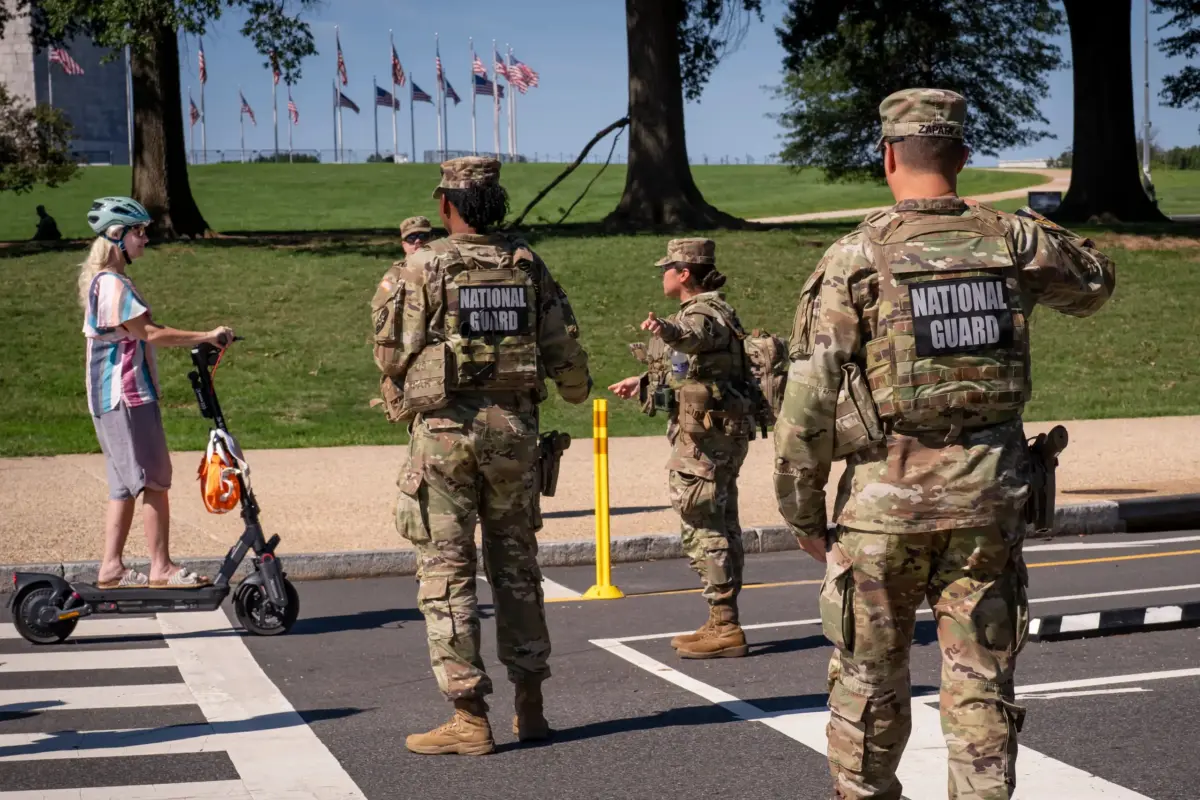

WASHINGTON — The controversial federal deployment of National Guard troops to the nation’s capital has faced a fresh wave of public scrutiny and political friction following the arrest of an Oklahoma National Guard specialist for carrying an unauthorized firearm. The incident marks the second time within a two-month window that a member of the high-profile federalized task force has faced criminal charges while stationed in Washington, D.C.
The ongoing mission, initiated under an emergency order by President Donald Trump in August 2025 to combat what the administration framed as lawlessness and rising crime, has continuously polarized lawmakers, local officials, and civil liberties advocates. Critics argue that the persistent domestic military footprint normalizes the militarization of an American municipality, while supporters defend the presence as a necessary measure to restore public order and assist overstretched law enforcement infrastructure.
Executive Overview
The latest legal fallout involves Spec. Jakob Noonan, a 22-year-old service member assigned to the Oklahoma National Guard contingent operating in the District of Columbia. Noonan was taken into custody by the U.S. Park Police following a routine traffic stop for an expired vehicle registration tag. According to law enforcement and court documents, Noonan was off-duty, traveling in his personal vehicle out of uniform, when officers discovered a firearm inside the vehicle without a valid D.C. concealed-carry permit.
This arrest compounds existing tensions surrounding the federal mission, arriving closely on the heels of an August incident involving a Georgia National Guard member who allegedly brandished a firearm against a fellow service member during an internal dispute. Together, these events have fueled a mounting debate regarding the oversight, training, conduct, and legal accountability of out-of-state troops operating under federalized authority within local jurisdictions.
Despite pushback from municipal leaders who question the necessity, cost, and legality of the extended operation—which is currently authorized to continue through January 2029—federal authorities have maintained the necessity of the deployment. However, these recurring disciplinary and legal infractions present significant public relations and command-and-control challenges for the Joint Task Force overseeing the thousands of troops stationed in the capital.
Detailed Chronology of the Arrest
According to detailed charging documents and official statements filed by the U.S. Park Police, the sequence of events leading to Spec. Noonan’s arrest unfolded during a routine traffic enforcement stop.
The Traffic Stop
On a Monday evening, officers with the U.S. Park Police pulled over a Honda SUV traveling through the District. The primary reason for the stop, as noted in police logs, was an expired temporary tag displayed on the rear of the vehicle.
At the time of the stop, Noonan was operating the vehicle, accompanied by a fellow National Guard member who was riding as a passenger. Both soldiers were off duty, dressed in civilian attire, and utilizing a personal vehicle rather than a military transport or official government vehicle.
Discovery of the Firearm
As officers approached the vehicle to interact with the driver, they observed an empty firearm holster resting in the rear passenger area. Capitalizing on this observation, the primary officer inquired whether there was a weapon located anywhere inside the vehicle.
Noonan immediately confirmed the presence of a firearm, volunteering information regarding its location. Several backup officers arrived shortly thereafter, and a subsequent inspection revealed a semi-automatic pistol.
Interrogation and Confession
During questioning at the scene, Noonan explained his presence in the capital, noting that he was temporarily residing in the District of Columbia as part of the active National Guard mission. Seeking to justify the presence of the weapon, Noonan informed officers that he hailed from Oklahoma—a jurisdiction recognized for its permissive open-carry laws—and asserted that the firearm was legally registered to him in his home state.
However, when pressed regarding local legal requirements, Noonan acknowledged that he did not possess a valid District of Columbia concealed-carry license or a reciprocal permit recognized by the capital’s strict gun control statutes. A subsequent records check confirmed that Noonan lacked any legal authorization to carry a concealed pistol within the boundaries of the federal district.
Charges and Legal Proceedings
Following the roadside interview, Noonan was placed under arrest and formally charged with carrying a pistol without a license (CPWL), a misdemeanor offense under D.C. law that carries potential jail time and fines.
Noonan made his initial appearance before a judge in the D.C. Superior Court on September 29. Legal representation for the soldier has proven difficult to immediately coordinate through public channels; attempts by media and investigators to reach his court-appointed attorney via the main office of the D.C. Superior Court public defender were met with unanswered phone calls and unreturned emails.
Supporting Context & Metrics: The Scale of the D.C. Mission
To fully understand the implications of Noonan’s arrest, it is essential to examine the broader scope, history, and operational parameters of the National Guard deployment in Washington, D.C.
Origins of the Deployment
The domestic deployment began in earnest in August 2025, when President Trump invoked executive authority to issue a sweeping emergency order. The administration cited spiraling crime rates, property offenses, and visible urban encampments as primary justifications for federal intervention, overriding traditional protocols that leave local policing in the hands of the Metropolitan Police Department (MPD) and municipal authorities.
Force Fluctuations
At its peak over the summer of 2025—coinciding with high-profile national celebrations surrounding America’s 250th anniversary—the capital played host to more than 5,000 active National Guard troops hailing from various states across the country. These forces were integrated into various strategic locations across the city, providing logistical, administrative, and tactical reinforcement to federal law enforcement entities such as the U.S. Park Police and the U.S. Capitol Police.
As peak commemorative events concluded, force levels were scaled down to a steady-state contingent of approximately 3,000 troops. These service members continue to rotate in and out of the capital on multi-month deployment cycles managed by a centralized Joint Task Force.
Scope of Duties
While the deployment was framed largely around crime reduction and supporting law enforcement arrest operations, the day-to-day responsibilities of the deployed Guard members have varied significantly. Beyond active patrols and supportive checkpoint security alongside civilian police, troops have frequently been assigned to civic beautification initiatives, urban revitalization projects, and seasonal infrastructure support, such as winter snow removal operations.
Despite these auxiliary community contributions, critics maintain that the presence of armed military personnel in uniform on street corners and intersections creates an atmosphere of unease and infringes upon local autonomy.
A Pattern of Misconduct?
Spec. Noonan’s arrest is not an isolated disciplinary incident within the ranks of the deployed task force. Just one month prior, in August, the deployment suffered another public relations and legal blow when Georgia National Guard member Zion Mitchell was arrested. Mitchell was subsequently charged with aggravated assault and weapons offenses after allegedly drawing a firearm on a fellow Guard member during a heated argument that reportedly stemmed from a dispute over military hair regulations.
Legal analysts and military law experts point out that while National Guard members are subject to both the Uniform Code of Military Justice (UCMJ) when activated under certain federal titles and local civilian laws when operating off-base, incidents involving firearms violations in strict jurisdictions like Washington, D.C., pose unique jurisdictional and disciplinary complexities.
Official Statements and Institutional Silence
The response from official bodies following Noonan’s arrest has highlighted the sensitivity of utilizing military personnel for domestic policing duties.
Law Enforcement Statements
The U.S. Park Police issued a formal, measured statement via email outlining the mechanics of the traffic stop. The agency clarified the sequence of events, emphasizing that the vehicle was stopped solely for a standard equipment and registration infraction—an expired tag—before the discovery of the empty holster and subsequent confession escalated the encounter into a criminal weapons investigation.
Military and Task Force Response
Conversely, the Joint Task Force exercising operational command and control over the deployed National Guard units maintained a notable silence immediately following the arrest. Requests for comment sent by media outlets to military public affairs officers went unanswered during the initial news cycle, leaving questions regarding potential internal administrative actions, reprimands, or repatriations of the accused soldier pending.
Oklahoma National Guard leadership has similarly faced pressure to address whether the soldier’s actions violated state-level military codes of conduct, though no formal statements had been released by state adjutant general representatives as of late September.
Future Outlook: Political Fallout and Extended Mandates
The legal troubles facing individual service members arrive against the backdrop of a prolonged and institutionalized federal presence in the nation’s capital.
The Longevity of the Mission
Despite continuous legal challenges from local D.C. leaders, city council members, and civil rights organizations who view the deployment as an overreach of federal executive power and an unnecessary financial drain on federal resources, the Trump administration has institutionalized the operation. Current planning documents and executive directives confirm that the National Guard deployment has been officially extended through January 2029, cementing the military footprint in Washington for the foreseeable future.
Implications for Local Governance
Local officials argue that occurrences like Noonan’s arrest validate their ongoing concerns regarding the integration of out-of-state military personnel into civilian environments. Critics contend that service members accustomed to the more lenient gun laws of states like Oklahoma or Georgia may struggle to adapt to the rigorous, highly restrictive firearm regulations enforced within the District of Columbia, elevating the risk of accidental legal infractions or more severe confrontations.
Conclusion
As Spec. Noonan prepares to navigate the D.C. Superior Court system, the broader implications of his arrest extend far beyond a single misdemeanor charge. The incident serves as a focal point for an ongoing national debate regarding federalism, civil-military relations, and the practical consequences of deploying thousands of armed, out-of-state troops to police the streets of the American capital. With the mission authorized to remain active for years to come, federal and military leadership will face mounting pressure to tighten disciplinary oversight and ensure that all deployed personnel strictly adhere to local and federal statutes.

0 Comments