

Executive Overview
As late summer transitions into the fervor of autumn sports, Gainesville, Florida, prepares to host one of its most significant annual rituals: the kickoff of the University of Florida (UF) Gator football season. On Saturday, tens of thousands of alumni, students, and sports enthusiasts will converge on Ben Hill Griffin Stadium—affectionately known to college football fans worldwide as "The Swamp." While the excitement surrounding the 7:45 p.m. kickoff is palpable, the sudden influx of nearly 90,000 visitors presents a monumental logistical challenge for municipal planners, university administrators, and law enforcement agencies.
To ensure public safety, facilitate orderly pedestrian movement, and mitigate gridlock, the University of Florida Police Department (UFPD), in coordination with the Gainesville Police Department (GPD) and the Florida Department of Transportation (FDOT), has engineered a comprehensive, phased traffic management plan. This plan involves strategic, time-staggered road closures, vehicle rerouting, and designated pedestrian-only zones surrounding the stadium and the adjacent Midtown commercial district.
With the first phase of closures scheduled to begin five hours prior to kickoff, city and university officials are urging residents, commuters, and game-day attendees to familiarize themselves with the altered traffic patterns. This investigative report provides an in-depth analysis of the scheduled closures, the logistical considerations driving these decisions, the economic and safety context of game days in Gainesville, and the long-term outlook for transit infrastructure in the university corridor.
Detailed Chronology: The Game Day Countdown
Managing the flow of tens of thousands of vehicles and pedestrians in a concentrated urban campus environment requires a highly structured, chronological approach. Rather than implementing a blanket shutdown of the campus, authorities utilize a phased closure strategy designed to minimize disruption to early-morning travelers while establishing a secure perimeter as pedestrian density peaks.
GAME DAY CLOSURE TIMELINE (Kickoff: 7:45 PM)
========================================================================
2:45 PM (T-Minus 5 Hours)   | Inner Perimeter Closures Begin
                            | - Smaller roads adjacent to Ben Hill Griffin Stadium
                            | - Authorized game-day staff & permit holders only
------------------------------------------------------------------------
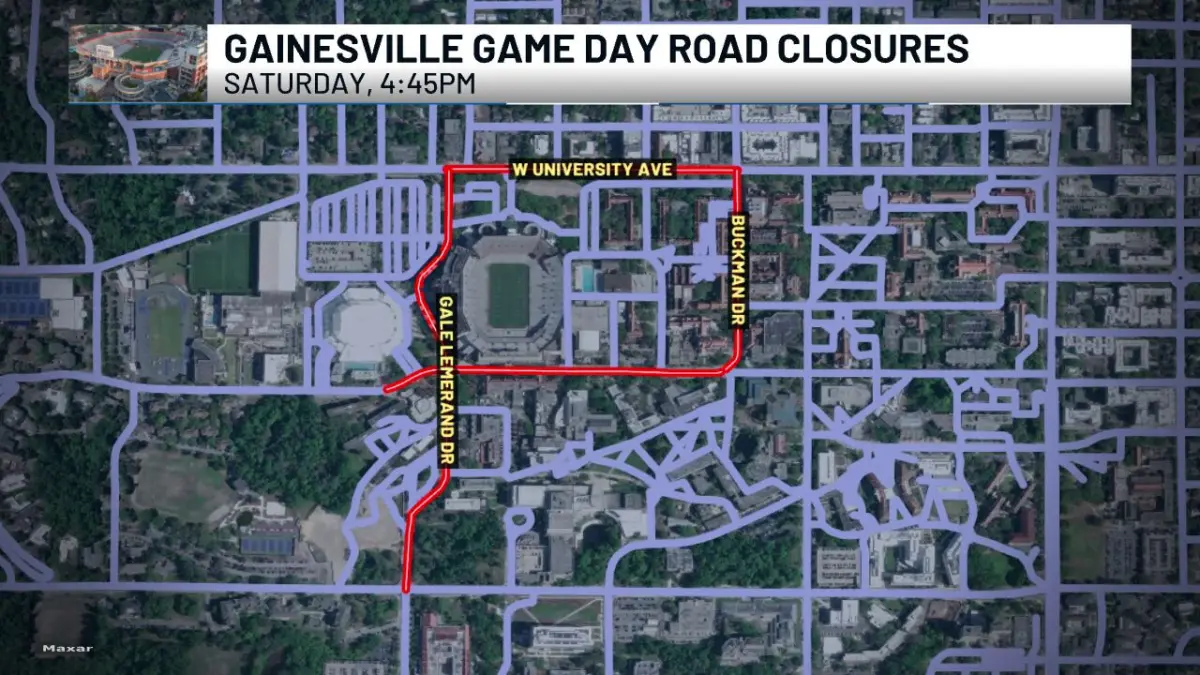
4:45 PM (T-Minus 3 Hours)   | Major Arterial Shutdown
                            | - University Avenue closed (Gale Lemerand Dr to Buckman Dr)
                            | - Pedestrian priority zone established
------------------------------------------------------------------------
7:45 PM                     | KICKOFF
------------------------------------------------------------------------
~11:00 PM (Post-Game)       | Egress Phase
                            | - One-way traffic flow patterns enforced
                            | - Priority given to outbound shuttles and emergency vehicles
========================================================================
Phase I: T-Minus Five Hours (2:45 p.m.) — The Inner Perimeter
The initial phase of traffic restrictions commences precisely five hours before the scheduled 7:45 p.m. kickoff, at approximately 2:45 p.m. During this window, smaller campus roadways directly adjacent to Ben Hill Griffin Stadium are closed to general vehicular traffic.
These early closures primarily affect:
- Stadium Road: Access is restricted to emergency vehicles, authorized game-day personnel, and specific media transport units.
- Gale Lemerand Drive (Immediate Stadium Segments): Portions of this critical north-south campus artery are restricted to secure the immediate perimeter of the stadium, allowing security personnel to establish safety checkpoints and permit-only parking zones.
By securing these smaller arterial roads early in the afternoon, authorities can safely facilitate the setup of broadcasting equipment, accommodate official team buses, and protect early-arriving tailgaters who congregate on the lawns and plazas surrounding the stadium.
Phase II: T-Minus Three Hours (4:45 p.m.) — The Arterial Shutdown
The most disruptive and critical phase of the traffic management plan occurs three hours prior to kickoff, at 4:45 p.m. At this juncture, authorities will implement a total closure of West University Avenue (State Road 26), spanning from Gale Lemerand Drive eastward to Buckman Drive (Northwest 17th Street).
University Avenue serves as the primary dividing line between the northern edge of the UF campus and the vibrant Midtown district, which features a high concentration of restaurants, bars, and student housing. As game time approaches, this corridor experiences extreme pedestrian density as fans migrate between off-campus venues and the stadium gates.
By completely halting vehicular traffic on this stretch of University Avenue, planners eliminate the risk of vehicle-pedestrian conflicts in an area where thousands of fans cross the street simultaneously. Eastbound and westbound transit through this corridor will be detoured onto alternative routes, such as Southwest 2nd Avenue, Southwest 16th Avenue, or West Newberry Road.
Phase III: Post-Game Egress and Dispersal
Following the conclusion of the game—typically around 11:00 p.m.—the logistical focus shifts from containment to evacuation. In the post-game phase, local law enforcement agencies enforce dynamic traffic patterns designed to funnel vehicles away from the campus core as rapidly as possible.
- One-Way Routing: Several major thoroughfares, including portions of University Avenue and Archer Road, may be temporarily converted to one-way streets to maximize outbound capacity.
- Traffic Signal Override: Traffic engineering teams manually override or adjust the timing of traffic signals along major evacuation corridors (such as Interstate 75 interchanges, 34th Street, and 13th Street) to prioritize outbound green lights.
- Emergency Corridor Maintenance: Dedicated lanes are preserved throughout the egress phase to ensure that emergency medical services (EMS) and fire department units can navigate the congested campus area without delay.
Supporting Context & Metrics: The Logistical Challenge of 90,000 Fans
To understand the necessity of these stringent road closures, one must examine the sheer scale of a University of Florida home game. The metropolitan area of Gainesville has a permanent population of approximately 141,000 residents. On game-day Saturdays, the population within a three-mile radius of the university campus swells by an estimated 80,000 to 100,000 visitors. This sudden influx effectively transforms Gainesville into one of the state’s largest cities for a twelve-hour window.
The Economic and Demographic Surge
The economic impact of Gator football is a vital driver for the regional economy, but it places an immense strain on local infrastructure.
| Metric | Estimated Value / Volume |
|---|---|
| Stadium Capacity | 88,548 (frequently exceeding 90,000 with standing room) |
| Game-Day Visitor Influx | 80,000 – 100,000 individuals |
| Local Economic Impact per Home Game | $8 million – $12 million (hospitality, retail, transport) |
| Municipal Personnel Deployed | 250+ officers and municipal workers per game |
| Average Vehicular Volume Increase | 45% increase on major arterial corridors |
This surge in population requires a highly coordinated municipal response. The costs associated with policing, traffic control, sanitation, and emergency services are substantial, yet they are deemed necessary investments to protect both the visiting public and local permanent residents.
Alternative Transit and the "Gator Aider" Network
To reduce the number of individual passenger vehicles attempting to park near the stadium, the City of Gainesville and the university heavily promote alternative transit systems. The cornerstone of this effort is the Regional Transit System (RTS) "Gator Aider" shuttle service.
The Gator Aider program operates park-and-ride shuttle services from several key satellite locations across Alachua County, including:
- The Oaks Mall (Interstate 75, Exit 387)
- Town of Tioga
- Celebration Pointe
- The Downtown Parking Garage
By utilizing designated transit-only lanes, these high-capacity shuttle buses can bypass standard traffic congestion, providing a reliable and efficient alternative for fans. Additionally, municipal planners have established designated geofenced pick-up and drop-off zones for rideshare services (such as Uber and Lyft) near the Stephen C. O’Connell Center and Southwest 2nd Avenue, preventing rideshare vehicles from stopping in active travel lanes and causing localized bottlenecks.
Official Statements: Prioritizing Public Safety and Pedestrian Protection
In joint briefings leading up to the season opener, representatives from the University of Florida Police Department and the Gainesville Police Department emphasized that public safety is the primary catalyst for the extensive road closures.
"Our top priority is ensuring that every fan, student, and resident can navigate the campus safely on game days," stated a spokesperson for the joint unified command. "The closure of University Avenue, in particular, is a non-negotiable safety measure. The sheer volume of pedestrian traffic crossing between Midtown and the stadium creates a highly volatile environment if mixed with vehicular traffic. By separating these two elements, we drastically reduce the risk of accidents."
Furthermore, law enforcement officials highlighted the increased integration of physical security barriers. In recent years, municipalities nationwide have adopted more robust perimeter security measures to prevent accidental or intentional vehicular incursions into crowded pedestrian zones. Visitors to Gainesville will notice heavy-duty water-filled barricades, concrete bollards, and strategically parked police cruisers blocking access points to closed roadways.
Traffic safety advocates have also lauded the decision to close University Avenue early. Historically, this corridor has been a focal point of pedestrian safety initiatives in Gainesville. Following several tragic accidents involving students in recent years, local and state agencies have worked collaboratively to implement traffic-calming measures, lower speed limits, and improve crosswalk visibility. The temporary game-day closures represent an extension of this ongoing commitment to pedestrian-centric urban planning.
Future Outlook: Modernizing Gainesville’s Urban Transit Grid
As the University of Florida continues to grow and Ben Hill Griffin Stadium undergoes planned modernizations, the logistical paradigms of the past must evolve. Municipal planners are increasingly looking toward smart-city technologies and sustainable transit solutions to manage future game-day traffic.
Smart Traffic Control and Predictive Analytics
The City of Gainesville is currently partnering with the UF College of Engineering to test and deploy advanced traffic management systems (ATMS). These systems utilize artificial intelligence and real-time camera feeds to analyze traffic density and automatically adjust traffic signal timing. In the future, this technology could be used on game days to dynamically route traffic away from congested intersections, reducing wait times and emissions from idling vehicles.
Permanent Pedestrian Infrastructure
There is an ongoing debate among urban planners regarding the long-term future of the West University Avenue corridor. Some advocates propose the creation of a permanent pedestrian plaza or a highly restricted transit-only mall in the segments directly bordering the campus. While such a transition would require significant restructuring of Gainesville’s east-west transit grid, the success of game-day closures serves as a practical proof-of-concept for a more pedestrian-friendly urban core.
Conclusion
As the Florida Gators prepare to take the field this Saturday, the success of the event will rely not only on the performance of the athletes but also on the silent coordination of hundreds of public safety and transit workers. By implementing structured road closures, promoting public transit, and prioritizing pedestrian safety, Gainesville authorities have established a robust framework capable of transforming a logistical hurdle into a safe, celebratory, and highly efficient community event. Drivers are advised to plan ahead, utilize alternative routes, and remain patient as the city celebrates the return of college football.

0 Comments