

Executive Overview
The dawn of a new managerial era at the Etihad Stadium delivered both the anxiety of transition and the familiar ecstasy of late-game salvation. On Sunday, August 23, 2026, Manchester City marked the opening of their Premier League home campaign with a hard-fought, heart-pounding 2-1 victory over a resilient Bournemouth side. For long stretches of the afternoon, it appeared that the ghosts of transition might haunt the reigning powerhouses, as an uncharacteristically disjointed City side struggled to break down a well-drilled Cherries defense.
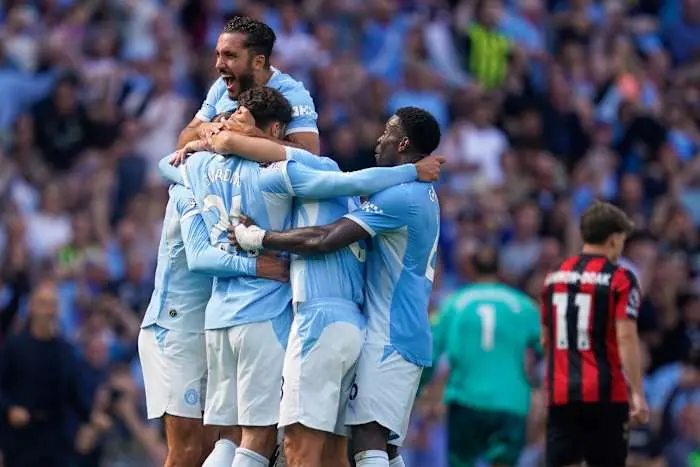
However, football matches are decided in the margins, and the introduction of substitute Rayan Cherki proved to be the tactical masterstroke that unlocked the contest. Trailing heading into the game’s final stages, City orchestrated a frantic late rally. Marc Guéhi leveled proceedings with a towering header from a corner in the 84th minute, before Josko Gvardiol bundled home the winner in the first minute of stoppage time.
The victory served as a baptism of fire for Enzo Maresca, who stepped into the daunting role of succeeding Pep Guardiola. Wearing a sharp, immaculate black suit on the touchline, the Italian manager cut an authoritative figure. Yet, the aesthetic polish on the sidelines belied a performance on the pitch that lacked the hypnotic, frictionless slickness synonymous with the Guardiola era—at least until the breathtaking flurry of the final ten minutes.
The match was preceded by a poignant, league-wide moment of mourning. Both players and supporters paused to observe a period of silence honoring the late Kevin Keegan, the legendary English icon and former manager of both Manchester City and Newcastle United, who passed away last month at the age of 75.
While Manchester City ultimately secured the three points necessary to steady their early-season nerves following a disappointing Community Shield defeat, the afternoon offered plenty of tactical food for thought across the Premier League landscape. Elsewhere on Sunday, Brighton & Hove Albion ran riot against a disheveled Aston Villa side, routing Unai Emery’s men 4-0 in a blistering first-half display at the Amex Stadium.
Detailed Chronology: How the Drama Unfolded at the Etihad
Pre-Match Atmosphere and Anticipation
The air around the Etihad Stadium on Sunday afternoon crackled with a distinct mixture of nervous anticipation and historical reverence. As supporters made their way to the ground, the overarching narrative centered on the managerial transition. A massive tifo unfurled in the stands reading "Welcome back Enzo," a heartfelt acknowledgment of Maresca’s previous tenure as Pep Guardiola’s trusted assistant during the historic treble-winning 2022–23 campaign.
Before a ball was kicked, the stadium fell into a heavy, respectful hush. Players from both sides stood arm-in-arm around the center circle to observe a minute of silence dedicated to Kevin Keegan. The emotional tribute bridged generations of English footballing history, reminding everyone present of the deep human stories underpinning the modern Premier League spectacle.
A Stifling First Half
When the whistle blew to commence the action, Bournemouth—led by their tactically astute manager—showed zero spatial intimidation. Rather than sitting in a passive low block, the visitors aggressively disrupted Manchester City’s passing lanes, forcing the hosts into uncharacteristic lateral circulation.
Maresca’s 4-3-3 setup, designed to mirror the positional flexibility of his predecessor, initially struggled for fluidity. Erling Haaland, isolated for large portions of the first half, cut a frustrated figure as service into the final third was repeatedly intercepted or crowded out by a disciplined Bournemouth backline. City dominated possession, as is customary, but their entries into the penalty area lacked the razor-sharp incisions that fans had grown accustomed to over the past decade.
Bournemouth, conversely, posed a persistent threat on the counterattack. Their wide midfielders exploited the spaces left vacant by City’s advancing full-backs, forcing Ederson into a couple of sharp, pragmatic saves that kept the scoreline deadlocked heading into the interval.
The Turning Point: Tactical Shifts and Cherki’s Introduction
As the second half progressed into its twilight, the Etihad grew increasingly restless. The memory of the 3-0 Community Shield defeat to Arsenal just a week prior hung heavy in the humid Manchester air. Sensing the stagnation, Maresca turned to his bench in the 70th minute, introducing French playmaker Rayan Cherki.
The substitution altered the gravitational pull of the match. Cherki’s low center of gravity, rapid acceleration, and willingness to attempt high-risk, penetrative passes immediately unsettled Bournemouth’s defensive structure. The visitors, who had defended heroically for over eighty minutes, began to tire under the relentless wave of blue shirts.
The Late-Game Deluge
The breakthrough finally arrived in the 84th minute. Following a sustained spell of pressure that yielded a succession of corners, a pinpoint delivery found summer signing Marc Guéhi. The central defender rose majestically above his marker, generating immense power to steer a header past the despairing dive of the Bournemouth goalkeeper. The Etihad erupted, the collective tension releasing in a roar that shook the stadium’s foundations.
With momentum firmly on their side, City refused to settle for a draw. The fourth official’s board indicated five minutes of added time, and Maresca’s men poured forward with unbridled intensity.
In the 91st minute, the decisive moment materialized. Rayan Cherki orchestrated a slick exchange on the edge of the box before sliding a clever pass into the path of Josko Gvardiol. The versatile Croatian defender, pushing forward from deep, took a composed touch before slotting a low, measured finish directly into the bottom-right corner of the net.
Initially, celebrations were muted as the assistant referee’s flag stayed raised on the far side, signaling an apparent offside. However, a lengthy and agonizing VAR review ensued. Replays confirmed that Gvardiol had timed his run to perfection, kept onside by a trailing Bournemouth boot. As the VAR signal flashed green on the stadium screens, pandemonium broke loose. Maresca punched the air with unbridled fury and joy, later embracing his players on the turf as the final whistle sounded seconds later.
Supporting Context & Metrics: Tactical Analysis and Wider League Trends
Statistical Breakdown of Manchester City vs. Bournemouth
While the scoreline suggests a narrow, closely fought affair, the underlying metrics paint a picture of total territorial dominance that ultimately translated into productivity only in the dying embers of the match.
- Possession: Manchester City 68% – 32% Bournemouth
- Total Shots: City 19 – 7 Bournemouth
- Shots on Target: City 7 – 3 Bournemouth
- Expected Goals (xG): City 2.45 – 0.82 Bournemouth
- Corner Kicks: City 9 – 2 Bournemouth
Despite controlling nearly seventy percent of the ball, City’s sluggish ball-speed in the first hour allowed Bournemouth to compress the spaces between their midfield and defensive lines. The introduction of Rayan Cherki was the statistical catalyst: within twenty minutes on the pitch, Cherki created four chances, registered two secondary assists, and completed 92% of his passes in the final third.
For Marc Guéhi, his late equalizer underscored his burgeoning importance to this evolving City squad. Beyond his defensive solidity, his aerial dominance in both boxes provides Maresca with a vital weapon against low-block defenses—a problem area that occasionally plagued City in the final years of the Guardiola era.
The Aston Villa Collapse at Brighton
While the Etihad drama commanded the headlines, events down on the south coast at the Amex Stadium provided an equally compelling narrative on Sunday. Brighton & Hove Albion dismantled Aston Villa in a stunning 4-0 masterclass that left Unai Emery’s side in disarray.
The Seagulls struck four times in a disastrous opening 31 minutes for the visitors, playing with an intensity and sharpness forged through their early-season European qualifying commitments. Villa’s misery was compounded in the 40th minute when midfielder Joao Gomes received a straight red card for lashing out at Brighton’s Georginio Rutter.
The result highlights what has been a deeply turbulent and unsettling offseason for Aston Villa. The departures of key personnel—including Morgan Rogers, Youri Tielemans, and Ezri Konsa—have significantly depleted the squad’s depth. Compounding matters are persistent, unsettling transfer speculations surrounding the long-term futures of talismanic striker Ollie Watkins and World Cup-winning goalkeeper Emi Martinez. Emery faces an immense psychological and tactical rebuilding job to restore stability to his dressing room.
Official Statements and Post-Match Reactions
The emotional weight of the afternoon was palpable in the post-match press conferences, where both managers reflected on a chaotic 90 minutes of football.
Manchester City Manager Enzo Maresca, speaking on the late victory and his touchline debut:
"First of all, I am very proud of the character shown by the players today. It is never easy when you are transitioning to new ideas, new structures, and the opponent comes with a clear, brave plan to disrupt you. In the first half, we lacked that final spark, that little bit of speed in our combinations. But football is played over 90 minutes, and the belief never left this squad.
To see the fans welcome me back with such warmth means everything. But this club is built on winning, and today was about finding a way to get over the line. Rayan [Cherki] changed the dynamic when he came on, and our defenders showed incredible bravery to attack the ball in the box. We have a long way to go to reach our absolute best, but starting with three points is the most important thing."
Bournemouth Manager, reflecting on the heartbreaking late collapse:
*"The boys gave absolutely everything they had for eighty-five minutes. To come to the Etihad and execute our tactical plan to that level of discipline is something we can be immensely proud of. We restricted them to very few clear-cut openings for a long time.
Of course, it hurts to concede so late. When you defend that well for so long, you hope to take something away. But against teams of this quality, with the individual brilliance they can bring off the bench, the concentration has to be absolute until the referee blows the final whistle. We take the positives, dust ourselves off, and prepare for the next challenge."*
Future Outlook: What Lies Ahead for the Premier League Contenders
As the dust settles on the second weekend of the 2026–27 Premier League campaign, the early league table is already beginning to take shape, revealing both the durability of the established elite and the vulnerabilities of clubs caught in transitional cycles.
For Manchester City, the immediate priority for Enzo Maresca will be translating the frantic energy of Sunday’s late comeback into sustained 90-minute control. While the tactical fingerprints of his philosophy are evident—particularly in the inverted positioning of the full-backs and the demand for patient buildup—the squad is still calibrating its internal clockwork. The integration of young talents like Rayan Cherki into high-stakes scenarios suggests that City’s squad depth remains the envy of Europe, even as they navigate life after Guardiola’s day-to-day stewardship. City must now look ahead to a demanding fixture slate where opponents will undoubtedly study Bournemouth’s defensive blueprint.
For Bournemouth, the performance at the Etihad should serve as a massive injection of confidence. If they can replicate that level of tactical discipline and defensive resilience against teams outside the traditional "Big Six," they will comfortably secure another season of Premier League safety and potentially challenge for a top-half finish.
Meanwhile, Aston Villa finds themselves at a critical crossroads. The manner of their 4-0 defeat to Brighton exposes structural cracks that cannot simply be patched over with tactical adjustments. Unai Emery must demand immediate clarity from his club’s hierarchy regarding squad reinforcements and the retention of unsettled core players before the transfer window slams shut. Failure to address these deficiencies risks derailing Villa’s continental ambitions before the autumn leaves even begin to fall.
As the Premier League marches forward, the narrative of the 2026–27 season promises unprecedented tactical intrigue, generational shifting on touchlines, and the undying, unpredictable drama that makes English football the most-watched spectacle on earth.

0 Comments