

Executive Overview
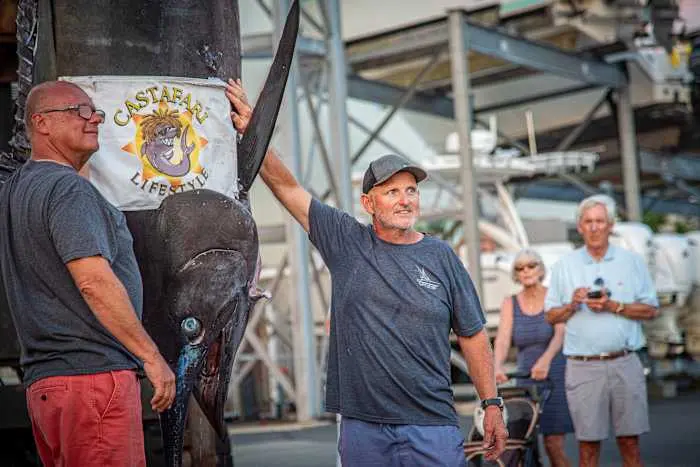
In what marine scientists and veteran anglers are hailing as a once-in-a-generation event, a monumental Atlantic blue marlin weighing an astonishing 1,260 pounds (571.5 kilograms) has been successfully reeled in off the coast of Massachusetts. The gargantuan billfish, measuring over 11 feet (335 centimeters) in length, was hauled aboard the charter vessel Castafari on Wednesday, August 19, 2026, following an intense, grueling three-hour battle at sea.
Spearheaded by charter captain Damon Sacco and angler Walter Chapman, the historic catch occurred at the edge of the continental shelf in a remote underwater trench known as the Atlantis Canyon, approximately 100 miles southeast of Cape Cod. When the Castafari returned to port in Falmouth, Massachusetts, later that day, the sheer scale of the leviathan drew awestruck crowds and immediate attention from the scientific community.
According to data maintained by the International Game Fish Association (IGFA), the newly landed specimen falls just 142 pounds short of the all-time world record for an Atlantic blue marlin—a legendary 1,402-pound behemoth caught off the coast of Vitória, Brazil, in December 1992. However, fisheries experts emphasize that capturing a blue marlin of this magnitude in the colder waters of the U.S. Northeast is exceptionally rare, pushing the boundaries of what marine biologists previously understood about the northern migratory patterns of these apex pelagic predators.
Beyond the sheer sporting achievement, the event has triggered significant scientific collaboration. The fish’s head has been secured by the University of Maine’s Pelagic Fisheries Laboratory for advanced biological analysis, offering researchers a rare window into the lifespan, age distribution, and oceanic habits of these elusive giants. As the angling community celebrates a feat that defies regional expectations, this report provides a comprehensive, multi-faceted look at the monumental catch, its ecological context, and its implications for marine science.
Detailed Chronology: The Three-Hour War at Atlantis Canyon
Setting the Stage at Sea
The expedition began like many others for Captain Damon Sacco, a seasoned charter boat captain with decades of experience navigating the notoriously unpredictable waters off the Massachusetts coastline. Operating out of Falmouth, Sacco helm-managed the Castafari toward the Atlantis Canyon—a dramatic, deep-sea abyss situated roughly 100 miles out on the edge of the continental shelf.
The location is well-known among deep-sea fishermen as a hotspot for pelagic species during the height of the summer season. However, targeting giant billfish in these waters requires a potent mix of specialized gear, endurance, and favorable environmental conditions. Aboard the vessel alongside Sacco was Walter Chapman, a lifelong fisherman and retiree hailing from Plymouth, Massachusetts, who had booked the charter with aspirations of a memorable day on the water. Little did either man know that the offshore excursion would soon enter the annals of regional maritime history.
The Strike and Initial Confusion
The encounter commenced with a sudden, explosive strike that immediately signaled a fish of uncommon power. When the creature first broke the surface of the water, Sacco’s initial reaction was one of sheer miscalculation. Seeing the towering dorsal fin slice through the waves, the captain suspected they had hooked an enormous shark.
"Then I got a better look at it and thought, dang, that thing’s pointed," Sacco recalled, detailing the pivotal moment of recognition. "But that’s too big for a marlin."
Sacco’s disbelief was rooted in biological reality: blue marlin of legendary proportions are rarely encountered this far north in New England waters, let alone hooked and successfully fought on rod and reel. Yet, as the creature repeatedly breached and demonstrated its raw, hydrodynamic prowess, it became undeniably clear that they were tethered to a textbook specimen of Makaira nigricans—the Atlantic blue marlin.
The Marathon Battle
With the stakes instantly elevated, Walter Chapman took his place in the angler’s chair, bracing for what would become the physical trial of his life. For approximately three consecutive hours, Chapman engaged in a grueling tug-of-war with the pelagic titan. The fish utilized its immense weight, explosive bursts of speed, and downward lunges to test every component of the tackle.
While Chapman fought the fish on rod and reel, Sacco’s primary responsibility shifted to vessel management. Describing his role during the marathon ordeal, Sacco joked that he was simply tasked to "drive the bus around and yell at people."
The marlin did not surrender easily. In a testament to its ferocity, the creature’s formidable bill struck the boat’s transom during the final stages of landing, leaving structural punctures that Sacco later affectionately dubbed "war marks." Finally, utilizing precise teamwork and exhaustion management, the crew managed to secure the billfish, hauling the massive silhouette onto the deck of the Castafari and setting a course back toward the mainland.
Supporting Context & Metrics: Anatomy of a Giant
Specimen Biometrics and World Standing
The sheer physical dimensions of the Massachusetts marlin place it in an elite historical tier of marine sportfishing:
- Total Weight: 1,260 pounds (571.5 kilograms)
- Total Length: Over 11 feet (335 centimeters)
- Proximity to Record: 142 pounds shy of the all-time IGFA world record (1,402 pounds, caught in Brazil, 1992)
- Location of Capture: Atlantis Canyon, continental shelf edge (~100 miles off Cape Cod)
- Duration of Fight: Approximately 3 hours
To contextualize a 1,260-pound blue marlin, one must understand the physiology of the species. Atlantic blue marlins are among the fastest and most powerful fish in the global ocean, capable of sustained cruising speeds and explosive sprints that can empty a heavy-duty reel of its line in seconds. Their streamlined bodies, cobalt-blue and silvery-white coloration, and dagger-like bills make them formidable apex predators, feeding primarily on squid, mackerel, tuna, and other pelagic schooling fish.
The New England Anomaly
From an oceanographic perspective, capturing a marlin of this scale in New England waters is an extreme statistical outlier. Walt Golet, director of the University of Maine Pelagic Fisheries Lab and an associate professor at the university’s School of Marine Sciences, explained the environmental constraints that make this catch so extraordinary.
"The water is simply too cold for them in the Northeast for the vast majority of the year," Golet noted. Because blue marlins are tropical and subtropical creatures that thrive in warm pelagic currents, their seasonal migration window into northern latitudes is remarkably narrow. Typically, these fish only venture as far north as New England during the peak warmth of late summer, when warm-core rings spin off the Gulf Stream and temporarily elevate offshore water temperatures.
For an individual specimen to reach such an advanced age and colossal size—and simultaneously find its way into the northernmost bounds of its migratory range—requires a confluence of ecological factors that marine scientists rarely witness firsthand.
Official Statements and Scientific Analysis
Insights from the University of Maine Pelagic Fisheries Lab
The scientific value of the Falmouth marlin cannot be overstated. Recognizing the rare opportunity to study a prime specimen of this magnitude, researchers at the University of Maine quickly coordinated with the vessel crew to secure biological samples.
Dr. Walt Golet emphasized that the fish’s head was transported directly to the UMaine laboratory for comprehensive analysis, with a primary focus on determining the creature’s precise age. By examining the otoliths (ear bones) or fin spine cross-sections—which grow annual ring structures much like the rings of a tree—scientists can estimate the age of pelagic species with a high degree of accuracy.
Preliminary examinations suggest the marlin was likely between 25 and 30 years old, an impressive age for a marine predator that faces numerous natural and anthropogenic pressures throughout its lifespan.
"I don’t suspect there will be a whole lot of blue marlin caught in the Atlantic in general that are going to top 1,200 pounds for the next several years," Dr. Golet stated, underscoring the scarcity of such mega-specimens in modern fisheries data.
The Angler’s Perspective and Community Reaction
Back on land, the return of the Castafari to Falmouth Harbor transformed into an impromptu community celebration. Word of the monumental catch spread rapidly through local docks, drawing a dense crowd of onlookers, fellow mariners, and media representatives eager to catch a glimpse of the silver-and-blue giant suspended from the scale.
Katie Curran, a Falmouth resident who witnessed the dockside spectacle, marveled at the sheer scale of the achievement.
"People fish their entire lives and never come close to a catch like this," Curran remarked. "Hats off to Captain Damon Sacco and the crew on the catch of a lifetime."
For Walter Chapman, the victorious angler who spent three hours locked in combat with the fish, the immediate aftermath involved practical logistics—specifically, what to do with over a thousand pounds of high-grade marlin meat. Confirming that the animal would not go to waste, Chapman explained that the harvest was thoughtfully distributed among roughly a dozen friends, family members, and crewmates.
"I wasn’t going to eat a 1,200-pound fish all by myself," Chapman quipped, adding that he immediately began scouring recipe books for culinary ideas. While parts of the rich, steak-like meat were destined for traditional preparations, Chapman noted that local fish chowder would undoubtedly feature prominently on the menu.
Future Outlook: Implications for Regional Fisheries and Marine Research
Conservation, Climate, and Pelagic Migrations
The successful landing of a 1,260-pound Atlantic blue marlin off Massachusetts opens broader conversations within marine biology regarding shifting ocean temperatures and pelagic fish distributions. As climate change continues to alter marine ecosystems, researchers are closely monitoring how warming waters in the Northwest Atlantic may influence the migratory corridors of large pelagic species like marlin, swordfish, and various tuna species.
While historical records occasionally feature large billfish in northern waters—dating back to the pioneering offshore sportfishing days of the mid-20th century—documented catches of this specific weight class north of the mid-Atlantic remain exceptionally scarce. The data extracted by the University of Maine Pelagic Fisheries Lab will contribute to ongoing stock assessments managed by international bodies such as the International Commission for the Conservation of Atlantic Tunas (ICCAT). Understanding the age structure, growth rates, and movement patterns of these apex predators is vital for establishing sustainable management frameworks that balance recreational sportfishing traditions with long-term marine conservation.
A Legacy Cemented in New England Maritime Lore
As the scales were finalized and the biological samples safely transferred to academic custody, the 2026 Atlantic blue marlin caught by Captain Damon Sacco and Walter Chapman officially etched its name into the folklore of New England maritime history.
For the local charter community, the event serves as a powerful reminder of the untamed biodiversity thriving just beyond the horizon of the continental shelf. In an era where commercial pressures and environmental shifts continually transform the marine landscape, the story of the Castafari’s monumental catch stands as an enduring testament to the raw majesty of the ocean—and the rare, unforgettable moments when human endurance meets the ultimate natural wonder.

0 Comments