
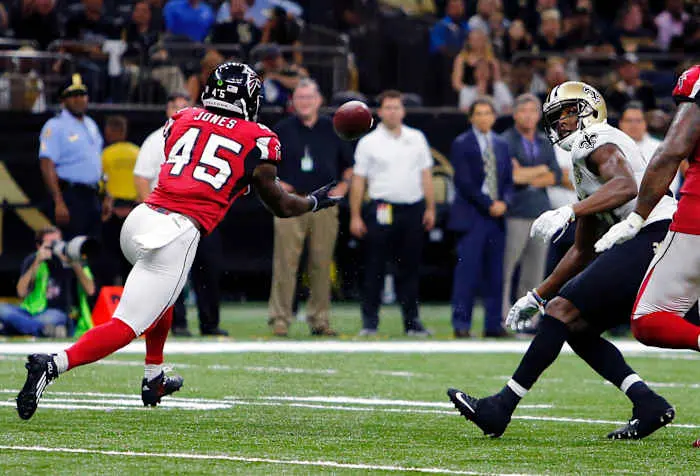

SANTA CLARA, Calif. — In a late-August roster maneuver designed to insulate against mounting training camp injuries and solidify positional depth ahead of final roster cuts, the San Francisco 49ers have acquired veteran linebacker Deion Jones in a trade with the New Orleans Saints. In exchange, the Saints receive running back Zamir White, according to a person with direct knowledge of the transaction who spoke to The Associated Press on the condition of anonymity Sunday night.
The move, first reported by ESPN, comes at a critical juncture in the National Football League calendar. With the league-mandated roster reduction from 90 players down to the regular-season limit of 53 looming just a week away, both franchises utilized the trade market to address acute roster vulnerabilities. For the 49ers, the acquisition of the 31-year-old Jones brings a proven, albeit aging, coverage linebacker into a defensive room currently managing minor injuries. For the Saints, the addition of White provides an immediate and necessary influx of backfield reinforcement following a training camp knee injury to star running back Alvin Kamara.
Executive Overview
The late-summer trade landscape in the National Football League is rarely defined by blockbuster acquisitions; rather, it is a period defined by calculated risks, fringe-roster evaluations, and contingency planning. The swap sending Deion Jones to the Bay Area in exchange for Zamir White fits this archetype perfectly, addressing specific, short-term needs for two contending franchises.
For San Francisco, the acquisition of Jones is a low-risk, high-upside play for interior defensive reinforcement. While the 49ers boast an elite starting linebacker tandem in All-Pro Fred Warner and Dre Greenlaw, recent injuries to depth pieces like Nick Martin and Jalen Graham exposed a thin underbelly in the linebacking corps. Furthermore, with a physical preseason finale against the Las Vegas Raiders on the horizon, head coach Kyle Shanahan and general manager John Lynch needed a reliable body to absorb defensive snaps and contribute immediately to special teams. Jones, a former Pro Bowler with extensive starting experience, offers precisely that institutional knowledge and veteran presence.
Conversely, the New Orleans Saints found themselves scrambling for backfield depth following an unfortunate injury timeline during joint practices and training camp. Star running back Alvin Kamara suffered a sprained knee, an ailment expected to sideline him for approximately four weeks and potentially force him to miss the opening canvass of the regular season. By acquiring Zamir White—a former Las Vegas Raiders contributor who had fallen down a crowded 49ers depth chart—New Orleans secures a physical, between-the-tackles runner who can shoulder the load during Kamara’s anticipated absence.
Detailed Chronology of the Trade
The framework of the trade crystallized over the weekend as both coaching staffs finalized their assessments following the second and third weeks of the NFL preseason.
Sunday Night Negotiations
Discussions between the 49ers’ front office and Saints management accelerated late Sunday evening. With the 90-man roster cutoff scheduled for the following Tuesday, both clubs recognized that several players on the bubble would either have to be traded or exposed to the perilous waters of the waiver wire.
The 49ers had already evaluated Zamir White extensively throughout August camp and the preseason slate. White logged 14 carries for 30 yards across two exhibition games for San Francisco. However, his path to the final 53-man roster narrowed significantly with the return of All-Pro Christian McCaffrey and promising rookie running back Kaelon Black to the practice field following respective injury layoffs. Realizing White was unlikely to crack the primary rotation behind McCaffrey, San Francisco’s front office pivoted toward leveraging the running back’s trade value to address a defensive need.
Identifying the Defensive Need
In San Francisco, the defensive strategy under coordinator Raheem Morris—who has history with Jones dating back to their shared tenure in Atlanta—thrives on speed, sideline-to-sideline range, and high football IQ. Over the final week of August practices, the 49ers’ linebacker room absorbed several hits. Depth contributors Nick Martin and Jalen Graham missed consecutive days of practice due to undisclosed injuries.
Faced with the prospect of playing a grueling preseason finale against Las Vegas with a depleted second and third-tier linebacker unit, the 49ers initiated inquiries regarding veteran linebackers who might be expendable on other rosters. Jones, who spent the past two seasons primarily in a reserve and special teams role with Tampa Bay, quickly emerged as a viable target. The trade was finalized late Sunday night, though league protocols delayed an official announcement until the paperwork could be formally processed by the league office.
Supporting Context & Metrics: Player Profiles and Team Needs
To fully understand the mechanics of this trade, one must examine the career trajectories of the players involved and the structural roster dynamics of both the 49ers and the Saints.
Deion Jones: The Veteran Backer
Deion Jones enters his tenth NFL season with a vast reservoir of professional experience. Drafted in the second round (52nd overall) of the 2016 NFL Draft out of LSU by the Atlanta Falcons, Jones immediately made an impact in the professional ranks.
- The Atlanta Years (2016–2021): Jones spent the first six seasons of his career as a defensive anchor in Atlanta. His peak came during the 2017 campaign, where he earned Pro Bowl honors after recording 138 total tackles, 3 interceptions, 10 passes defended, and a defensive touchdown. Notably, Jones played under current 49ers defensive coordinator Raheem Morris during Morris’s stint on the Falcons’ coaching staff, providing an innate familiarity with the terminology, scheme expectations, and cultural demands of the defensive system.
- Recent Stints (2022–2025): Following his departure from Atlanta, Jones had brief stops with the Cleveland Browns and, most recently, the Tampa Bay Buccaneers. Over the past two seasons in Tampa Bay, Jones transitioned into a rotational reserve role, focusing heavily on special teams contributions while mentoring younger linebackers.
- Fit in San Francisco: While Jones is no longer the explosive, every-down coverage mismatch weapon he was during his prime in Atlanta, his veteran savvy makes him an ideal insurance policy. In San Francisco, he will slot in behind Warner and Greenlaw, competing with younger depth pieces while offering immediate insurance against further injuries in the middle of the field.
Zamir White: The Backfield Bruiser
Zamir White’s journey to New Orleans represents a fresh start after a brief, stop-gap stint in the Bay Area.
- Las Vegas Roots (2022–2025): Selected out of the University of Georgia, White spent his first four professional seasons with the Las Vegas Raiders. His most productive professional stretch came late in the 2023 regular season, where he flashed considerable potential as a downhill, punishing runner. Over his tenure in Las Vegas, White accumulated 198 carries for 736 yards, proving capable of handling heavy workloads when called upon.
- The San Francisco Interlude: Following his departure from Las Vegas, White signed with San Francisco to compete for a depth role behind Christian McCaffrey. He appeared in two preseason games, logging 14 carries for 30 yards. However, the emergence of rookie Kaelon Black and the return of McCaffrey rendered White expendable.
- The New Orleans Opportunity: White steps into an ideal situational environment with the Saints. With Alvin Kamara sidelined for up to a month due to a knee sprain sustained during practice, New Orleans required a capable, physical runner to complement their existing offensive scheme. White’s north-south running style provides a distinct stylistic contrast that offensive coordinators can utilize in short-yardage and early-down situations while Kamara rehabilitates.
Roster Construction and the 53-Man Cutdown
The timing of this trade underscores the frantic nature of late-August roster management across the National Football League. Under current league guidelines, all 32 franchises must trim their active rosters from the summer maximum of 90 players down to the regular-season limit of 53 players.
This period typically triggers a flurry of minor trades as front offices attempt to extract value from players who are guaranteed to be cut or whose roster spots have been claimed by surging rookies and returning veterans.
The San Francisco Roster Equation
For the 49ers, managing the 90-to-53 cutdown requires balancing elite championship aspirations with the stark reality of attrition. San Francisco’s defense is built around foundational superstars, but sustaining a 17-game regular-season schedule—plus a projected deep postseason run—demands reliable depth.
By trading Zamir White—a player who likely would have cleared waivers or failed to make the final 53-man cut—general manager John Lynch successfully converted a surplus asset at running back into a much-needed body at linebacker. The move ensures that practice sessions leading up to the final preseason contest against Las Vegas will not be compromised by a lack of operational personnel at the second level of the defense.
The New Orleans Roster Equation
For the Saints, the acquisition of White is a direct response to a medical crisis. Losing Alvin Kamara for the opening month of the season threatens to derail an offense attempting to establish an early-season rhythm.
Rather than relying exclusively on unproven undrafted free agents or scouring the waiver wire for players discarded by other franchises, New Orleans proactively traded a defensive reserve they could afford to lose (Jones) for a proven NFL running back. White provides immediate insurance, ensuring that head coach Dennis Allen and his offensive staff do not have to drastically alter their game plans during Kamara’s absence.
Future Outlook
As the dust settles on this late-August transaction, both teams turn their immediate attention toward the final week of the preseason and the impending roster cuts.
What Lies Ahead for the 49ers
For Deion Jones, the immediate challenge is mastering the nuances of the 49ers’ defensive playbook in real-time. Although he possesses prior familiarity with Raheem Morris’s defensive philosophies from their time together in Atlanta, modern defensive schemes have evolved significantly. Jones will be expected to absorb the playbook quickly, contribute extensively on special teams units during Thursday night’s preseason finale against the Las Vegas Raiders, and prove that he can still play winning football at the NFL level.
For San Francisco, the acquisition of Jones provides a safety net. If Fred Warner or Dre Greenlaw were to miss time during the regular season, the drop-off in defensive communication and coverage execution is mitigated by having a veteran of Jones’s caliber waiting in the wings.
What Lies Ahead for the Saints
For Zamir White, the runway to make an immediate impact is exceptionally short. With Alvin Kamara sidelined, White will be thrust into intensive meetings to learn the Saints’ offensive terminology ahead of Week 1. If he can harness the downhill running style that defined his late-season surge in Las Vegas, White has a legitimate opportunity to carve out a permanent role in the New Orleans backfield, potentially earning high-leverage touches well after Kamara returns to the lineup.
Ultimately, this trade stands as a textbook example of pragmatic, proactive NFL management: two smart front offices identifying opposing surpluses and deficits, executing a swift exchange, and positioning their respective rosters to weather the inevitable storms of a grueling professional football season.

0 Comments