

Executive Overview
The Florida State Seminoles’ nightmare season away from Tallahassee extended into historic proportions on Friday night, deepening a trajectory that has alarmed the program’s faithful and intensified scrutiny on the coaching staff. Following a roaring start that momentarily quieted the raucous home crowd, FSU surrendered 44 unanswered points to fall 44-20 to the University of Louisville at Cardinal Stadium.
With this latest defeat, the Seminoles dropped to 3–3 overall and 1–2 in Atlantic Coast Conference (ACC) play, while cementing an unwanted milestone: their 13th consecutive loss in games played away from home.
What began as a promising showcase of offensive efficiency—highlighted by a commanding 14-0 lead in the opening quarter—metamorphosed into an administrative and tactical disaster. Florida State’s defense was systematically dismantled, yielding nearly 400 yards on the ground, while the offense evaporated under a wave of self-inflicted wounds, penalties, and mental lapses.
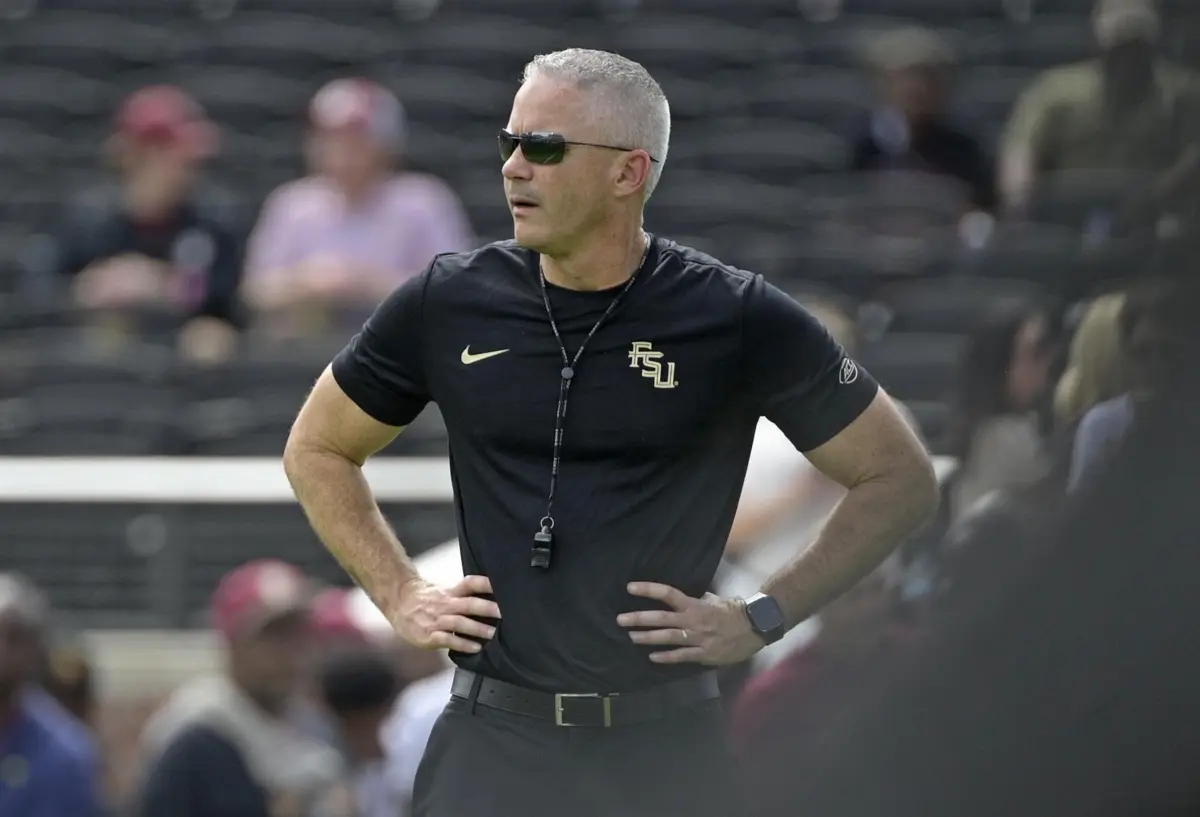
Head coach Mike Norvell, flanked by quarterback Ashton Daniels and edge rusher Rylan Kennedy, faced a brutal post-game reality check with the media. Rather than deflecting blame, the leadership core offered stark admissions of failure, pointing to a severe deficiency in mental toughness, structural discipline, and execution. As the Seminoles tumble out of control, the margin for error evaporates instantly: next week, a bruised and battered FSU squad must travel to Miami Gardens to face the No. 4-ranked Miami Hurricanes in one of the most hostile environments in college football.
Detailed Chronology of the Collapse
The Illusion of Control: A 14-0 First Quarter
For the first fifteen minutes of Friday night’s contest, the script favored the visitors. Florida State executed its early game plan with surgical precision, exploiting openings in the Louisville defense while establishing a physical presence. The Seminoles jumped out to a quick 14-0 advantage, silencing the stadium and forcing the Cardinals onto their heels.
Quarterback Ashton Daniels commanded the pocket efficiently during the opening surge, utilizing quick-tempo play-calling and high-percentage throws to keep the chains moving. The offensive line opened lanes for the running game, and the defense forced early stops against an explosive Louisville offensive unit. At that juncture, FSU appeared entirely prepared to break its agonizing road losing streak, playing with the poise and confidence expected of a perennial contender.
The Turning Point: Fourth-Down Ambition and the 97-Yard Dagger
The momentum shifted dramatically—and permanently—late in the first half. Clinging to their early lead, the Seminoles faced a critical fourth-down conversion deep in Louisville territory. Rather than playing conservatively and settling for a field goal to extend their cushion, Norvell opted to keep his offense on the field.
The play call dialed up a man-coverage counter: a screen pass designed to exploit an aggressive Cardinals blitz. However, the execution disintegrated instantly. The play was snuffed out before it could develop, resulting in a turnover on downs and handing the ball back to Louisville.
What followed was the definitive back-breaker of the evening. Instead of capitalizing on a short field, Louisville engineered a breathtaking, one-play, 97-yard touchdown drive that completely flipped the psychological landscape of the game. Cardinal star playmaker Isaac Brown—who orchestrated a masterclass of offensive dominance throughout the night—punctuated his performance with explosive runs and a devastating kickoff return that effectively broke FSU’s defensive resistance.
The 44-0 Avalanche
Once the 97-yard touchdown struck, the Seminoles dissolved. Over the final three quarters, Louisville outscored FSU 44-6, turning a competitive contest into an absolute rout. The mental fortitude that Norvell emphasized in weekly preparation evaporated under the lights.
FSU’s defense, completely disoriented by Brown’s shiftiness and Louisville’s physical offensive line play, missed gap assignments and failed to wrap up in space. Offensively, the chains stalled. Penalties erased positive yardage, dropped passes killed drives, and Daniels found himself under constant duress as the pocket collapsed. By the time the final whistle blew, the 14-0 lead felt like a distant memory from an entirely different game, leaving the Seminoles to grapple with the bitter reality of another blowout loss on enemy turf.
Supporting Context & Metrics: The Anatomy of a Rout
Historical Context of the Road Streak
The narrative surrounding Florida State’s inability to win away from Tallahassee has officially transformed from an analytical trend into a psychological burden. With Friday’s 44-20 setback, the Seminoles have now dropped 13 consecutive games outside of Doak Campbell Stadium. In modern major-college football, maintaining a competitive profile while suffering this magnitude of road ineptitude is virtually impossible. This streak points to deeper issues regarding travel preparation, emotional resilience, and the capacity of players to handle hostile environments without fracturing under pressure.
Statistical Breakdown: The Ground Game Bleed
The defensive statistics tell a horrifying story for defensive coordinators. FSU surrendered an astronomical 397 rushing yards to the Louisville offense. In modern football, allowing nearly 400 yards on the ground is a direct indictment of front-seven discipline, gap integrity, and tackling fundamentals.
- Total Rushing Yards Allowed: 397 yards
- Final Score Differential: Louisville 44, FSU 20 (Outscored 44-6 after the first quarter)
- Record Implications: FSU falls to 3-3 overall, 1-2 in the ACC.
- Streak Status: 13th consecutive road loss.
Isaac Brown served as the primary catalyst for this statistical massacre. His ability to turn standard handoffs and special teams opportunities into game-breaking plays exposed FSU’s defensive structure. When edge rushers and linebackers lost their gap discipline, Brown punished them instantly, exploiting every microscopic seam.
Official Statements and Post-Game Reactions
Head Coach Mike Norvell: "It Starts with Me"
Addressing the media after the loss, Mike Norvell did not hide behind excuses or shift blame away from the coaching staff. His tone was somber, direct, and accountability-driven.
"Too many times where we didn’t show the detail, the discipline, the mental toughness that’s necessary on the road. Starts with me — the guys were not prepared for those moments like they needed to be. We all need to take ownership in it — coaches, players, everybody involved."
Norvell did not shy away from evaluating the defensive collapse and the decision to go for it on fourth down:
"We felt good about the play, still feel good about the thought process. Unfortunately, we didn’t do a good enough job in that moment. They got to go 97 yards, and they did it in one play."
On the defensive catastrophe of allowing nearly 400 yards rushing, Norvell’s frustration was palpable:
"Bad plays are going to happen, but freaking rise up, do your damn job and go play the next play. They had 397 yards rushing tonight. That’s awful. Sometimes we had a player in position and we didn’t execute the way that we needed to. It comes down to all of us. Comes down to me. We’ve got to take a deep breath, respond to the situation — Isaac [Brown] was a great player tonight. He really took over the game with the kickoff return and then big runs. We can’t help great players by not doing and being where we need to be."
Quarterback Ashton Daniels: "We Killed Ourselves"
Quarterback Ashton Daniels echoed his head coach’s sentiments regarding self-sabotage. In his post-game evaluation, Daniels pointed to mental errors as the primary culprit behind the offense’s sudden stall after the first quarter.
"We killed ourselves tonight. Penalties, execution, mental errors. That’s what held us off the field. We just didn’t execute. Going up three scores on a good football team, especially on the road, I think we had a lot of momentum probably, but we didn’t, so [it] doesn’t matter. I wanted to go for it. I think that would have been big if we got that conversion. Man coverage, we ran a screen and we just didn’t execute as an offense."
Daniels also addressed the team’s inability to arrest Louisville’s momentum after the demoralizing 97-yard touchdown:
"We like to say, ‘Don’t let the momentum affect us as a team,’ but we did tonight. We didn’t fight back when we needed to. We didn’t put points up on the board when we needed to. They’re a good team, but we beat ourselves tonight. We’re going to home and learn from that, grow from it."
Edge Rusher Rylan Kennedy: A Psychological Battle Lost
Defensive stalwart Rylan Kennedy offered an inside look at the psychological unraveling that occurred on the field following Louisville’s explosive plays.
"After that long run, we kind of lost control. We wasn’t us. It was just a mental battle. We should have just kept being mentally strong and just next play, next play."
Addressing the dominance of Isaac Brown, Kennedy placed the responsibility squarely on the defense’s shoulders:
"I respect him, but I feel like it was more on us. Just knowing where to fit in our gaps, knowing how to strain and just doing our job. Practice was good. I feel like we was prepared. We did what we needed to do. When it came to the game time and that situation, we didn’t respond like how we used to."
Future Outlook: The Road to Miami
As the dust settles on Friday night’s collapse in Louisville, the Florida State Seminoles have precious little time to lick their wounds. Sitting at an uninspiring 3–3 overall and 1–2 within the Atlantic Coast Conference, the structural foundation of the 2024 campaign is visibly shaking.
The immediate test ahead is arguably the most daunting challenge on the college football calendar. Next Saturday at 7:00 p.m., the Seminoles will travel down to Hard Rock Stadium in Miami Gardens, Florida, for a prime-time showdown against the No. 4-ranked Miami Hurricanes.
Facing an elite, highly ranked rival on the road is difficult under any circumstances. Doing so immediately following a 44-point defensive collapse, while carrying a 13-game road losing streak, represents an extreme test of character, resilience, and coaching capability.
For Mike Norvell and his staff, the upcoming week of practice cannot simply be about physical preparation or schematic adjustments. It must be an exercise in psychological reconstruction. If the Seminoles cannot find a way to eliminate the mental errors, penalize the self-sabotage, and instill the discipline required to execute away from home, the historic road losing streak will almost certainly extend to 14 games against one of their fiercest historical adversaries.

0 Comments