

Executive Overview
TALLAHASSEE, Fla. — After enduring a rocky, uneven start to the 2025 college football season, the Florida State Seminoles finally flashed the championship-caliber dominance head coach Mike Norvell has long preached. Following a sluggish first quarter at Doak Campbell Stadium that left home fans holding their collective breath, the Seminoles rattled off 38 unanswered points to secure a resounding 38-7 victory over the Virginia Cavaliers on Saturday evening.
The turning point of the game—and perhaps of Florida State’s season—was a masterclass in complementary football. After surrendering a 7-0 lead and getting outgained significantly in the opening frame, FSU’s defense pitched a near-shutout, locking down a Virginia rushing attack that entered the contest averaging nearly 200 yards per game. Meanwhile, the Seminole offense exploded, amassing 464 total yards.
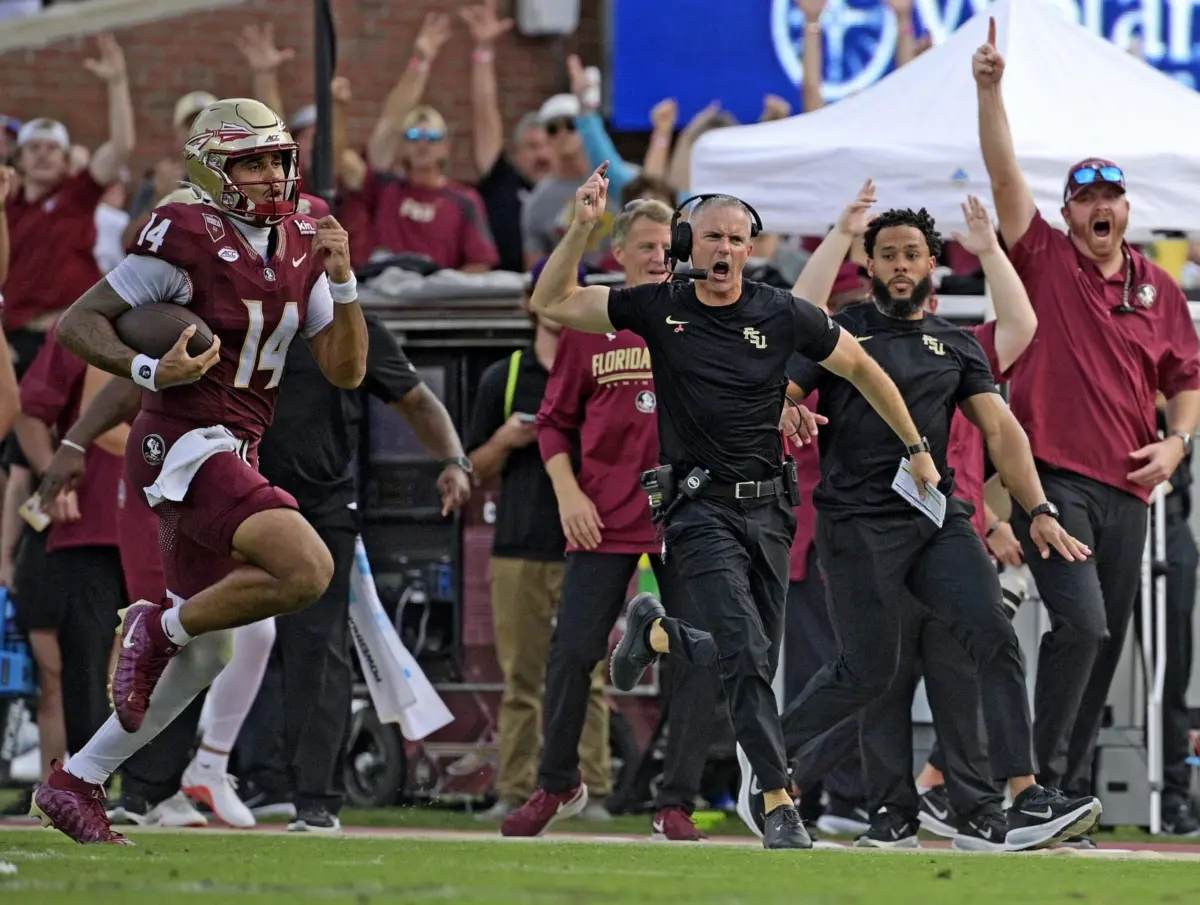
Quarterback Ashton Daniels put on a historic performance, rewriting the Florida State record books by accounting for five rushing touchdowns while racking up 136 yards on the ground. When combined with a ferocious defensive front that generated 10 sacks, the Seminoles (3-2, 1-1 ACC) transformed an early deficit into a statement win.
Yet, even in the wake of a 31-point blowout, Norvell’s post-game demeanor was remarkably measured. The fifth-year head coach praised his team’s grit and resilience through early-season adversity, but emphasized that the Seminoles still have not played a complete, 60-minute game of football. With a short week looming and a tough Friday night road matchup against Louisville dead ahead, FSU’s coaching staff is wasting no time pivoting from celebration to correction.
Detailed Chronology: How the Seminoles Turned the Tide
A Slow Burn and a Stumbling Start
For the first fifteen minutes of action inside Doak Campbell Stadium, it appeared the Seminoles were sleepwalking through another disjointed outing. Virginia controlled the tempo early, utilizing a deliberate offensive scheme to keep FSU’s high-powered playmakers off the field.
At the end of the first quarter, the scoreboard painted a grim picture for the home crowd: Virginia led 7-0. The statistical disparity was equally jarring. The Cavaliers had churned out 101 yards of total offense, while Florida State’s sputtering offense managed a meager 38 yards. The ghosts of past early-season struggles seemed to hang heavily over the stadium turf.
The 98-Yard Catalyst and Second-Quarter Onslaught
If the first quarter belonged to the Cavaliers, the second quarter belonged exclusively to the Seminoles in a tidal wave of momentum that completely flipped the script of the game.
The catalyst arrived in the form of a daunting 98-yard touchdown drive. Pinned deep in their own territory, Norvell’s offense finally found its rhythm. Featuring a brilliant mix of short-area passing, perimeter screens to establish spacing, and punishing interior runs, FSU marched the length of the field. A key screen play broke open the field, injecting life into an offense that had been dormant.
From that moment forward, the floodgates opened. Florida State outscored Virginia 38-0 over the final three quarters. The second quarter alone yielded nearly 200 yards of offense for the Seminoles while holding the Cavaliers to negative yardage. Daniels punctuated the drives with his legs, scoring consecutive touchdowns as Virginia’s defensive structure collapsed under the relentless pressure.
Sustaining the Throttle: The Third-Quarter Masterclass
Norvell later pointed to the opening sequence of the second half as his favorite stretch of the entire game. Coming out of the locker room with a comfortable lead, teams often fall victim to complacency. FSU did the exact opposite.
The Seminole defense forced a swift three-and-out, asserting immediate physical dominance. The offense capitalized instantly, driving down the field for another touchdown to extend the lead and keep the pressure squarely on the Cavaliers. Unlike their previous road trip—where a weather delay caused a disastrous post-halftime collapse—Florida State maintained its killer instinct, ensuring the game remained out of reach.
Supporting Context & Metrics: Breaking Down the Dominance
The final box score reveals a comprehensive, multi-phase dismantling of a reputable Virginia program. Florida State finished the night outgaining the Cavaliers 464 yards to 205.
Ground Game Supremacy
The most glaring statistical disparity came in the trenches. Virginia arrived in Tallahassee boasting a formidable ground game, averaging 192.8 rushing yards per contest. FSU’s defensive front completely neutralized that identity, holding the Cavaliers to a paltry 37 yards on 40 carries—an average of less than one yard per rush attempt.
Conversely, the Seminole offensive line imposed its absolute will. FSU pounded out 281 yards on the ground, wearing down an experienced Virginia front seven. Running back Ousmane Kromah chipped in efficiently with 80 yards on 17 carries, keeping the chains moving and allowing Daniels to pick his spots.
The Defensive Front Unleashed
Questions had swarmed around Florida State’s pass rush during the first four games of the season, a stretch in which the unit managed a meager seven total sacks. Coordinator Tony White adjusted his schemes, unleashing a coordinated, multi-layered onslaught that completely baffled the Virginia offensive line.
The Seminoles recorded a staggering 10 sacks on the night. Nine different FSU defenders recorded at least half a sack, showcasing unprecedented depth and cohesion. Edge rusher Rylan Kennedy led the charge with two sacks, while Chris Jones added 1.5. The secondary and linebackers played with palpable "edge" and technique, swarming to the ball and forcing Virginia to go 0-for-4 on fourth-down conversion attempts.
Ashton Daniels: Record-Breaking Efficiency
Ashton Daniels was the undisputed engine of the victory. Beyond his historic five rushing touchdowns—a new program record for a Florida State quarterback—Daniels operated with surgical efficiency through the air. He completed 12 of 19 passes for 183 yards and one interception.
Virginia’s defensive strategy focused heavily on taking away FSU’s vertical passing game, keeping safeties deep and forcing the Seminoles to matriculate the ball underneath. Daniels and his pass-catchers adapted seamlessly, utilizing wideouts like Duce Robinson and Jayvan Boggs to exploit intermediate zones, which in turn cracked open expansive running lanes.
Official Statements & Post-Game Analysis
Speaking to the media following the victory, head coach Mike Norvell balanced profound relief with his characteristic demand for perfection.
"To start off, we’re really proud of our team," Norvell opened. "The team, coaches, everybody on the ground involved within the program. The work that went into this week, just to continue working. It wasn’t just one week. It’s been our process. We’ll take care of us. I believe this can be a really good and dominant football team. It didn’t start the way we wanted to start. We still haven’t played a 60-minute game yet. But those last 45 minutes were really impressive."
Norvell was quick to credit defensive coordinator Tony White and his staff for adapting their game plan on the fly. He highlighted the defensive improvements not as an overnight miracle, but as the direct result of foundational discipline and accountability.
"You felt the edge that they played with," Norvell said of his defense. "There was some incredible effort, incredible application of technique. You looked out there and you saw a forcing unit, because it’s not just the D-line. Linebackers, safeties. You felt the way that they attacked and how they played off of each other."
Addressing the outside noise and external skepticism that followed FSU’s 2-2 start, Norvell emphasized that internal belief and unwavering brotherhood kept the program from fracturing under pressure.
"I have watched them come together since January," Norvell noted when asked about the team chemistry. "If it was a team that broke apart through challenges, then it wouldn’t be much of a team, and it wouldn’t be real. These guys have faced challenges, they’ve faced outside noise. Every week you go out there and win by a lot, or you can get your butt kicked. I’m excited about where this team is trending, and we have a lot of work to continue."
On Ashton Daniels’ historic night, Norvell offered high praise while contextualizing the quarterback’s leadership and perseverance.
"I thought Ashton played at a high level. He’s a great playmaker," Norvell stated. "You see the respect that the defense tonight had for our backs, for our receivers, in the way they were trying to defend us, and he asked for some respect tonight on the performance he had. Our football team, he deserved that tonight."
Future Outlook: The Road Ahead
While a 38-7 victory provides an undeniable injection of confidence for a locker room that desperately needed validation, the Seminoles have no time to rest on their laurels.
The college football calendar waits for no one, and Florida State faces a treacherous, compressed schedule. The coaching staff will convene Sunday evening—bypassing a physical practice to prioritize film study and self-scouting—to correct the execution errors that led to FSU’s dismal first quarter.
Preparation for a dangerous Friday night road matchup against Louisville begins in earnest on the practice fields Monday morning. ACC play is notoriously volatile, and road games under the lights present unique psychological and physical hurdles.
As Norvell repeatedly reminded reporters, true consistency remains the ultimate frontier for this program. Until the Seminoles string together a wire-to-wire, dominant 60-minute performance against elite competition, the head coach’s foot will remain firmly on the gas pedal.
For now, Florida State has proven what its ceiling looks like when all three phases click into harmonious execution. If the Seminoles can bottle the energy, physicality, and tactical brilliance of those final 45 minutes against Virginia, the rest of the Atlantic Coast Conference has been officially put on notice.

0 Comments