

Executive Overview
In a historic referendum that drew intense global scrutiny, the electorate of Iceland has decisively rejected a proposal to restart negotiations on joining the European Union. The vote, held on Saturday, August 29, 2026, and finalized the following morning, concluded with 52.8% of voters casting ballots against resuming accession talks, compared to 47.2% in favor.
The decision effectively shelves a decades-long, deeply polarizing national debate. The referendum was fast-tracked by Iceland’s left-leaning coalition government, which assumed power in 2024. Originally scheduled for 2027, the vote was moved forward in response to escalating geopolitical anxieties in the Arctic, triggered in part by unpredictable foreign policy rhetoric from Washington regarding neighboring Greenland.
Despite these security concerns and a strong "Yes" campaign in the metropolitan hub of Reykjavik, rural and coastal communities rallied to defend Iceland’s sovereign control over its lucrative fishing grounds. By rejecting the mandate to reopen talks with Brussels, Icelandic voters chose to preserve the country’s unique status quo: enjoying frictionless access to the European single market via the European Economic Area (EEA) agreement, while retaining complete independence over its natural resources and monetary policy.
Detailed Chronology
[2008] Iceland's Banking Collapse (Kreppa)
   │
[2009] Social Democratic Government submits formal EU application
   │
[2013] Euroskeptic coalition freezes negotiations
   │
[2015] Formal withdrawal of EU accession bid
   │
[2024] Left-leaning coalition elected; promises referendum by 2027
   │
[2025-2026] Geopolitical tensions rise over U.S. Arctic rhetoric
   │
[Aug 2026] Referendum expedited; "No" campaign wins with 52.8%
The Long Road to the 2026 Referendum
To understand the gravity of the August 2026 vote, one must look back to the cataclysmic financial crisis of 2008. The collapse of Iceland’s three major commercial banks—the Kreppa—sent the value of the Icelandic króna plunging, wiped out domestic savings, and shattered trust in the country’s independent economic institutions. In the wake of this disaster, a newly elected coalition led by the Social Democratic Alliance submitted a formal application to join the EU in July 2009, viewing the Eurozone as a safe haven of financial stability.
However, as the domestic economy gradually stabilized and the painful memories of the crash faded, skepticism toward Brussels re-emerged. In 2013, a coalition of the Progressive Party and the Independence Party took power on an explicitly euroskeptic platform, freezing the accession talks. In March 2015, the government formally withdrew Iceland’s application without holding a public referendum, a move that sparked years of protests and lingering political resentment.
The 2024 Coalition and the Arctic Catalyst
The issue remained dormant until the general elections of late 2024. A left-leaning coalition, led by Prime Minister Kristrún Frostadóttir, secured power with a pledge to resolve the EU question once and for all through a democratic mandate. The government initially planned to hold a non-binding referendum in mid-2027 to gauge whether the public desired a return to the negotiating table.
This timeline was abruptly accelerated in late 2025. U.S. President Donald Trump renewed his controversial, highly publicized designs on neighboring Greenland, repeatedly suggesting that the United States should seek control of the strategic island to counter Russian and Chinese influence in the Arctic. In a series of public addresses, President Trump mistakenly referred to Iceland instead of Greenland four times.
               ┌──────────────────────────────┐
               │    Arctic Geopolitics 2026   │
               └──────────────┬───────────────┘
                              │
             ┌────────────────┴────────────────┐
             ▼                                 ▼
   [U.S. Arctic Policy]              [European Solidarity]
   • Focus on Greenland/GIUK Gap     • Push for unified defense
   • Unpredictable rhetoric          • Stronger regulatory alignment
   • Increased military presence     • Shared environmental mandates
While seemingly a rhetorical slip, the blunder sent shockwaves through Reykjavik. Though Iceland has been a founding member of NATO since 1949, it possesses no standing military of its own. Pro-European factions seized on the moment, arguing that Iceland required the robust political and economic solidarity of the European Union to insulate itself from shifting geopolitical winds. Recognizing a window of heightened public engagement, Prime Minister Frostadóttir’s government moved the referendum forward to August 2026.
Election Night: A Tale of Two Icelands
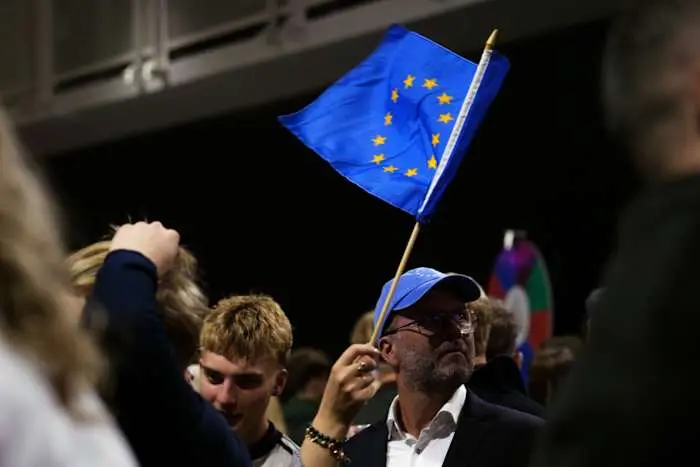
As polls closed on the evening of Saturday, August 29, 2026, early returns from the capital area of Reykjavik showed a commanding lead for the "Yes" campaign. Pro-EU supporters gathered at election-night venues, waving European Union flags in anticipation of a historic pivot toward continental integration.
However, as midnight passed and ballots from the outer constituencies—particularly the Northwest, Northeast, and South—began to be tallied, the tide turned. The initial "Yes" lead evaporated, replaced by a razor-thin margin for the "No" campaign. By dawn on Sunday, August 30, the gap had widened to a definitive margin of 5.6 percentage points, cementing a victory for the euroskeptic opposition.
Supporting Context & Metrics
The referendum exposed a deep demographic and economic divide within Iceland, a nation of approximately 400,000 residents.
The Urban-Rural Divide
The geographic distribution of the votes highlights a stark divergence in economic priorities between the cosmopolitan capital and the rest of the island.
| Region | Primary Economic Drivers | Referendum Alignment | Key Concerns |
|---|---|---|---|
| Reykjavik & Capital Area | Technology, Finance, Tourism, Public Sector | Strongly "Yes" | Currency volatility, inflation, global isolation, cost of borrowing. |
| Rural & Coastal Constituencies | Fishing, Agriculture, Aluminum Smelting | Decisively "No" | Loss of sovereignty, EU Common Fisheries Policy, foreign competition. |
Reykjavik, which houses more than 60% of the country’s population, was the sole district to return a majority for the "Yes" vote. For urban professionals, academics, and tech entrepreneurs, the volatile Icelandic króna remains a persistent burden, driving up inflation and borrowing costs. They viewed the adoption of the Euro as a crucial step toward long-term stability.
Conversely, in the coastal villages and farming heartlands, the prospect of EU membership was viewed as an existential threat. The driving force behind this opposition was the defense of Iceland’s Exclusive Economic Zone (EEZ).
The Battle for the Blue Economy
Fishing is not merely an industry in Iceland; it is the cornerstone of national identity and historical independence. The country’s hard-fought victories in the "Cod Wars" against the United Kingdom between the 1950s and 1970s established its 200-nautical-mile exclusive fishing zone, a boundary that saved the domestic economy from collapse.
Under the EU’s Common Fisheries Policy (CFP), fishing quotas are negotiated and managed centrally from Brussels. Opponents of the referendum argued successfully that joining the EU would inevitably force Iceland to share its pristine, highly managed waters with industrial trawlers from Spain, France, and the Netherlands.
[Iceland's 200-Mile EEZ] ──► Managed via strict domestic quotas (Sustainable Yield)
                                      ▲
                                      │  VS.
                                      ▼
[EU Common Fisheries Policy] ──► Centrally negotiated quotas (Shared Access)
Iceland’s domestic quota system, though controversial at home, has kept fish stocks highly sustainable and highly profitable. The domestic fishing lobby, led by powerful coastal collectives, mounted a highly effective campaign reminding voters of the historical struggles to keep foreign fleets out of Icelandic waters.
The EEA Compromise: The Best of Both Worlds?
A major factor working against the "Yes" campaign was the existing framework of the European Economic Area (EEA). Signed in 1994, the EEA agreement allows Iceland, alongside Norway and Liechtenstein, to participate fully in the EU’s internal market.
This arrangement grants Iceland:
- Free movement of goods, services, capital, and persons.
- Participation in the Schengen Area, allowing passport-free travel across most of Europe.
- Cooperation in crucial programs like the Horizon Europe research initiative.
Because Iceland already enjoys these benefits without paying full membership fees or relinquishing control over its agricultural and fisheries sectors, the "No" campaign argued that full EU membership offered little incremental value at a massive cost to national sovereignty.
Official Statements
In the wake of the finalized results on Sunday morning, leaders from across the political spectrum addressed the nation, reflecting a mix of relief, disappointment, and a shared desire for national reconciliation.
The Government’s Response
Prime Minister Kristrún Frostadóttir, who had staked significant political capital on the "Yes" campaign, struck a conciliatory tone in her address to the national broadcaster, RÚV:
"The people of Iceland have spoken, and in a democracy, the will of the voter is the ultimate authority. While I believed, and still believe, that our long-term security and economic stability would be best served at the heart of the European family, I respect this outcome. Our task now is to ensure this vote does not divide us. I do not feel bitterness; the debates were passionate, but they showed a nation deeply engaged in its own future."
The Opposition’s Triumph
Leaders of the "No" coalition celebrated what they characterized as a historic defense of Icelandic independence.
Sigmundur Davíð Gunnlaugsson, former Prime Minister and leader of the Centre Party, who has long been one of the country’s most vocal euroskeptics, stated:
"This is a monumental victory for Icelandic sovereignty. We have once again proven that we do not need to bow to external pressures or surrender our most valuable resources to Brussels. Our strength lies in our independence, our ability to chart our own course, and our direct control over the seas that have sustained our people for over a thousand years."
Guðrún Hafsteinsdóttir, leader of the conservative Independence Party, emphasized the economic rationale behind the rejection:
"Our businesses and our fishing communities can breathe a sigh of relief today. The voters have recognized that the European Economic Area agreement already gives us the access we need without the heavy-handed regulations and loss of self-determination that full EU membership would entail. We will continue to build strong bilateral relations across the globe on our own terms."
Lilja Dögg Alfreðsdóttir, leader of the Progressive Party, added:
"We have protected our food security, our agricultural heritage, and our coastal communities. This vote reinforces the unique identity of Iceland as a sovereign North Atlantic nation."
The Voice of the Electorate
The sentiment of the average euroskeptic voter was captured by Daniel Bjarkason, a resident of the western town of Akranes, who spoke to reporters in Reykjavik:
"This simply isn’t the time to go. Maybe in 10, 15, or 20 years, we can take another look if the world changes. But for now, we are too divided on this issue. To make such a massive constitutional change, you need a clear consensus—something like 70% in favor. A narrow victory either way would have torn the country apart. This result keeps us grounded in who we are."
Future Outlook
The rejection of the referendum has immediate and long-term implications for Iceland’s domestic politics, economic strategy, and geopolitical positioning in the increasingly contested Arctic region.
Domestic Political Fallout
The defeat of the referendum represents a significant setback for Prime Minister Frostadóttir’s left-leaning coalition. While the Prime Minister has ruled out calling an early election, the result is expected to embolden the opposition parties—particularly the Independence and Centre parties—who will likely leverage this victory to challenge the government’s economic policies ahead of the next scheduled general elections. The coalition will now need to pivot away from European integration and focus on domestic solutions to combat the persistent inflation and high interest rates that fueled the "Yes" campaign.
                  ┌──────────────────────────────┐
                  │    Iceland's Strategic Path  │
                  └──────────────┬───────────────┘
                                 │
         ┌───────────────────────┼───────────────────────┐
         ▼                       ▼                       ▼
[Strengthen EEA Status]   [Bilateral Trade Agreements] [NATO & Arctic Defense]
• Maintain single market  • Deepen ties with UK/Asia  • Expand security role
• Retain veto on rules    • Leverage green energy     • Counterbalance US/Russia
Economic Strategy: Embracing Bilateralism
With the EU option off the table for the foreseeable future, Iceland is expected to double down on its strategy of bilateral diplomacy and trade. The country was the first European nation to sign a free trade agreement with China in 2013, and economic analysts predict Reykjavik will now seek to expand its trade relationships with post-Brexit Britain, the United States, and rapidly growing markets in Asia.
Furthermore, Iceland will continue to market itself as a global leader in green energy. Utilizing its abundant geothermal and hydroelectric resources, the country aims to attract further foreign investment in green data centers, land-based aquaculture, and high-tech carbon capture technologies—all while keeping the Icelandic króna as its national currency.
Navigating the Arctic Frontier
Geopolitically, the vote solidifies Iceland’s position as an independent, non-EU actor in the Arctic Council. As ice sheets melt and new shipping lanes open, the Arctic is rapidly becoming an arena of strategic competition between the West, Russia, and China.
Without the political umbrella of the EU, Iceland will rely heavily on its bilateral security agreement with the United States and its active participation in NATO to secure its airspace and maritime borders. The government will face the delicate task of maintaining close security cooperation with Washington while defending its sovereign territory from foreign political posturing.
Ultimately, the referendum of August 2026 has confirmed that for the majority of Icelanders, the pride of self-determination, won from Denmark in 1944 and defended in the Cod Wars, remains far more valuable than the promise of continental integration. Iceland remains a nation apart—anchored in the North Atlantic, guarded by its seas, and fiercely independent.

0 Comments