
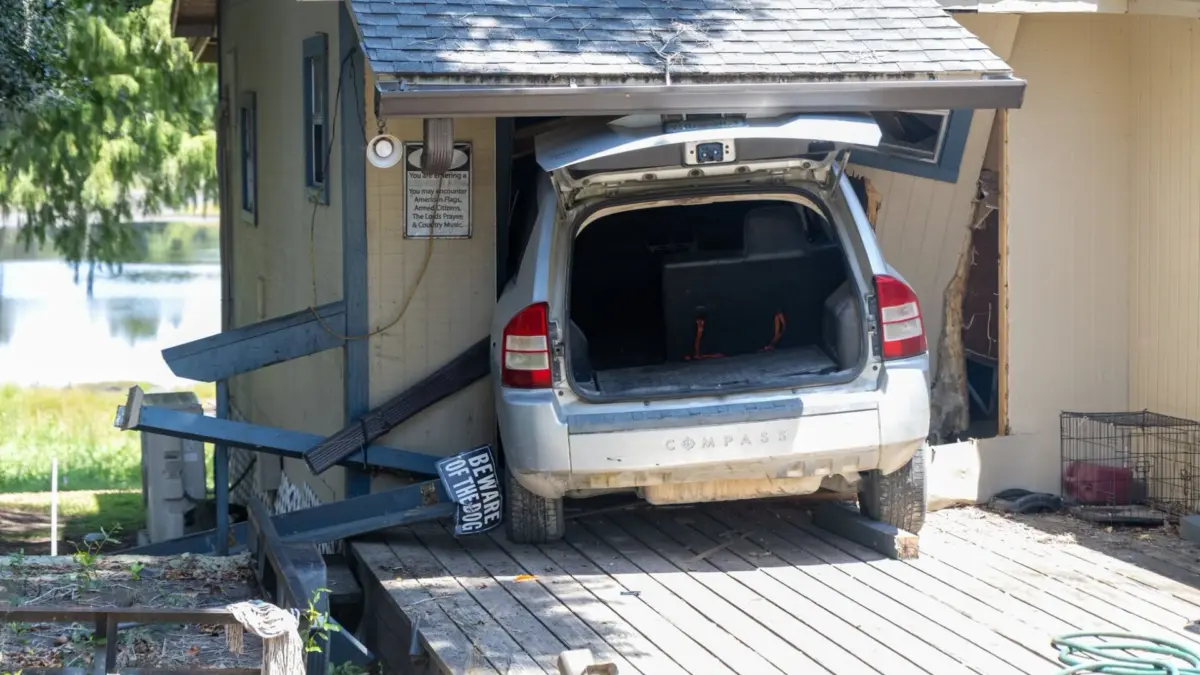

OCKLAWAHA, Florida — A quiet Saturday afternoon in the unincorporated community of Ocklawaha was abruptly shattered on August 15, 2026, when a passenger vehicle veered off the roadway and crashed directly into a residential duplex. The high-velocity impact caused severe structural damage to the building, triggered a rapid deployment of emergency services, and resulted in the hospitalization of one individual.
Marion County Fire Rescue (MCFR) crews arrived at the scene shortly after 12:30 p.m. to find a chaotic scene marked by crumbled concrete, shattered glass, and compromised load-bearing walls. While emergency personnel confirmed that no residents were trapped inside the home at the time of the collision, the incident has renewed urgent discussions regarding traffic safety, residential zoning protections, and the rising frequency of vehicle-into-building crashes across the state of Florida.
Executive Overview
The collision occurred in a residential sector of Ocklawaha, a community nestled in south-central Marion County, known for its mix of rural landscapes, lakeside properties, and connecting county roads. According to initial emergency dispatches, a single vehicle lost control under circumstances that remain under active investigation, breaching the exterior boundary of a multi-family duplex.
Upon impact, the vehicle penetrated the living space of one of the duplex units, causing immediate structural compromise. Marion County Fire Rescue dispatched multiple units, including heavy rescue engines, paramedics, and structural assessment specialists. First responders immediately initiated a search-and-rescue sweep of the affected units to ensure no occupants were pinned beneath the collapsed drywall, masonry, and interior furnishings.
Fortunately, emergency crews confirmed that no occupants inside the duplex were trapped or pinned by the debris. However, the incident was not without casualties. One individual—whose identity and role as either the driver of the vehicle or an occupant of the duplex has not yet been officially released—sustained injuries severe enough to warrant emergency transport to a regional trauma center.
Local building inspectors and code enforcement officers were subsequently summoned to the scene to assess whether the duplex remains habitable or if the structural damage poses an imminent threat of partial collapse.
Detailed Chronology of the Incident
To understand the mechanics of the crash and the subsequent emergency response, a precise timeline of the events of Saturday, August 15, 2026, has been established through dispatch logs, eyewitness accounts, and official statements from Marion County Fire Rescue:
+-----------------------------------------------------------------------------+
|                                TIMELINE OF EVENTS                           |
+-----------------------------------------------------------------------------+
| 12:30 PM | Vehicle veers off-road and collides with the Ocklawaha duplex.    |
| 12:32 PM | Multiple 911 calls report a high-velocity impact & structural damage.|
| 12:38 PM | MCFR units arrive, establish command, and secure the perimeter.  |
| 12:45 PM | Paramedics triage the injured party; no entrapment is confirmed. |
| 01:05 PM | Patient is stabilized and transported to a regional hospital.    |
| 01:30 PM | Utility companies disconnect power/gas; building inspectors arrive. |
+-----------------------------------------------------------------------------+
The Moment of Impact (12:30 p.m.)
The quiet of the early afternoon was interrupted when the vehicle departed its lane of travel. Traveling at a speed that investigators are currently working to calculate, the vehicle crossed the property line, bypassed any natural or artificial barriers, and struck the outer wall of the duplex. The force of the collision breached the exterior stucco and drywall, pushing debris deep into the interior living quarters.
Emergency Dispatch and Rapid Mobilization (12:32 p.m. – 12:38 p.m.)
Nearby residents reported hearing a sound resembling an explosion, followed by the screeching of tires and settling debris. Multiple 911 calls were placed immediately. Callers reported that a car had fully penetrated a home and expressed immediate concern that residents might be buried under the rubble.
MCFR dispatched a comprehensive response team. Due to the potential for structural collapse, specialized units trained in urban search and rescue techniques were alerted. The first fire engines arrived on the scene within minutes of the dispatch.
Scene Assessment and Triage (12:38 p.m. – 1:00 p.m.)
Upon arrival, incident commanders established a secure perimeter. The immediate priority was twofold: assessing the physical stability of the compromised duplex to prevent secondary collapse, and locating any victims.
Firefighters entered the undamaged portions of the duplex to conduct a rapid primary search. They confirmed that while the physical destruction inside the impacted unit was extensive, no residents were trapped beneath the fallen structural elements. Simultaneously, paramedics began treating one injured individual at the scene, administering advanced life support measures to stabilize the patient for transport.
Mitigation of Secondary Hazards (1:00 p.m. – 2:00 p.m.)
With the patient safely en route to the hospital, fire crews shifted their focus to hazard mitigation. High-impact collisions into residential structures frequently sever utility lines, creating severe risks of electrical fires, natural gas leaks, or water damage.
Technicians from local electric and gas utilities were called to the scene to perform emergency shutoffs. MCFR personnel utilized thermal imaging cameras to monitor the structure for any hidden hot spots or electrical arcing within the damaged walls.
Supporting Context & Metrics
The incident in Ocklawaha is not an isolated anomaly; rather, it highlights a persistent and growing hazard across both regional and national landscapes. Vehicle-into-building crashes represent a significant, yet often overlooked, category of public safety threats.
National Statistics on Vehicle-into-Building Collisions
Data compiled by the Storefront Safety Council, a national advocacy group dedicated to tracking and preventing vehicle-into-building crashes, reveals alarming metrics:
- Daily Frequency: On average, vehicles crash into commercial and residential buildings up to 100 times per day in the United States.
- Annual Toll: These incidents result in more than 16,000 injuries and approximately 2,600 fatalities annually.
- Primary Causes: The leading causes of these crashes include pedal misapplication (16%), operator error or distraction (30%), medical emergencies (12%), and driving under the influence of alcohol or drugs (17%).
Marion County Infrastructure and Traffic Dynamics
Marion County, which encompasses Ocala and unincorporated communities like Ocklawaha, has experienced rapid population growth over the past decade. This demographic shift has led to increased traffic density on roads that were originally designed for lower-volume, rural traffic.
+-----------------------------------------------------------------------------+
|                 CONTRIBUTING FACTORS IN RURAL/SUBURBAN CRASHES              |
+-----------------------------------------------------------------------------+
| Speed Limits     | Rural transition zones often feature sudden speed drops. |
| Infrastructure   | Lack of protective barriers (bollards/guardrails).       |
| Road Design      | Sharp curves, lack of shoulders, and limited lighting.   |
| Driver Behavior  | Distracted driving and speed-related lane departures.    |
+-----------------------------------------------------------------------------+
In Ocklawaha, many residential properties sit in close proximity to county roads and state highways, such as County Road 464C and State Road 25. These thoroughfares often feature speed limits ranging from 45 to 55 mph. When a vehicle leaves the roadway at these speeds, the lack of protective infrastructure—such as guardrails, deep setbacks, or structural bollards—leaves homes highly vulnerable to high-energy impacts.
Official Statements and Investigative Focus
As the physical debris is cleared, the focus of local authorities has shifted toward a comprehensive investigation to determine the definitive cause of the crash.
Marion County Fire Rescue Response
In a post-incident brief, a spokesperson for Marion County Fire Rescue emphasized the efficiency of the responding crews while noting the potential severity of the situation:
"Our primary objective during any vehicle-into-structure dispatch is the preservation of life and the rapid stabilization of the scene. Our crews performed admirably, quickly verifying that no occupants were trapped within the compromised duplex. While one individual required emergency transport to the hospital, we are grateful that the consequences were not more severe, given the level of structural damage sustained by the building."
Law Enforcement Investigation
The Florida Highway Patrol (FHP) and the Marion County Sheriff’s Office are collaborating to reconstruct the collision. Investigators are currently evaluating several critical variables:
- Mechanical Failure: Analysts will inspect the vehicle’s braking system, steering assembly, and onboard diagnostic computer (the "black box") to rule out sudden mechanical malfunctions.
- Operator Impairment or Distraction: Toxicology reports and mobile device forensic audits may be utilized to determine if chemical impairment or distracted driving played a role in the lane departure.
- Environmental Conditions: Although the crash occurred during daylight hours, investigators are examining road surface conditions, visibility, and any potential roadway obstructions that could have caused the driver to swerve.
Future Outlook and Preventative Measures
The Ocklawaha crash underscores the critical intersection between emergency management, structural engineering, and urban planning. In the wake of this incident, several long-term challenges and preventative solutions must be addressed.
Structural Rehabilitation and Resident Displacement
For the residents of the impacted duplex, the road to recovery will be lengthy. When a vehicle breaches a load-bearing wall, the structural integrity of the entire building is compromised.
Local building officials are expected to issue a "red-tag" designation, rendering the property uninhabitable until a certified structural engineer designs a comprehensive shoring and reconstruction plan. During this period, the displaced residents will rely on community support networks, insurance coverages, or emergency housing assistance.
Technical Solutions: Designing for Crash Prevention
Civil engineers and safety advocates suggest that simple, cost-effective infrastructure modifications could dramatically reduce the severity of vehicle-into-building impacts:
- Installation of Architectural Bollards: Heavy-duty, steel-reinforced concrete posts can be strategically placed along high-risk curves or properties adjacent to high-speed roads. These bollards are designed to absorb the kinetic energy of a vehicle, stopping it before it can breach residential walls.
- Natural Barriers: The implementation of strategic landscaping, such as earthen berms, boulders, and dense groupings of mature trees, can act as natural deceleration zones for runaway vehicles.
- Zoning Reform: Future residential developments along major corridors may require increased setback distances, ensuring that homes are positioned far enough from the roadway to minimize the risk of direct impact.
As Marion County continues to expand, local planners and commissioners face the ongoing challenge of balancing infrastructure development with community safety. The investigation into the Ocklawaha duplex crash will provide vital data, helping to shape future safety protocols and protect residential neighborhoods from similar vehicular incursions.

0 Comments