

Executive Overview
PELHAM, Ala. — In an era where local law enforcement interactions with the public are frequently scrutinized through a lens of high-stakes tension and serious public safety concerns, a decidedly lighthearted mechanical failure in Pelham, Alabama, has captured the national imagination. On a standard afternoon that began like any other, the routine operations of the Pelham Police Department took an unexpectedly comedic turn when a commercial delivery vehicle carrying a precious cargo of America’s favorite baked goods stalled out directly in the agency’s primary driveway.
The vehicle in question—a heavily branded Dunkin’ delivery truck packed with thousands of sweet treats—suffered a catastrophic mechanical breakdown at the absolute epicenter of local law enforcement authority. For the officers and administrative staff stationed inside the municipal complex, the coincidence was simply too delicious to ignore. Leaning into one of the most enduring tropes in American pop culture—the age-old association between police officers and donuts—the Pelham Police Department turned an ordinary traffic nuisance into a masterclass in community relations and viral public engagement.
This comprehensive report examines the sequence of events that brought the iconic pink-and-orange distribution vehicle to a halt right at the threshold of the precinct. Through detailed chronology, contextual background on modern law enforcement social media strategy, official statements, and a look at the broader cultural impact of the incident, we explore how a broken serpentine belt or overheated radiator managed to generate widespread smiles, viral internet fame, and a timely reminder of the power of self-deprecating humor in public service.
Detailed Chronology of Events
To fully understand the scope of this unprecedented municipal emergency—and the swift, highly coordinated response it commanded—one must examine the timeline of events as they unfolded outside the Pelham Police Department headquarters.
T-Minus Zero: The Improbable Arrival
The incident began shortly before noon on a seemingly unremarkable weekday. Traffic along the thoroughfare outside the Pelham municipal complex was flowing at its standard pace. Inside the precinct, dispatchers were handling routine calls, patrol officers were wrapping up report writing, and department leadership was managing daily administrative duties.
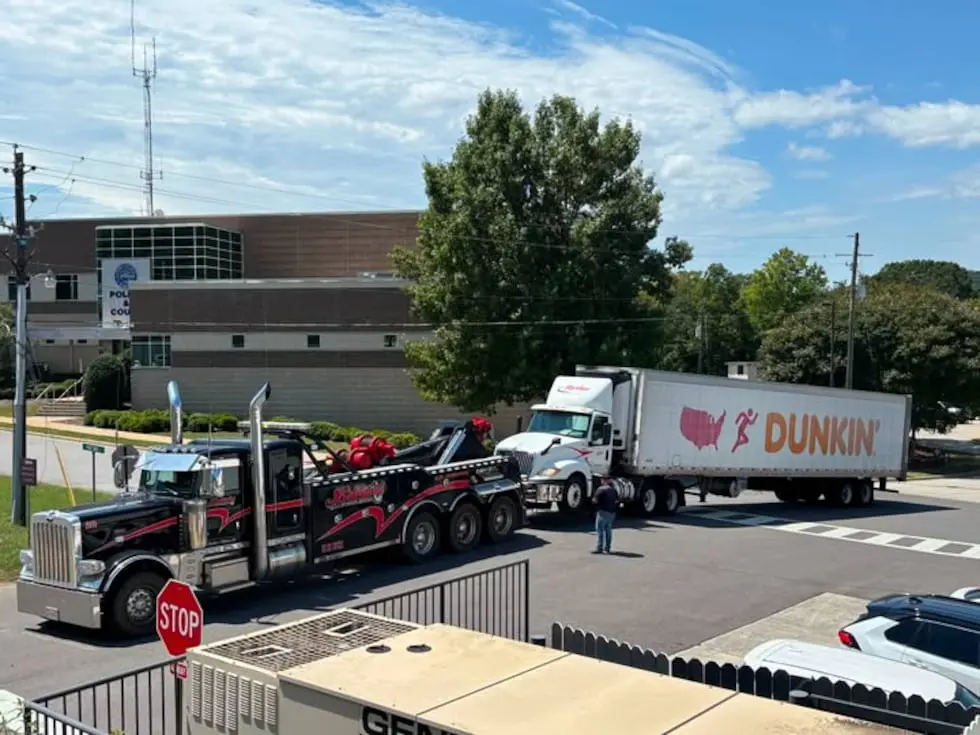
Without warning, the distinct, heavy rumble of a commercial diesel engine sputtered and died. The vehicle, a fully loaded box truck bearing the unmistakable branding of Dunkin’, rolled to a definitive and unceremonious halt. Crucially, it did not break down a mile down the road, nor did it stall at a congested commercial intersection where it might disrupt standard morning commuters. Instead, through what can only be described as a staggering alignment of geographic fate and mechanical misfortune, the truck stalled directly in the direct line of sight—and right across the primary ingress and egress paths—of the Pelham Police Department headquarters.
The Immediate Assessment and Tactical Response
Upon hearing the sudden cessation of the engine followed by the hiss of cooling systems, staff inside the building looked out the reinforced glass windows to investigate the obstruction. What they discovered was an operational hurdle of a uniquely appetizing nature.
Standard protocol for a disabled commercial vehicle blocking a municipal driveway usually involves dispatching a traffic unit to manage cones, coordinating with commercial towing entities, and ensuring the flow of official emergency vehicles remains unimpeded. However, the presence of the Dunkin’ logo immediately shifted the operational calculus.
Recognizing both the logistical bottleneck and the comic gold sitting right outside their front door, on-duty personnel initiated a rapid-response evaluation. As department leadership later joked in public statements, when a vehicle of this specific culinary magnitude is involved, hesitation is simply not an option. Patrol units and administrative staff alike quickly recognized that time was of the essence—not necessarily to clear the roadway, but to ensure that the delicate cargo within remained secure and untampered with.
The Extraction and Safe Recovery
Fortunately, the crisis did not require a specialized hazardous materials team or a prolonged tactical extraction. The driver of the delivery vehicle, displaying admirable composure under the intense psychological pressure of being stranded directly in front of the local constabulary, immediately contacted commercial roadside assistance.
Within a remarkably short window, a heavy-duty wrecker arrived on the scene to rescue the disabled distribution truck. Pelham police officers, demonstrating their multitasking capabilities, stepped outside to assist with traffic flagging, ensuring that the wrecker could safely hook up to the stranded sweet-mobile without causing further delays.
According to official departmental briefings issued shortly after the scene was cleared, the operation was a complete success. The disabled vehicle was hoisted, secured, and towed away for necessary mechanical repairs. Most importantly, municipal authorities were able to issue a definitive, highly reassuring statement to an anxious public: no donuts were harmed during the entire course of the incident.
Supporting Context & Metrics: The Anatomy of a Viral Police Post
The viral success of the Pelham Police Department’s response is not an isolated accident; it is part of a broader, highly sophisticated evolution in how municipal agencies utilize digital communication to bridge the gap between law enforcement and the communities they serve.
The Rise of Humor in Municipal Communications
For decades, police blotters and public information officer (PIO) releases were notoriously dry, formal, and strictly transactional. Press releases adhered to rigid bureaucratic language, focusing exclusively on charges filed, traffic advisories, and crime statistics. However, with the advent of social media platforms like Facebook, X (formerly Twitter), and Instagram, police departments have increasingly recognized the value of humanizing their personnel.
Research in public sector communications consistently shows that content featuring humor, self-awareness, and relatability achieves exponentially higher organic reach and engagement than standard informational posts. When the Pelham Police Department posted about the disabled Dunkin’ truck, they tapped directly into a universally understood cultural meme. By leaning into the classic trope of police officers loving donuts, the department successfully disarmed potential skepticism, showcasing a warm, approachable personality that resonates deeply with citizens.
Social Media Engagement Metrics
While exact internal analytics for the Pelham Police Department’s specific post remain proprietary, similar viral law enforcement posts across the United States typically experience extraordinary statistical surges:
- Engagement Spikes: Posts combining local news with self-effacing humor routinely see engagement rates—measured by likes, loves, shares, and comments—that are 500% to 1,000% higher than standard public safety announcements.
- Geographic Reach: What begins as a hyper-local incident in a city of roughly 25,000 residents rapidly transcends state lines, frequently picked up by regional news affiliates, national aggregators, and digital lifestyle publications.
- Sentiment Analysis: Comment sections on such posts overwhelmingly trend positive, filled with witty puns, expressions of community goodwill, and lighthearted banter between citizens and local officers. This builds a reservoir of public trust that can prove invaluable during times of serious crisis or community stress.
The Economic and Cultural Footprint of Dunkin’
To understand the gravity of the cargo, one must appreciate the sheer scale of the brand involved. Dunkin’, founded in 1950 in Quincy, Massachusetts, has grown into a multinational titan of coffee and baked goods, boasting thousands of locations worldwide. A single delivery truck represents a vital node in a complex supply chain, carrying thousands of freshly glazed, powdered, and filled confections destined to fuel local morning routines.
Had those donuts been compromised, the local morning economy could have faced a temporary, albeit minor, crisis of caffeinated productivity. The swift intervention by Pelham’s finest ensured that the fragile supply chain remained intact, preserving the delicate balance between morning commuters and their daily sugar fixes.
Official Statements and Public Reaction
The true measure of the incident’s impact can be found in the exact phrasing used by the Pelham Police Department and the overwhelming wave of reactions from the online community.
The Departmental Declaration
Recognizing the comedic goldmine landed squarely on their doorstep, the Pelham Police Department took to their official Facebook page to chronicle the afternoon’s events. In a statement that quickly circulated across regional news networks, the department wrote:
“We’re not saying officers responded faster than usual… but when a truck full of donuts is involved, you don’t take any chances.”
The post was accompanied by photographic evidence showing the large delivery truck stalled prominently outside the municipal headquarters, perfectly framing the juxtaposition of law enforcement authority and pastry logistics. The caption struck the exact right balance of playful self-awareness without compromising professional decorum.
Community Responses and Puns Galore
As expected, the local citizenry did not let the opportunity pass without contributing their own comedic commentary. Within hours, the comment section of the department’s Facebook post exploded with hundreds of reactions and witty puns. Local residents and internet sleuths alike chimed in with observations such as:
- “That’s what I call a Code 10-Glazed emergency!”
- “Did they set up a perimeter to ensure no sprinkles escaped into the wild?”
- “Talk about a sting operation!”
- “Glad to see the department is handling the hard-hitting cases with the urgency they deserve.”
The lighthearted banter demonstrated a healthy, mutually appreciative relationship between the residents of Pelham and the men and women sworn to protect them. In an era where police-community relations can sometimes be fraught with tension, moments of shared laughter serve as a vital social lubricant.
Future Outlook: Lessons Learned and Permanent Impact
As normal operations resume at the Pelham Police Department and the memory of the stalled delivery truck fades into municipal lore, it is worth reflecting on the broader takeaways from this sweet episode.
Vehicle Maintenance and Municipal Preparedness
On a purely practical level, the incident serves as a gentle, humorous reminder to commercial fleet operators regarding the importance of routine vehicle maintenance. Even the most reliable distribution networks are susceptible to mechanical failure, and while breaking down in front of a police station is certainly embarrassing for a driver, it is far safer than stalling out in the middle of a high-speed interstate highway during rush hour. Local officials noted with relief that the driver was uninjured, the traffic disruption was minimal, and the mechanical issue was resolved swiftly thanks to prompt roadside assistance.
Setting the Standard for Community Engagement
For the Pelham Police Department, the incident has cemented their reputation as an agency that does not take itself too seriously while maintaining absolute dedication to public service. In public relations masterclasses of the future, the department’s handling of the "Dunkin’ Breakdown of 2026" will likely be cited as a textbook example of organic, highly effective community engagement.
By choosing to laugh along with the public rather than ignoring the coincidence, the department reinforced a powerful message: beneath the uniforms, badges, and heavy responsibilities of law enforcement lie human beings who appreciate a good joke, a well-timed pun, and, of course, a fresh donut.
As Pelham continues to grow and evolve, the legend of the day the donuts came to the police station will undoubtedly live on—a sweet reminder that sometimes, the best policing involves knowing when to secure the perimeter, call a tow truck, and share a well-earned laugh with the community you serve.

0 Comments