

Executive Overview
For the second consecutive season, college football fans across the country found themselves captivated on a Monday night by the surreal prospect of a Florida State University (FSU) opening-week upset. In Tallahassee, the atmosphere inside Doak Campbell Stadium crackled with a volatile mix of desperate hope and profound existential dread as the Seminoles flirted with a miraculous victory against the SMU Mustangs.
Yet, as the dust settled and the final ticks ran off the clock, a sobering reality set in: the ultimate outcome—a narrow defeat for the Seminoles—was, in the grand calculus of the program’s long-term health, a net positive.
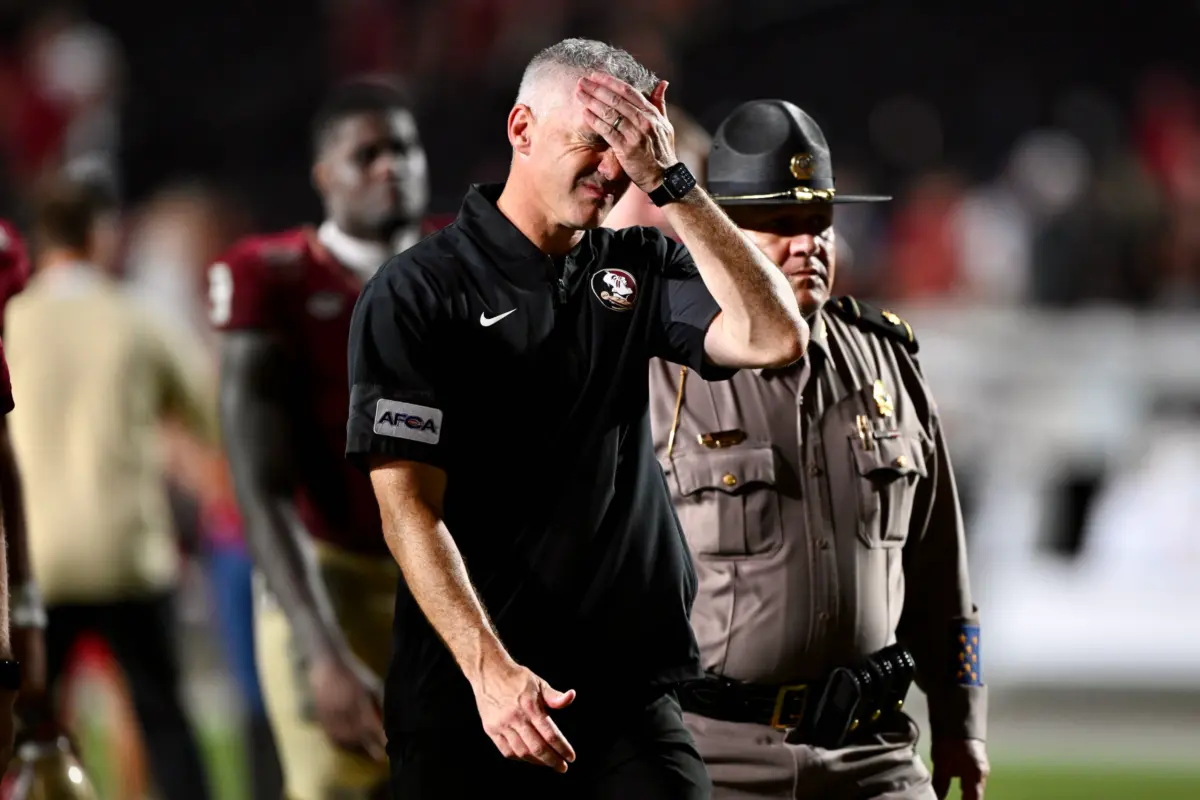
Let us dispense with the illusion that a stolen victory would have served as a watershed moment for head coach Mike Norvell’s beleaguered tenure. Had FSU managed to crawl across the finish line and secure a win, it would not have convinced a skeptical fanbase, a demanding administration, or a critical national media to hop back onto a bandwagon that has suffered catastrophic structural failures over the past two seasons. The collective memory of a disastrous 2024 campaign remains too raw, and the persistent, deafening choruses of "Fire Norvell" echoing through the concrete bowels of Doak Campbell Stadium on Monday night proved definitively that the masses have abandoned ship.
A win would not have masked the profound structural deficiencies plaguing every single phase of the Florida State program. Instead, it would have merely served as linguistic gauze over a gaping arterial wound, delaying an inevitable reckoning that now feels permanently etched into the program’s immediate future. This comprehensive investigative report examines the anatomy of Monday night’s chaotic contest, analyzes the statistical indictments of a deeply flawed roster, evaluates the institutional fallout, and projects the trajectory of a Seminoles program searching desperately for its compass.
Detailed Chronology: The Anatomy of a Missed Opportunity
To understand why this game ultimately solidified the consensus surrounding Norvell’s hot seat, one must examine how the contest unspooled in real time. The narrative of the game cannot be told simply through the final score; it must be viewed through the lens of a team that was utterly dominated statistically yet found itself within striking distance deep into the fourth quarter solely due to self-immolation by the opposition.
First Half: Stagnation and Defensive Exposure
From the opening kickoff, the tone in Tallahassee was defined by nervous tension. The crowd, eager to recapture the euphoria of last year’s stunning opening-week upset over Alabama—where an effective offense orchestrated by coordinator Gus Malzahn and a stifling defense under Tony White created genuine belief—quickly realized that the 2025 iteration of the Seminoles bore little resemblance to those fleeting moments of past optimism.
In the game’s first half, the Florida State offense was an exercise in absolute stagnation. Confronted by a disciplined SMU defense, FSU head coach Mike Norvell deployed a remarkably conservative game plan. Quarterback Ashton Daniels was treated less as a dynamic playmaker and more as a caretaker whose primary job was simply not to lose the game. The passing attack was virtually nonexistent, lacking both vertical stretch and rhythmic consistency. Norvell’s palpable lack of confidence in his passing game was reflected in a heavy, predictable reliance on the ground attack, which the Mustangs’ front seven systematically bottled up.
Meanwhile, the Florida State defense—supposedly the cornerstone of any modern rebuild—was a sieve on crucial downs. Time and time again, Tony White’s unit broke down in high-leverage situations. Receivers were routinely left running wide open across the secondary, and third-and-long conversions became an exercise in demoralizing inevitability for the home crowd. Despite generating early stops through sheer luck, the structural integrity of the defensive scheme was compromised repeatedly.
Second Half: The Turnover Mirage
As the game bled into the third and fourth quarters, SMU did everything within its power to gift-wrap a victory for the Seminoles. The Mustangs experienced a catastrophic sequence of ball-security failures, turning the football over four times over the course of the evening.
By all conventional metrics of football strategy, winning the turnover battle 4-1 at home should translate to a comfortable, multi-score victory. Yet, astonishingly, Florida State never led in the contest. They failed to generate even a fleeting moment where the stadium could genuinely believe that a lead was safe or sustainable. The offense could not capitalize on short fields or sudden-change possessions, continually stalling out and settling for punts or futile drives.
The defense, despite being the beneficiaries of four Mustang turnovers, surrendered a staggering 585 yards of total offense. To label any defensive performance where nearly 600 yards of real estate are yielded as a "positive" is an exercise in statistical delusion. The turnovers were not forced by elite, game-wrecking defensive pressure; rather, they were unforced errors by an SMU offense that was simultaneously marching up and down the field at will.
The Desperation Finish
As the clock wound down into the final minutes, FSU found itself presented with an unearned, golden opportunity to steal a win. Yet, even in the game’s dying moments, the operational disarray that has come to define the Norvell era reared its head. In a sequence mirroring the organizational lapses from the previous week, the Seminoles were forced to burn a critical timeout on special teams because they failed to field 11 players on the field—a staggering procedural error for a major-conference program.
The game finally culminated in a frantic, desperate "pitch-fest" on the game’s absolute final play—a fittingly chaotic end to an evening where Florida State’s only true offensive achievement was managing to avoid turning the ball over themselves, save for that chaotic final-second desperation lateral. When the clock hit zero, the scoreboard registered a loss, but the acoustic reality in the stadium was far more deafening: a unified, furious fanbase demanding immediate accountability.
Supporting Context & Metrics: A Statistical Indictment
When evaluating the long-term arc of a college football program, box scores can sometimes lie, but systemic trends tell an uncompromising truth. The statistical profile of Florida State’s performance against SMU lays bare a program in deep, structural regression.
The Offensive Impasse
The deployment of Ashton Daniels at quarterback was supposed to inject versatility and poise into an offense desperate for an identity. Instead, the game plan exposed a fatal lack of trust between the coaching staff and their personnel.
- Passing Game Anemia: Daniels was rendered a non-factor in the vertical passing game. The inability to push the ball downfield allowed SMU’s safeties to aggressively creep toward the line of scrimmage, neutralizing the run game and compressing the operational window for FSU’s skill players.
- Predictability: Without a viable downfield passing threat, Norvell’s play-calling reverted to a predictable shell. Third-and-medium and third-and-long situations became automatic punting downs, starving the defense of necessary rest and tilting the time-of-possession battle heavily in SMU’s favor.
Defensive Frailties
The defensive numbers from Monday night are nothing short of alarming, regardless of the four forced turnovers:
| Metric | FSU vs. SMU Performance |
|---|---|
| Total Yards Allowed | 585 Yards |
| Third-Down Efficiency | Horrific conversion-rate failures; numerous wide-open receiver assignments |
| Turnover Margin Deficit | +3 (FSU forced 4, committed 1 on final play) |
| Game Control | Trailed or tied for 100% of regulation (Never Led) |
To surrender 585 yards of total offense while winning the turnover margin by three possessions is a statistical anomaly that highlights profound systemic rot. It indicates that while luck occasionally favored the Seminoles in terms of fumbles and tipped balls, the fundamental architecture of the defense—tackling angles, zone coverages, and pass-rush containment—was utterly non-competitive.
Special Teams and Operational Disasters
Championship-level programs are built on attention to detail. Yet, for the second consecutive week, Florida State was penalized by its own organizational chaos, burning a crucial second-half timeout simply because the coaching staff failed to ensure 11 players were on the field. While the punting and kicking units executed adequately when called upon, these foundational administrative breakdowns speak volumes about the day-to-day management of the football operations facility in Tallahassee.
Official Statements and Institutional Atmosphere
The immediate aftermath of a high-profile home loss under the bright lights of national television invariably brings forth defensive posturing from coaching staffs and raw, unvarnished emotion from the stakeholders who fund the enterprise.
The Coaching Staff Perspective
In his post-game press conference, head coach Mike Norvell attempted to channel a spirit of resilience, pointing to the grit required to keep the team within striking distance until the final whistle.
"We fought until the very last play," Norvell told reporters in the immediate wake of the defeat. "There are things we saw out there that show the character of this football team, but obviously, we have to execute at a much higher level across all three phases. We left too many plays on the field, and defensively, we didn’t get off the field when we needed to."
However, industry insiders note that the rhetoric coming out of the football offices has begun to ring hollow. The contrast between last year’s post-Alabama optimism—where the program genuinely felt it was turning a corner behind Gus Malzahn’s offensive scheme and Tony White’s aggressive defensive adjustments—and the current malaise is stark. The narrative of "building blocks" has worn thin among a constituency that watched a disastrous 2024 campaign bleed directly into an uninspired, structurally deficient performance in the 2025 opener.
The Fanbase and Booster Verdict
If the coaches are fighting to control the narrative, the fanbase has unilaterally seized the microphone. As documented by eyewitness accounts and circulating media footage, the walk up the ramps and out of Doak Campbell Stadium on Monday night was accompanied by a visceral, unified chorus: “Fire Norvell.”
This was not the grumbling of a few disgruntled message-board posters; it was a stadium-wide consensus. The acoustic reality of those boos carries immense political weight in collegiate athletics. Boosters, athletic department administrators, and university leadership cannot indefinitely ignore a paying public that has fundamentally lost faith in the leadership of the program.
Had Florida State pulled off an unearned, miraculous victory against SMU, it would have created an institutional paradox. It would have placated just enough casual observers to muddy the waters of evaluation, creating a false narrative of recovery. Instead, the raw, unmasked reality of the performance stripped away any remaining protective layers, leaving the administration with a crystal-clear view of public sentiment.
Future Outlook: The Inevitable Horizon
As the college football calendar marches relentlessly forward, the overarching question in Tallahassee is no longer if a change will be made, but when.
The Timeline of Accountability
In the modern landscape of Name, Image, and Likeness (NIL) collectives, massive television contracts, and hyper-competitive conference realignment, elite college football programs cannot afford prolonged stretches of organizational drift. Florida State possesses the historical pedigree, the recruiting footprint, and the financial backing to compete at the absolute apex of the Atlantic Coast Conference and the national stage.
Yet, the trajectory under the current regime points in precisely the opposite direction. Every game that passes without a cohesive, competitive identity on both sides of the ball pushes the administration closer to a decisive financial and structural intervention.
- The Buyout Calculus: While coaching buyouts in modern college athletics carry astronomical price tags, the cost of sustained apathy, declining ticket sales, season-ticket renewals, and donor alienation often far outweighs the price of a contractual reset.
- Recruiting Implications: High school prospects and transfer portal targets watch Monday night windows closely. A program mired in offensive stagnation and defensive disarray struggles to retain elite talent commitments, creating a compounding downward spiral.
Conclusion: A Necessary Release Valve
It is entirely natural for human nature to crave a Hollywood ending—to want to see the underdogs pull off a stunning, improbable upset and ride a wave of emotional momentum into the heart of the season. The human inclination to root for a dramatic Week 1 turnaround is powerful.
However, long-term athletic health requires cold, analytical objectivity. A victory on Monday night would have been a profound disservice to the Florida State Seminoles. It would have masked deep-seated operational failures, granted an undeserved reprieve to a coaching staff unable to field 11 players on special teams, and delayed a day of reckoning that is now rapidly approaching.
By falling short, the team revealed its true colors, and the fanbase delivered an unmistakable verdict. The road ahead for Florida State is steep, arduous, and fraught with difficult decisions, but clarity—however painful it may be in the short term—is always the essential first step toward genuine recovery.

0 Comments