

Executive Overview
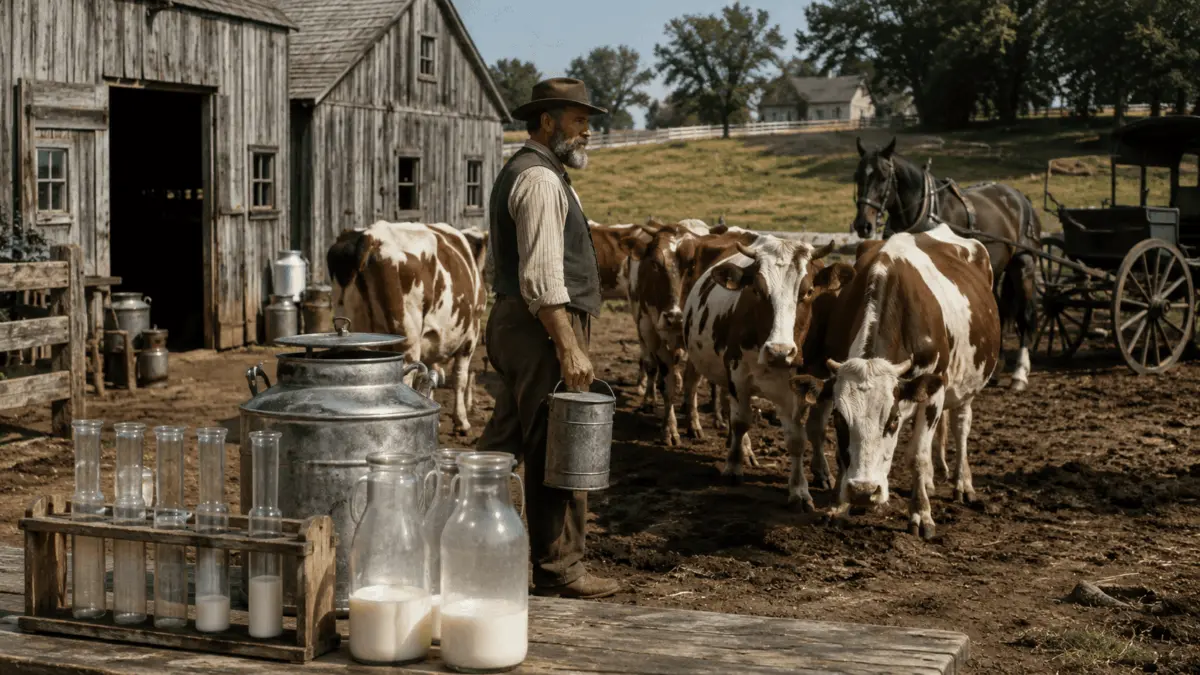
The modern dairy industry, a powerhouse of global agriculture characterized by precision, rigorous quality control, and scientific valuation, was built upon the ingenuity of a single nineteenth-century chemist. In 1890, Stephen Moulton Babcock—a professor at the University of Wisconsin Agricultural Experiment Station—unveiled a deceptively simple, inexpensive, and remarkably accurate method for determining the butterfat content of milk. Known universally as the Babcock Test, this breakthrough eliminated industry-wide fraud, provided a scientific baseline for milk pricing, and revolutionized selective dairy cattle breeding.
Before Babcock’s intervention, the dairy trade operated in a commercial "wild west." Milk was frequently adulterated with water, skimmed of its rich cream, or bought and sold based purely on volume rather than nutritional composition. Farmers lacked empirical tools to identify their most productive cows, and processors struggled to maintain uniform standards in butter and cheese production. By distilling complex chemical analysis into a rapid laboratory procedure using sulfuric acid and a specialized centrifuge, Babcock democratized dairy science.
Refusing to patent his invention, Babcock gifted his discovery to the public domain, cementing his legacy as a pioneer of public-interest scientific research. This article explores the remarkable trajectory of Stephen Babcock’s life, the mechanics and socio-economic impact of his famous test, the broader landscape of late-19th-century agricultural innovation, and the enduring ripples of his work on modern dairy farming.
Detailed Chronology: From Upstate New York to the University of Wisconsin
To understand the mind that revolutionized dairy farming, one must trace Stephen Babcock’s journey from humble rural roots to the pinnacle of American academia.
Early Life and Education (1843–1870)
Born on a farm in Bridgewater, New York, on January 22, 1843, Babcock developed an early, visceral understanding of agricultural life. He witnessed firsthand the trials of dairy farming—the unpredictable yields of cattle, the backbreaking labor of processing milk by hand, and the economic uncertainties faced by agrarian families. Despite these grounded beginnings, young Babcock possessed an insatiable academic curiosity. He pursued higher education in the East, graduating from Tufts College (now Tufts University) in 1866 with a degree in chemistry.
Following his undergraduate studies, Babcock taught chemistry and natural sciences at various institutions, but his ambition pointed toward deeper scientific inquiry. In the late 1860s and 1870s, the United States lacked the specialized graduate research infrastructure found in Europe. Consequently, like many ambitious American scientists of his era, Babcock crossed the Atlantic to immerse himself in the rigorous laboratories of Germany.
European Training and the Ph.D. (1870–1882)
Babcock enrolled at the prestigious University of Göttingen, a global epicenter for chemical research. Under the tutelage of prominent European chemists, he refined his analytical techniques, mastering quantitative chemistry and organic analysis. He earned his Ph.D. in 1879, armed with a deep appreciation for how empirical science could solve industrial and agricultural problems.
Upon returning to the United States, Babcock briefly served as an instructor at Tufts College and worked as a chemist for the New York State Agricultural Experiment Station in Geneva. During this period, he began focusing his analytical skills on agricultural chemistry—specifically, the complex chemical composition of milk and animal feeds. His reputation for meticulous research caught the attention of agricultural leaders in the Midwest, a region rapidly emerging as America’s dairy heartland.
The Wisconsin Years and the Quest for a Solution (1882–1890)
In 1888, Babcock accepted a position as professor of agricultural chemistry at the University of Wisconsin–Madison and chief chemist at the Wisconsin Agricultural Experiment Station. At the time, Wisconsin was transitioning from a wheat-dominated economy to a dairy powerhouse, driven by visionary agricultural leaders like William Dempster Hoard.
However, the rapid commercialization of dairy farming outpaced its technological tools. Farmers were pooling their milk at local cooperative cheese factories and creameries. Milk was paid for strictly by weight or volume, offering a perverse economic incentive: farmers who watered down their milk or used low-fat, high-yielding breeds received the same payout as those producing rich, high-butterfat milk. This lack of quality control threatened to destabilize the burgeoning cooperative movement.
Agricultural experiment stations across the nation scrambled for a solution. Several scientists had attempted to measure butterfat, but their methods were either too slow, too dangerous for field use, or prohibitively expensive. Babcock took up the challenge, spending years analyzing the fat globules suspended in milk plasma and seeking a reliable way to liberate and quantify them.
The Babcock Test: Mechanics, Science, and Socio-Economic Impact
By 1890, Babcock unlocked the solution. The genius of the Babcock Test lay not in complex theoretical physics, but in its elegant, accessible application of fundamental chemistry.
How the Test Worked
The procedure required only basic laboratory apparatus and could be executed by a trained creamery operator in minutes:
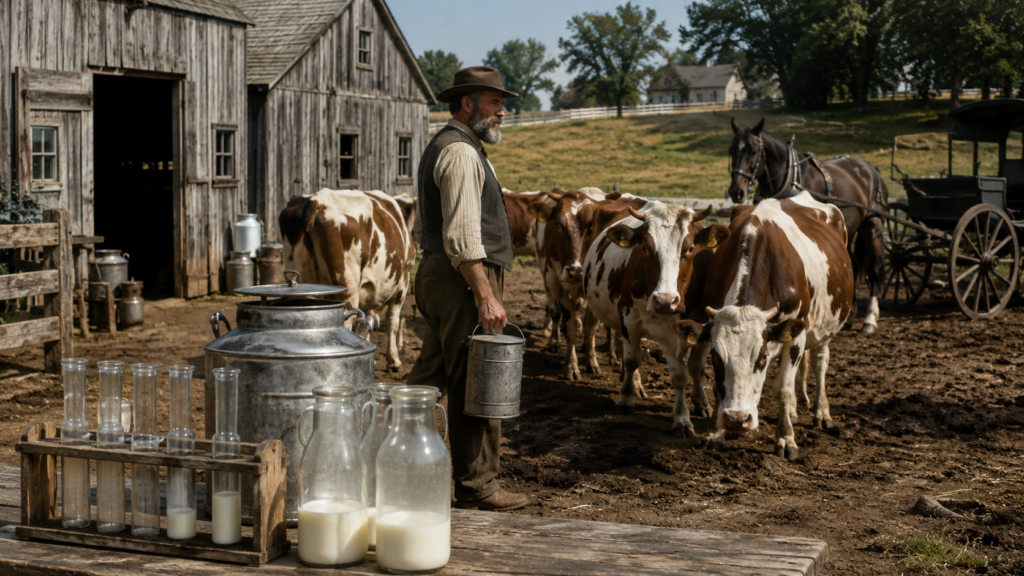
- Sampling: A precise sample of milk (17.6 cubic centimeters) was measured using a specialized pipette and placed into a narrow-necked, graduated test bottle.
- Acid Digestion: An equal volume of commercial sulfuric acid (17.5 cc) was added to the milk. The acid served a dual purpose: it generated intense heat, which melted the solid fat globules, and it dissolved the milk proteins (casein) that held the emulsion together, freeing the fat.
- Centrifugation: The mixture was placed in a hand-cranked or steam-driven centrifuge and spun rapidly for several minutes. Centrifugal force separated the components by density, driving the lighter liquid butterfat to the top.
- Reading the Results: Hot water was added to float the separated fat up into the narrow, calibrated neck of the bottle. By reading the scale on the neck, the operator could instantly determine the exact percentage of butterfat in the sample.
Economic Liberation of the Dairy Farmer
The impact of this simple procedure was seismic. Almost overnight, the Babcock Test shifted the economic foundation of the dairy industry from quantity to quality.
- Eradicating Fraud: Dishonest practices—such as skimming cream for home use before selling the residual milk, or diluting milk with well water—became instantly detectable.
- Rewarding Excellence: Farmers who invested in better breeding stock, superior feed management, and high-butterfat dairy breeds (such as Jerseys and Guernseys) were finally compensated fairly for the true value of their product.
- Streamlining Manufacturing: Creameries and cheese factories could now accurately calculate their "yield efficiency," optimizing the conversion of milk into butter and cheese, thereby reducing waste and maximizing profitability.
Supporting Context & Metrics: Transforming the Rural Economy
The scale of transformation catalyzed by the Babcock Test can be measured through historical metrics of production, economic valuation, and institutional growth at the University of Wisconsin.
| Metric / Indicator | Pre-Babcock Era (Pre-1890) | Post-Babcock Era (1890–1910) |
|---|---|---|
| Pricing Model | Flat rate per pound or gallon of whole milk. | Tiered pricing based strictly on verified butterfat percentage. |
| Industry Transparency | High rates of adulteration; widespread consumer and processor distrust. | Standardized testing protocols established industry-wide standards. |
| Breed Selection | Focused primarily on volume of milk yield, ignoring fat content. | Balanced breeding programs emphasizing both volume and butterfat richness. |
| Economic Value | Regional dairy markets limited by quality inconsistencies. | Rapid expansion of national export markets for American cheese and butter. |
Furthermore, Babcock’s refusal to patent his invention prevented the monopolization of dairy technology. Had he chosen commercial exploitation, he could have amassed a vast personal fortune. Instead, he prioritized public welfare and agricultural progress. In a letter addressing commercial inquiries, Babcock famously remarked that his work belonged to the state and the people who supported his research.
Official Statements and Historical Reflections
The historical weight of Stephen Babcock’s contributions has been widely acknowledged by agricultural historians, university leadership, and industry associations.
Reflecting on the cultural and economic shift of the 1890s, agricultural historians often cite an address given by former University of Wisconsin President Charles R. Van Hise, who emphasized the unique role of public research institutions:
"The discovery of the Babcock test is an illuminating example of how pure science, translated into practical application by a dedicated public servant, can elevate an entire commonwealth from economic uncertainty to sustained prosperity."
Decades later, the American Dairy Science Association (ADSA) formally recognized the centennial of the test, noting that modern dairy herd improvement associations (DHIAs) trace their direct lineage to the data collection systems made possible by Babcock’s initial laboratory protocols.
In his later years, Babcock remained remarkably modest about his monumental achievement. When honored by agricultural societies, he consistently deflected praise toward his colleagues at the Wisconsin Experiment Station, viewing himself merely as a workman executing his duty to advance human knowledge.
Future Outlook: The Enduring Legacy of Babcock in Modern Dairy
As the agricultural sector enters the mid-21st century—marked by automated milking systems, real-time milk-quality sensors, genomic selection, and artificial intelligence—the fundamental ethos established by Stephen Babcock remains alive and well.
Today’s dairy farms utilize sophisticated infrared spectroscopy and automated inline meters to analyze milk composition—fat, protein, somatic cell count, and lactose—within seconds of milking. Yet, the conceptual foundation of these cutting-edge technologies rests securely upon the precedent set in 1890: that milk payment, animal husbandry, and food safety must be governed by precise, objective, and scientifically verifiable data.
Stephen Babcock passed away in July 1931, leaving his entire modest estate to the University of Wisconsin to further agricultural research. His name endures across campus buildings, endowed professorships, and historical markers, but his truest monument is the global dairy industry itself.
From small organic family farms to massive automated dairy complexes, every stakeholder who evaluates milk based on its nutritional components operates within the framework forged by a curious farm boy from upstate New York who chose to look closer at the white liquid of the farmyard.

0 Comments