

Executive Overview
In an era where social media algorithms heavily incentivize attention-seeking behavior, the boundary between harmless adolescent pranks and severe criminal misconduct has increasingly blurred. This reality was starkly demonstrated in Phoenix, Arizona, where a 14-year-old boy was arrested following a destructive incident linked to the viral "Door Kick Challenge." The juvenile, whose identity has been withheld due to his age, is accused of causing approximately $10,000 in property damage to a residential home, while utilizing a stolen vehicle to execute the crime.
The incident, which occurred in a quiet Phoenix neighborhood, has reignited national conversations regarding the legal accountability of minors, the financial burdens imposed on victims of viral trends, and the intersection of digital peer pressure with organized juvenile delinquency. Arrested by the Phoenix Police Department on September 13, 2026, the teenager faces serious charges, including criminal damage and unlawful use of transportation. As law enforcement agencies continue their search for a second outstanding suspect, the case serves as a warning to parents, educators, and social media platforms about the real-world consequences of online clout-chasing.
Detailed Chronology
The events of this case unfold across two municipalities in the Phoenix metropolitan area, highlighting a fast-moving sequence of auto theft, property destruction, and rapid police intervention.
+-----------------------------+      +-----------------------------+      +-----------------------------+
|    Pre-Incident Theft       |      |     Sept 12, 6:30 AM        |      |      Sept 13 Arrest         |
|  Red Ford truck stolen from  | ---> | Suspects arrive in Phoenix; | ---> |  14-year-old identified,    |
|   Scottsdale, Arizona.      |      | kick custom door ($10K dmg) |      | arrested, booked at Durango |
+-----------------------------+      +-----------------------------+      +-----------------------------+
The Prelude: Auto Theft in Scottsdale
Before the physical damage was inflicted on the Phoenix residence, the criminal chain of events began in the neighboring city of Scottsdale. According to investigators, the 14-year-old suspect and an accomplice gained unlawful possession of a red Ford pickup truck. Police later confirmed that this vehicle had been officially reported stolen. During their subsequent investigation, detectives uncovered additional evidence linking the primary 14-year-old suspect to a second stolen vehicle, suggesting a broader pattern of auto theft preceding the viral challenge attempt.
The Incident: September 12, 2026
At approximately 6:30 a.m. on Thursday, September 12, 2026, the stolen red Ford truck pulled up to a residence located near the intersection of 44th Street and Thunderbird Road in Phoenix.
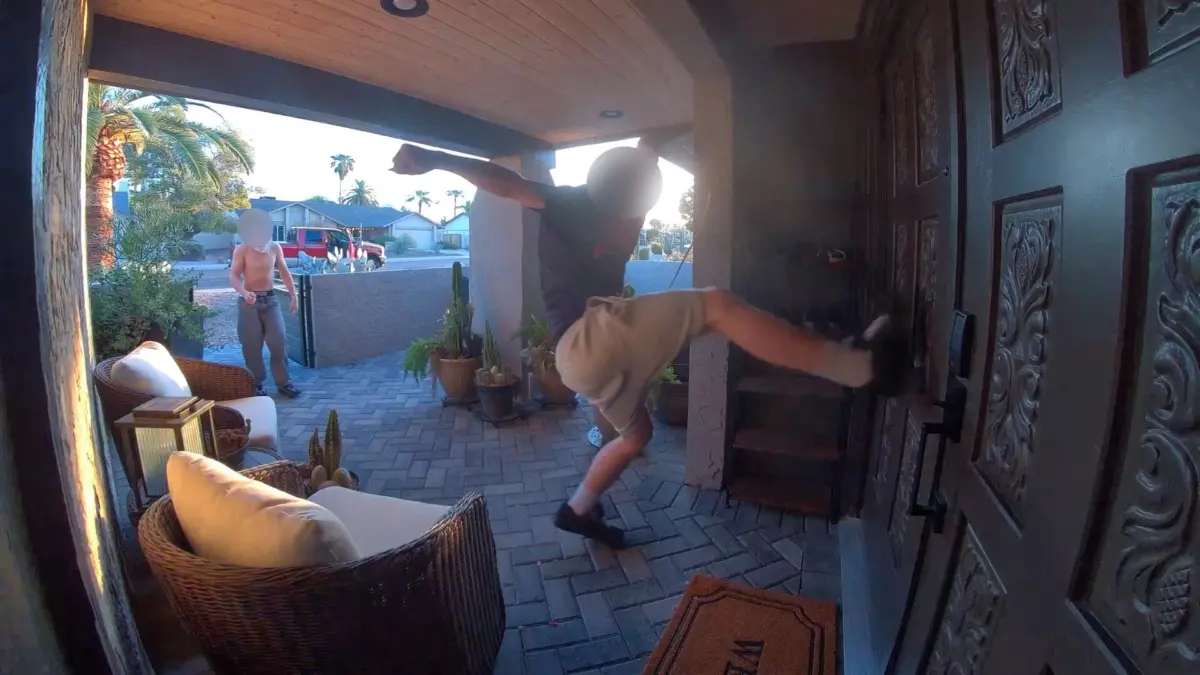
Home security footage captured the subsequent events in vivid detail:
- Concealment Attempt: Two underage male suspects exited the stolen vehicle. As they approached the property, both individuals attempted to cover their faces to evade identification by security cameras.
- Breaching the Perimeter: The suspects opened the property’s front gate, entering the private courtyard of the home.
- The Strike: One of the teenagers stepped up to the front door and delivered a violent, high-impact kick directly to the structure before both suspects fled the scene in the stolen truck.
The force of the impact shattered the structural integrity of the home’s custom-built front door. The homeowners later revealed that the door was a bespoke, custom piece that cannot simply be repaired; instead, it must be entirely remade and reinstalled from scratch, carrying an estimated replacement cost of $10,000.
The Apprehension: September 13, 2026
The Phoenix Police Department acted swiftly following the report of the incident. Utilizing footage from the homeowners’ Ring doorbell camera and collaborating with neighboring jurisdictions, detectives quickly identified the 14-year-old driver.
On Friday, September 13, 2026—less than 36 hours after the attack—police located and arrested the teenager. He was booked into the Durango Juvenile Detention Facility in Phoenix. The juvenile has been formally charged with:
- One count of Criminal Damage (classified under Arizona law based on the high monetary value of the destruction).
- One count of Unlawful Use of Means of Transportation (associated with the stolen Scottsdale truck).
At the time of writing, the second suspect remains unidentified, and the Phoenix Police Department’s investigation remains active.
Supporting Context & Metrics
To fully understand the gravity of this arrest, it is necessary to examine the broader sociological and legal framework surrounding viral challenges, property crime valuations, and juvenile auto theft trends.
The Anatomy of the "Door Kick Challenge"
The "Door Kick Challenge" is a recurring viral trend that periodically resurfaces across major short-form video platforms such as TikTok and Instagram Reels.
[Social Media Trend] ---> [Desire for Online Engagement] ---> [Property Trespass & Damage] ---> [Criminal Charges]The premise of the challenge is simple yet highly disruptive: participants film themselves approaching a residential home—frequently late at night or during the early hours of the morning—and kicking the front door to the beat of a popular song (often Ke$ha’s "Die Young" or similar high-tempo tracks) before running away.
While participants often perceive the act as a victimless prank, the real-world impact on homeowners is profound. Beyond the immediate physical damage, the sudden, violent noise of a door being kicked in can cause severe psychological distress, mimicking the initial stages of a home invasion. In some instances nationwide, homeowners have responded with defensive force, raising the stakes of these pranks from property damage to potential loss of life.
The Economic and Legal Thresholds of Property Damage
In the state of Arizona, the financial cost of property damage directly dictates the severity of the criminal charges filed. Under Arizona Revised Statutes (A.R.S.) § 13-1602, criminal damage is classified based on the dollar value of the loss:
| Damage Valuation | Classification under Arizona Law | Potential Penalties (Adult equivalent) |
|---|---|---|
| Under $250 | Class 2 Misdemeanor | Up to 4 months in jail, fines |
| $250 to $1,000 | Class 1 Misdemeanor | Up to 6 months in jail, probation |
| $1,000 to $2,000 | Class 6 Felony | Up to 1.5 years in prison |
| $2,000 to $10,000 | Class 5 Felony | Up to 2.5 years in prison |
| $10,000 or more | Class 4 Felony | Up to 3.75 years in prison, mandatory restitution |
Because the custom door at the Phoenix residence was valued at approximately $10,000, the 14-year-old suspect’s actions sit on the threshold of a Class 4 Felony charge for criminal damage. When combined with the felony charge of Unlawful Use of Transportation (A.R.S. § 13-1803), the legal consequences for this minor are extraordinarily severe, far exceeding the typical disciplinary measures associated with juvenile mischief.
The Intersection of Viral Trends and Auto Theft
This case highlights a disturbing escalation: the integration of vehicle theft into viral property damage challenges. Law enforcement agencies across the United States have noted that juveniles are increasingly utilizing stolen vehicles to commit secondary crimes. This tactic serves multiple purposes for young offenders:
- It provides rapid transportation to and from crime scenes.
- It prevents investigators from tracing getaway vehicles back to the suspects’ parents or guardians.
- It allows juveniles to participate in multiple high-risk online challenges simultaneously (such as combining auto theft trends with property damage dares).
Official Statements
Following the arrest, representatives from local law enforcement emphasized the importance of inter-agency cooperation and issued stern warnings to the community regarding the long-term consequences of digital delinquency.
A spokesperson for the Phoenix Police Department highlighted the rapid coordination that led to the juvenile’s arrest:
"This case demonstrates strong collaboration between multiple agencies and investigative units, resulting in the swift identification and arrest of the subject. What may begin as a misguided attempt at online notoriety can quickly escalate into felony-level criminal charges that carry life-altering consequences."
The department also issued a direct appeal to parents and guardians, urging them to take an active role in monitoring their children’s digital footprint:
"We are urging parents and guardians to talk with their kids about the consequences of taking part in dangerous online trends. These are not harmless pranks; they are crimes that cause real financial and emotional harm to our community members. We ask all community members to remain vigilant and report any suspicious activity immediately."
Future Outlook
As the Phoenix Police Department continues its investigation into the second suspect, this case highlights several critical challenges facing modern law enforcement, suburban communities, and the juvenile justice system.
Legal Trajectory for the Suspect
The 14-year-old suspect’s case will be processed through the Maricopa County juvenile court system. Unlike the adult system, which focuses heavily on punitive measures, the juvenile justice system prioritizes rehabilitation, education, and victim restitution. However, given the high financial toll of the damage ($10,000) and the involvement of multiple stolen vehicles, the court may impose rigorous probation terms, mandatory community service, and significant financial restitution requirements on the suspect’s family.
The Role of Smart Home Technology in Modern Policing
The rapid resolution of this case underscores the pivotal role that consumer security technology plays in modern criminal investigations. Doorbell cameras, private surveillance systems, and community-based sharing networks (such as Ring’s Neighbors app) allow residents to instantly share high-definition video evidence with law enforcement. This neighborhood-level surveillance network has made it increasingly difficult for perpetrators of viral challenges to escape identification, effectively closing the gap between the commission of a crime and police intervention.
Preventive Measures and Digital Literacy
Moving forward, school districts and community organizations in the Phoenix area are expected to increase programming focused on digital literacy and the legal realities of social media challenges. Experts suggest that combatting these trends requires a three-pronged approach:
                  +-----------------------------------+
                  |  Community Preventive Framework   |
                  +-----------------------------------+
                                    |
         +--------------------------+--------------------------+
         |                          |                          |
+--------v---------+       +--------v---------+       +--------v---------+
| Parent Education |       | School Programs  |       | Tech Regulation  |
| Monitoring apps, |       | Legal workshops, |       | Algorithmic bias |
| open dialogue on |       | real-world cost  |       | safety controls, |
| viral pressures. |       | presentations.   |       | reporting loops. |
+------------------+       +------------------+       +------------------+
Only through coordinated efforts between families, schools, law enforcement, and technology developers can communities hope to curb the destructive cycle of viral-inspired juvenile delinquency. Until then, the Phoenix Police Department remains on high alert, emphasizing that those who choose to participate in online challenges at the expense of their neighbors will face tangible, real-world justice.

0 Comments