
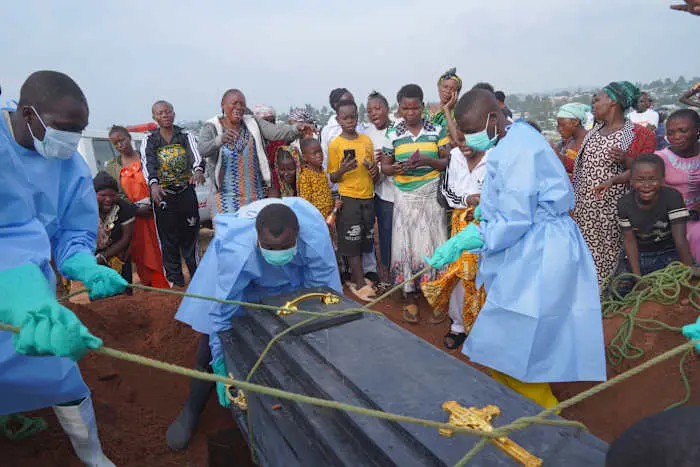

BUNIA, Democratic Republic of Congo — In the red-clay cemetery of Bunia, a stark ritual has become almost commonplace. Under a heavy African sun, burial teams clad in impermeable, head-to-toe protective gear lower yet another wooden casket into the earth. Inside lies Jeannine Katusabe, one of the more than 3,000 victims claimed by what public health officials are now calling the most aggressive and rapidly spreading Ebola epidemic in modern history.
As the new academic year commences across the eastern provinces, school officials nervously check the temperatures of children filing through gates, praying that classrooms do not become incubators for the deadly filovirus.
According to the latest epidemiological data released by the Ministry of Health, the outbreak has surpassed a grim milestone: more than 3,000 lives lost out of over 6,100 confirmed cases. Declared a global health emergency by the World Health Organization (WHO) in mid-May, the crisis is escalating at an unprecedented velocity, continuously outstripping the capacities of local and international tracking, treatment, and containment infrastructures.
With the virus now actively circulating across six provinces and threatening to eclipse historical epidemiological benchmarks, the international public health community finds itself locked in a desperate race against time, conflict, and viral mutation.
Executive Overview: A Catastrophe Unfolding in Real Time
The ongoing Ebola epidemic in the Democratic Republic of Congo (DRC) is no longer localized; it is a sprawling humanitarian emergency that threatens regional and global stability. Since the WHO classified the outbreak as a Public Health Emergency of International Concern (PHEIC), the disease has carved a devastating path through the country’s eastern zones—most notably in Ituri and North Kivu.
The numbers alone tell a harrowing story of systemic overload. As of the latest ministry figures, the outbreak has recorded 6,186 confirmed cases and 3,007 deaths, yielding a case fatality rate that threatens to spiral further out of control as new health zones are continually breached. Public health experts warn that these figures are likely the tip of the iceberg. The Africa Centers for Disease Control and Prevention (Africa CDC) estimates that the actual scale of the epidemic could be three times larger than official tallies, obscured by weak surveillance networks, active conflict zones, and deeply entrenched community distrust.
What distinguishes this outbreak from previous historical episodes is its sheer velocity. The virus is moving faster than containment strategies can be deployed. Healthcare workers, exhausted and underfunded, have staged multiple strikes to demand unpaid wages, further hobbling the front-line response. Compounding these human resource challenges are endemic regional conflicts, violent attacks on treatment centers, highly mobile populations of informal gold miners, and fragile public health infrastructure.
As the international community watches with bated breath, epidemiologists warn that if current transmission trajectories hold, this outbreak is on a direct path to rival or even exceed the catastrophic 2014–2016 West African epidemic, which claimed over 11,000 lives. Yet, unlike previous outbreaks fueled by the Zaire ebolavirus—for which highly effective vaccines and therapeutics exist—this crisis is driven by the rare Bundibugyo strain, for which no fully licensed vaccine or specific targeted treatment currently exists.
Detailed Chronology: From the First Spark to a National Crisis
To understand how the DRC arrived at this precipice, one must trace the timeline of a crisis that moved from a localized health warning to an international catastrophe in a matter of months.
The Spark: Mid-May 2026
The outbreak was officially declared a global health emergency in mid-May, following a sudden cluster of unexplained hemorrhagic fever deaths in eastern Congo. Initial epidemiological investigations pointed toward Ituri province as the epicenter. Health authorities quickly recognized unusual clinical presentations, which were soon confirmed to be caused by the Bundibugyo species of the Ebola virus—a rare and lethal strain historically associated with outbreaks in neighboring Uganda, but never before seen exploding with such ferocity inside the DRC.
The Summer Surge: June – July 2026
Throughout the early summer months, the virus defied containment efforts. Movement across porous borders and the constant migration of informal gold miners through Ituri and neighboring provinces acted as human vectors, carrying the pathogen deep into rural settlements and densely populated trading hubs.
During this period, the logistical fault lines of the response became glaringly apparent. Treatment centers reported critical shortages of personal protective equipment (PPE), while operational funds failed to trickle down to front-line responders. Frustrated by months of unpaid hazard pay, health workers launched the first of several paralyzing strikes, temporarily halting contact-tracing operations and leaving suspected cases unmonitored in the community.
The Academic Test: September 2026
As autumn approached, the government faced a agonizing policy dilemma: keep schools closed to suppress transmission or resume education to restore a semblance of normalcy. Ultimately, the decision was made to reopen schools on September 1. Images of school officials scanning children’s foreheads with infrared thermometers at the entrance of classrooms in Ituri quickly flashed across international newswires. While public health officials implemented hand-washing stations and daily health screenings, epidemiologists expressed grave concerns that classrooms could serve as secondary transmission sites, mirroring the transmission dynamics seen during past respiratory and viral outbreaks.
The North Kivu Expansion: Late August – Present
By late August and early September, the epidemiological map darkened further. The virus breached two new health zones in North Kivu. Compounding the alarm, the case fatality rates in North Kivu are significantly higher than those observed in the rest of the affected provinces, driven by severe delays in seeking care and heightened local insecurity that prevents medical teams from entering contested areas. To date, six provinces have reported confirmed cases, turning a localized eastern flare-up into a nationwide emergency.
Supporting Context & Metrics: The Anatomy of an Unprecedented Epidemic
The severity of the current epidemic cannot be understood through raw case counts alone. It is the convergence of ecological, geopolitical, and biological factors that has weaponized the Bundibugyo virus against the population of eastern Congo.
1. The Biological Threat: The Bundibugyo Strain
Unlike the 2018–2020 North Kivu outbreak—which was driven by the Zaire ebolavirus and successfully beaten back thanks to the rapid deployment of the rVSV-ZEBOV (Ervebo) vaccine and monoclonal antibody treatments like mAb114 and REGN-EB3—the current crisis is driven by the Bundibugyo virus.
- The Treatment Void: There are currently no approved vaccines or targeted therapeutics specifically designed and licensed for the Bundibugyo strain.
- The Intervention Debate: While the Congolese government has begun distributing the Ervebo vaccine—hoping it might offer some degree of cross-protection based on preliminary immunological data—the WHO acknowledges that its efficacy against the Bundibugyo variant remains unproven. Meanwhile, pharmaceutical researchers are racing to develop novel vaccine candidates tailored to the strain, but clinical trials take months, and the epidemic is moving in days.
2. The Statistical Blind Spot
According to assessments by the Africa CDC, official figures represent only a fraction of the actual devastation. Weak surveillance systems, fear of stigmatization, and community resistance mean that many individuals die at home without ever interacting with the formal health system. Contact tracing—the bedrock of any successful epidemic containment strategy—is operating at a fraction of its required capacity due to insecurity and community pushback. Public health modelers suggest that true infection numbers could be triple the officially confirmed 6,186 cases.
3. Socio-Economic and Geopolitical Drivers
The persistence of the outbreak is heavily anchored in the socio-economic realities of eastern Congo:
- Armed Conflict: The Ituri and North Kivu regions have long been plagued by militia violence, displacing hundreds of thousands of civilians into overcrowded, unsanitary displacement camps where infectious diseases spread like wildfire.
- Attacks on Healthcare Infrastructure: Clinics and response teams have repeatedly faced physical attacks and community hostility, driven by mistrust of authorities, misinformation, and conspiracy theories.
- The Ituri Gold Rush: The region’s economy relies heavily on informal, highly mobile gold mining communities. Miners constantly move between remote forest camps and bustling trade towns, effectively acting as asymptomatic or early-stage vectors who carry the virus across provincial and national borders before falling ill.
Official Statements and International Response
The gravity of the crisis has drawn sharp rebukes and urgent appeals from global health leaders who fear the international community is reacting too slowly to a catastrophe in the making.
During a virtual briefing in Geneva, senior WHO officials did not mince words. Representatives noted that the outbreak is tracking closely with the early stages of West Africa’s historic 2014–2016 epidemic, which ultimately claimed over 11,000 lives across Guinea, Liberia, and Sierra Leone.
"We are witnessing an epidemic that is outpacing our collective capacity to respond," warned a senior WHO emergency coordinator. "Without an immediate, massive influx of operational funding, logistical support, and unimpeded access for health workers to conflict zones, we risk watching history repeat itself on an even more catastrophic scale."
The Africa CDC has echoed these concerns, emphasizing that standard containment playbooks are failing because they are not properly adapted to the complex security landscape of eastern DRC. The agency has called for a coordinated regional response, urging neighboring nations—particularly Uganda, Rwanda, and South Sudan—to heighten surveillance at border crossings while avoiding economically crippling trade and travel bans.
Domestically, the government in Kinshasa has faced immense pressure. Ministry of Health officials have defended their handling of the crisis, pointing to the Herculean efforts of front-line nurses and doctors working under constant threat of violence. In response to the paralyzing strikes over unpaid wages, the central government has pledged to clear salary arrears and provide immediate hazard pay enhancements, though implementation has been uneven in remote field offices.
Future Outlook: Can the Tide Be Turned?
As autumn deepens in Central Africa, the trajectory of the epidemic hangs in a precarious balance. The coming months will determine whether the outbreak can be beaten back or whether it will establish an entrenched foothold across the heart of the African continent.
Public health experts agree that turning the tide requires a fundamental shift in strategy, divided into several critical imperatives:
- Securing Humanitarian Access: International diplomatic channels must pressure armed factions in Ituri and North Kivu to establish "health corridors," ensuring medical teams, vaccines, and supplies can reach populations trapped behind front lines.
- Resolving Front-Line Grievances: Immediate and guaranteed disbursement of salaries and hazard pay for local healthcare workers is non-negotiable. A strike-free workforce is the absolute prerequisite for effective surveillance and treatment.
- Accelerating R&D for Bundibugyo Therapeutics: Global pharmaceutical giants, research institutions, and international regulatory bodies must fast-track clinical trials for vaccines and monoclonal antibodies specifically tailored to neutralize the Bundibugyo strain.
- Community-Led Engagement: To overcome deep-seated mistrust, the response must shift away from top-down enforcement toward community-led education, utilizing local leaders, traditional healers, and survivors as trusted messengers to encourage early reporting and safe burials.
Back in Bunia, as another family mourns beneath the tropical rain, the stakes could not be higher. The international community faces a stark choice: invest the necessary capital, security, and scientific resources to extinguish the fire while it is still containable, or stand witness as the crucible of Ituri consumes thousands more lives, pushing global health security to the brink.

0 Comments