
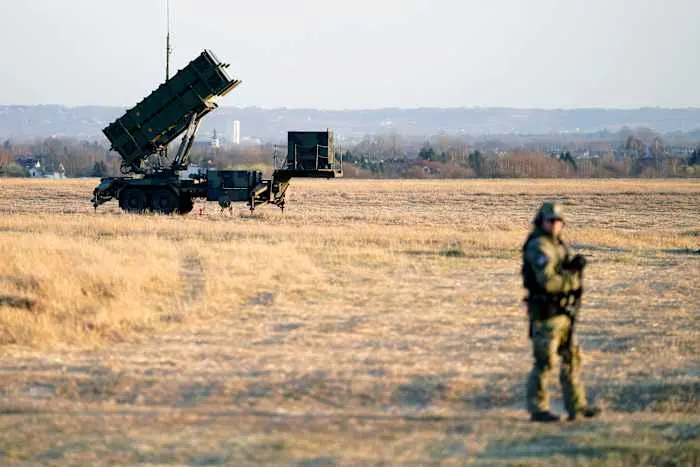

WASHINGTON — A quiet but severe security crisis is unfolding across the European continent. As the United States military grapples with a high-intensity, six-month-old war against Iran in the Middle East, its defensive posture in Europe has been severely compromised.
According to senior Western military and intelligence officials, the U.S. armed forces are currently experiencing a "beyond critical" shortage of advanced air defense interceptors on NATO’s eastern flank. This depletion has left European allies highly vulnerable to potential Russian ballistic missile strikes, exposing a dangerous gap in the alliance’s ability to defend its own airspace.
Executive Overview
For nearly five years, the primary focus of NATO’s air defense planners was the containment of Russian aggression along the borders of Eastern Europe. However, the outbreak of direct military hostilities between the United States and Iran in early 2026 has fundamentally rewritten the global security calculus. To shield American troops and allied infrastructure in the Persian Gulf from relentless waves of Iranian drones, cruise missiles, and ballistic trajectories, the Pentagon has quietly dismantled parts of its European defensive umbrella.
The core of this vulnerability lies in the acute shortage of Patriot missile interceptors—the gold standard of Western theater air defense. A U.S. defense official stationed in Europe and a senior NATO official, both speaking on the condition of anonymity to discuss highly sensitive operational matters, have confirmed that current stockpiles are insufficient to withstand a sustained Russian ballistic missile assault.
Should Moscow launch a targeted campaign against critical European infrastructure, such as logistics hubs, military headquarters, or power grids, NATO forces could find themselves in a position similar to Ukraine: forced to prioritize which vital assets to protect while watching others be destroyed.
While senior Pentagon leadership publicly maintains that U.S. global readiness remains uncompromised, military analysts and field commanders warn that the defense industrial base is failing to keep pace with a multi-theater security crisis.
Detailed Chronology: From Ukraine to the Persian Gulf
The path to the current interceptor crisis is a story of compounding geopolitical emergencies, where the consumption of high-end munitions has consistently outpaced industrial production.
[2022–2025]                          [Feb 2026]                     [Spring–Summer 2026]              [Aug 2026]
US transfers ~600 Patriots to        US-Iran War begins;            Massive interceptor drawdown;     CIA Director Ratcliffe
Ukraine; stockpiles drop             Middle East deployments        65% of US Patriot inventory       secretly visits Moscow
under planned drawdowns.             surge to counter drone swarms. expended; Europe left vulnerable.  to warn against escalation.
1. The Ukrainian Crucible (2022–2025)
Following Russia’s full-scale invasion of Ukraine in February 2022, the United States and its European allies began transferring air defense assets to Kyiv. Over the course of the first four and a half years of the conflict, the Biden administration authorized the transfer of approximately 600 Patriot interceptors to Ukraine.
While these transfers strained Western reserves, defense analysts note that this drawdown was carefully planned, measured, and offset by projected production increases. The goal was clear: prevent Russian air superiority at all costs.
2. The Outbreak of the U.S.-Iran War (February 2026)
The strategic equation changed dramatically in February 2026 when long-simmering tensions between Washington and Tehran erupted into open warfare. The conflict quickly escalated into a high-volume missile and drone exchange.
Faced with sophisticated, multi-directional attacks from Iranian forces and their regional proxies, the U.S. Central Command (CENTCOM) required immediate, massive air defense reinforcement.
3. The Great Munitions Reallocation (Spring–Summer 2026)
To protect American military bases in Iraq, Syria, and Jordan, as well as critical shipping lanes and partner nations in the Gulf, the Pentagon began raiding stockpiles worldwide.
Patriot batteries and thousands of interceptor missiles originally earmarked for the European theater—including vital logistics hubs like the Rzeszow-Jasionka Airport in Poland—were packed up and flown to the Middle East. Over the next six months, U.S. and Gulf partner forces fired off interceptors at an unprecedented rate to counter Iranian drone swarms and ballistic missiles, some of which succeeded in inflicting casualties on American personnel.
4. The August 2026 Diplomatic Backchannel
By late August 2026, as the war with Iran reached its six-month milestone, the intelligence community grew deeply alarmed by NATO’s exposure in Europe.
In a highly unusual move, CIA Director John Ratcliffe embarked on a secretive trip to Moscow. According to reports first published by The Wall Street Journal, Ratcliffe’s mission was to deliver a direct, face-to-face warning to Russian officials: do not mistake NATO’s current air defense shortfalls for a lack of resolve, and do not attempt to test the alliance’s borders.
President Donald Trump subsequently downplayed the trip, characterizing it to reporters as "sort of semi-routine," though defense insiders viewed it as a clear sign of operational panic.
Supporting Context & Metrics: The Math of Depletion
The scale of the current munition deficit is best understood through the stark metrics of the Western defense industrial base. The rapid consumption of high-end interceptors has exposed a fundamental mismatch between the realities of modern warfare and the peacetime production schedules of Western defense contractors.
The Patriot Inventory Collapse
According to data compiled by the Center for Strategic and International Studies (CSIS), the war with Iran has been the single greatest driver of the Patriot stockpile collapse:
- Total U.S. Interceptor Inventory (Pre-2026): Approximately 2,330 missiles.
- Expended in the Iran Conflict: Roughly 1,500 missiles (representing a staggering 65% of the total U.S. inventory).
- Transferred to Ukraine (2022–2026): Approximately 600 missiles.
- Remaining Global Reserve: Under 300 missiles, split between active deployments, testing, and minimal homeland defense reserves.
U.S. Patriot Interceptor Stockpile Depletion (2026)
─────────────────────────────────────────────────────────────
██████████████████████████████  65% Expended in Iran War (1,500)
████████████                    26% Transferred to Ukraine (600)
████                            9% Remaining Global Reserve (~230)
─────────────────────────────────────────────────────────────
Total Pre-War Inventory: ~2,330 missiles
To put these numbers in perspective, the United States is projected to manufacture only about 600 Patriot missiles in the entirety of 2026. While Lockheed Martin and Raytheon have set an ambitious production goal of 2,000 Patriot missiles per year, that target is not projected to be met until 2030.
Technical Challenges of Ballistic Defense
The reliance on the Patriot system stems from its unique capability to intercept high-speed ballistic missiles, such as Russia’s Iskander-M or Kinzhal. These weapons travel on high-altitude, steep trajectories and descend toward their targets at speeds exceeding Mach 5.
While cheaper air defense systems and anti-aircraft guns can successfully down slow-moving Iranian-designed Shahed drones, only a high-end, hit-to-kill interceptor like the Patriot PAC-3 can reliably neutralize a ballistic threat in its terminal phase.
+-------------------------------------------------------------------------+
|                      AIR DEFENSE CAPABILITY MATRIX                      |
+------------------------+-----------------------+------------------------+
| Target Type            | Patriot System (US)   | SAMP/T NG (FR/IT)      |
+------------------------+-----------------------+------------------------+
| Low-Speed Drones       | Highly Effective      | Effective              |
| Cruise Missiles        | Highly Effective      | Effective              |
| Ballistic Missiles     | Combat Proven (Mach 5)| Upgraded (Untested)    |
| Operational Range      | Up to 160 km          | Up to 120 km           |
+------------------------+-----------------------+------------------------+
The Lack of Alternatives
Europe currently has very few viable alternatives to fill this gap:
- SAMP/T NG: The French-Italian Sol-Air Moyenne Portée/Terrestre New Generation (SAMP/T NG) is touted as a competitor to the Patriot, with Paris promising accelerated deliveries to Ukraine. However, this upgraded version remains largely untested in high-intensity combat, and the current operational variant has a significantly shorter range than the Patriot.
- Naval Assets: While U.S. and European Aegis-equipped destroyers can provide localized air defense, they are bound to maritime environments. They cannot easily protect inland infrastructure—such as military bases in Poland or Romania—without risking exposure to land-based anti-ship cruise missiles.
- Offensive Munitions Offset: The military picture is slightly less bleak regarding offensive strike capabilities. European nations retain healthy stocks of air-launched cruise missiles, such as the British Storm Shadow and the German Taurus. However, as one military strategist noted, "You cannot shoot down an incoming ballistic missile with a cruise missile; offense does not replace a shield."
Official Statements: Public Reassurance vs. Private Alarm
The discrepancy between what military officials are saying behind closed doors and what they are telling the public highlights the delicate diplomatic balancing act currently underway.
The View from the Field
Privately, military leaders are sounding the alarm. A U.S. defense official in Europe warned that the current lack of ready interceptors would leave command structures highly vulnerable:
"If we faced a coordinated, multi-axis ballistic missile strike tomorrow, we would have to make impossible choices. We do not have the depth of magazine to stop a sustained attack. We would be forced to watch critical infrastructure take punch after punch in the mouth."
Ed Arnold, a senior associate fellow at the Royal United Services Institute (RUSI) in London, pointed out the strategic absurdity currently facing some European powers:
"The uncomfortable reality is that countries like Germany have spent billions purchasing incredibly advanced, expensive Patriot launch systems, but they are now in the ridiculous position of having virtually no ammunition to fire from them because the global supply chain has been drained by the Middle East."
The Official Denials
In contrast, public-facing officials are working overtime to project strength and deter potential adversaries.
U.S. Army Colonel Martin O’Donnell, a senior NATO military spokesperson, pushed back against the characterization of the shortage as "beyond critical":
"It is simply not the case that NATO is defenseless. The alliance is fully capable of blocking punches. We possess the necessary air defense munitions to defend our territory while continuing to support our partners in Ukraine."
Similarly, Chief Pentagon Spokesman Sean Parnell released a strongly worded statement dismissing any claims of operational vulnerability:
"Claims of U.S. munition shortages are false. We have everything required to strike at the time and place of the President’s choosing. Across multiple combatant commands, we have already executed successful operations while maintaining a deep, ready arsenal to defend our people and our interests."
Future Outlook: The Dangerous Window (2026–2030)
NATO now faces a critical four-year window of vulnerability. Between now and 2030—when global Patriot production is projected to finally stabilize at 2,000 missiles per year—the alliance must navigate a highly volatile security landscape with a depleted arsenal.
[Sept 2026]                     [Early 2027]                  [2028–2029]                 [2030]
Germany Patriot production      First deliveries to           Slow replenishment of       Stockpiles rebound;
facility opens in Schrobenhausen. Germany, Spain, Netherlands. European defense reserves.  production hits 2,000/yr.
The European Industrial Push
To mitigate the crisis, NATO is attempting to localize the production of American military technology on European soil. The first European Patriot missile production facility, located in Schrobenhausen, Germany, is scheduled to open in September 2026.
Deliveries from this facility are expected to begin in early 2027. However, the initial production runs are already fully claimed by nations that placed orders years ago, including Germany, the Netherlands, Spain, and Romania. It will take years for these new assembly lines to make a meaningful dent in the global deficit.
The Saving Grace: Russia’s Constraints
If there is a silver lining for NATO, it lies in the heavy toll that the ongoing war in Ukraine has taken on the Russian military. While Moscow has transitioned its economy to a wartime footing, its own stocks of high-end precision missiles have been heavily depleted by near-nightly bombardment campaigns against Ukrainian cities.
Furthermore, Ukraine’s successful long-range drone strikes deep inside Russian territory have forced the Kremlin to pull its own air defense systems back to protect domestic oil refineries and military airfields.
As RUSI’s Ed Arnold observed:
"The uncomfortable truth is that, right now, the best air defense that NATO has in Europe is not our own depleted stockpiles, but rather the severe operational and material constraints currently binding the Russian military."
Whether those Russian constraints will last long enough for Western production lines to recover remains the defining national security question of the decade.

0 Comments