WASHINGTON — Beneath the polished veneer of high-level diplomacy, a discordant symphony of protest and patriotism echoed through the streets of the nation’s capital on Thursday, September 24, 2026. As U.S. President Donald Trump extended an exceptionally warm, highly personalized welcome to Chinese President Xi Jinping—complete with an airport greeting, a private tour of a newly constructed helipad, and an intimate, candlelit dinner—the surrounding federal enclave became a battleground of political expression.
For hours, the airspace near Lafayette Park and the U.S. Capitol was filled with the competing sounds of anti-regime chants and pro-Beijing anthems. The scene laid bare the deep-seated ideological fractures that continue to complicate the bilateral relationship between the world’s two largest superpowers. While the two leaders discussed trade, security, and global supply chains behind the fortified walls of the White House, hundreds of demonstrators gathered to remind the world of the human cost of China’s domestic policies.
Executive Overview
The state visit of President Xi Jinping to Washington in September 2026 arrived at a critical juncture in U.S.-China relations. Designed as a showcase of diplomatic stabilization and economic bargaining, the summit instead highlighted the irreconcilable gap between state-level pragmatism and grassroots human rights advocacy.
Inside the White House, the Trump administration sought to cultivate a highly receptive, transactional atmosphere. President Trump’s decision to personally greet Xi at the airport and offer a private tour of executive facilities signaled a desire to build rapport and secure concessions on trade tariffs and currency valuation.
Outside, however, the narrative was vastly different. A coalition of Tibetan independence activists, Uyghur advocates, Hong Kong democracy champions, and Chinese dissidents formed a continuous wall of protest. Their presence served as a stark counterweight to the official pageantry, systematically dismantling Beijing’s preferred narrative of a harmonious, unified global power.
Conversely, organized counter-demonstrators aligned with Beijing staged their own rallies. This demonstrated that the geopolitical battle for public opinion is actively waged not just in the South China Sea or tech corridors, but on the streets of Western democracies.
Detailed Chronology of the Day’s Demonstrations
The day’s events unfolded in a carefully choreographed series of mobilizations across Washington, D.C., beginning in the early hours of Thursday and culminating in a loud standoff during the evening’s state dinner.
[08:00 AM] Dissident Assembly at Chinese Embassy
   │
   ▼
[11:00 AM] March to the U.S. Capitol (Tibetan & Uyghur Rallies)
   │
   ▼
[02:00 PM] Pro-Beijing Groups Gather at Xi's Hotel
   │
   ▼
[04:30 PM] Lafayette Park Standoff (Loudspeakers & Chants)
   │
   ▼
[07:30 PM] State Dinner Staged Amid Continuous Protests
Morning: The Embassy Mobilization and March to the Capitol
The demonstrations began at approximately 8:00 AM outside the Embassy of the People’s Republic of China in the international district. Dissidents representing various religious and political organizations gathered to deliver speeches condemning the Chinese Communist Party’s (CCP) authoritarian governance.
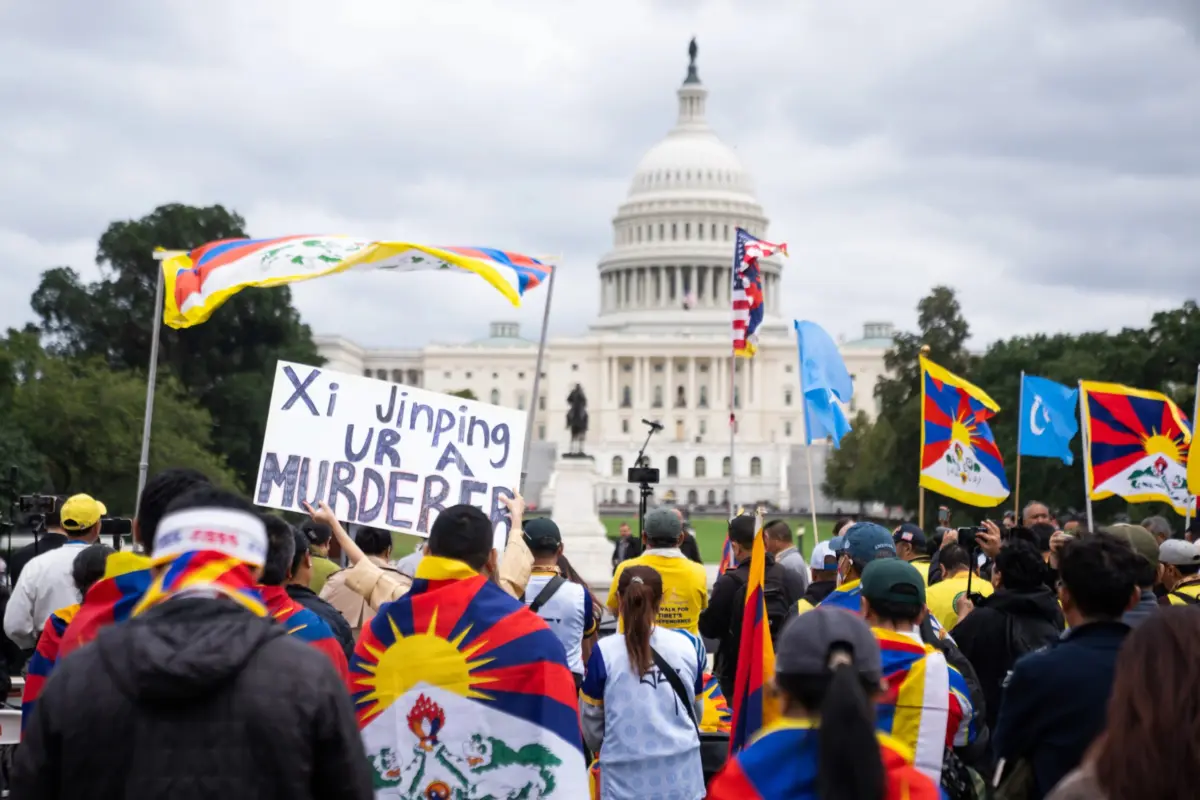
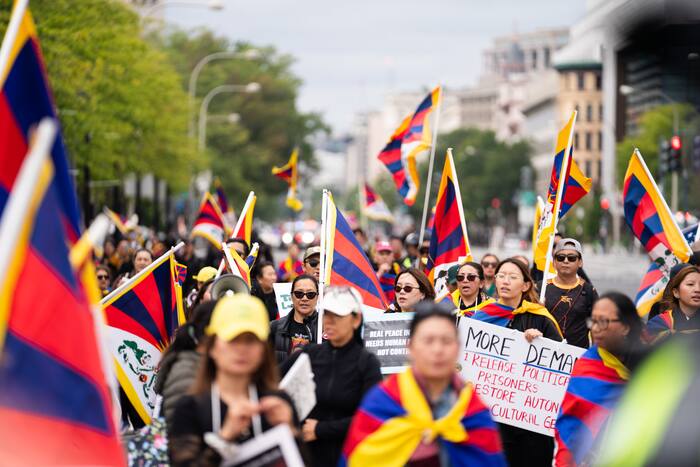
By mid-morning, the crowd had grown to several hundred. They began a highly visible march through the city toward the U.S. Capitol.
At the Capitol grounds, the protest took on a deeply personal tone. Activists displayed the snow lion flag of Tibet alongside banners calling for the independence of East Turkestan (Xinjiang) and the preservation of Taiwanese sovereignty. Among the crowd was 17-year-old Anjali Tenzin Sonn, a second-generation Tibetan activist.
"I grew up hearing stories about my mother fleeing Tibet on foot across the Himalayas, and my grandfather suffering as a political prisoner under Chinese rule," Sonn said, describing the gathering as "inspirational." For youth like Sonn, the protest was not merely a political act, but a preservation of generational trauma and cultural identity.
Afternoon: The Counter-Rally and the Lafayette Park Assembly
By 2:00 PM, a counter-narrative emerged outside the luxury hotel hosting the Chinese delegation. Approximately 200 pro-Beijing demonstrators gathered behind police barricades. Waving both Chinese and American flags, the group chanted, "Welcome, welcome, a warm welcome."
They held professionally printed banners reading, "A warm welcome to Chairman Xi on his visit to the U.S." and "Hello, Uncle Xi." Observers noted that many of these counter-demonstrators were mobilized through local Chinese community associations and student groups, a tactic frequently deployed by Chinese consulates to project a image of overseas loyalty to the state.
Meanwhile, anti-Xi protesters began converging on Lafayette Park, directly opposite the White House North Portico. By late afternoon, a diverse crowd had assembled to "unwelcome" the Chinese leader.
The physical proximity of the park to the White House executive residence meant that the sounds of the protest—amplified by megaphones and portable sound systems—carried directly to the state rooms where preparations for the evening’s dinner were underway.
Evening: The State Dinner and the Lafayette Park Standoff
As twilight fell, the honor guard assembled on the North Portico, and a red carpet was rolled out for arriving dignitaries. The atmosphere in Lafayette Park grew increasingly electric. Protesters chanted, "Xi Jinping has got to go!" and "Shame! Shame on Xi Jinping!"
The volume of the chants peaked just as the official motorcades began arriving. Despite heavy security and metal fencing separating the demonstrators from the executive mansion, the vocal opposition remained a constant, unavoidable backdrop to the evening’s formal proceedings.
Supporting Context & Metrics: The Roots of Dissent
To understand the intensity of the protests, one must analyze the specific domestic policies in China that have driven diverse groups into a unified coalition of dissent.
Movement / Issue
Key Grievance
Primary Slogan / Symbol
Key Demographic
Tibet Independence
Cultural erasure, religious repression, and lack of self-determination.
"Free Tibet" / Snow Lion Flag
Tibetan Diaspora (Generational)
Xinjiang (East Turkestan)
Mass internment, forced labor, and systematic surveillance of Uyghurs.
"Stop the Genocide" / Blue Flag
Uyghur Muslims & Human Rights Allies
Hong Kong Democracy
Erosion of "One Country, Two Systems" under the National Security Law.
"Liberate Hong Kong, revolution of our times"
Young professionals & students
Taiwan Sovereignty
Military intimidation and diplomatic isolation by Beijing.
"Keep Taiwan Free"
Taiwanese-Americans
Religious Freedom
Crackdowns on unregistered house churches and Falun Gong.
"End Dictatorship"
Chinese Christians & Religious Dissidents
The "Zouxian" Migration Phenomenon
Among the protesters was Zhang Na, a 31-year-old former warehouse worker from Los Angeles. Her journey to the gates of the White House illustrates a growing trend of irregular migration from China, known colloquially as zouxian (walking the line).
Weary of China’s prolonged, draconian COVID-19 lockdowns and the subsequent economic stagnation, Zhang made the perilous decision to flee. Three years prior, she flew to Ecuador—one of the few countries offering visa-free entry to Chinese nationals—before embarking on a grueling overland journey through Central America to the U.S. southern border.
"I hope Emperor Xi won’t remain in power," Zhang stated bluntly. "I hope he can give Chinese people real freedom—freedom of speech and religion."
Zhang’s presence highlights how domestic policies within China are actively driving a new wave of highly motivated political dissidents directly into the United States. This adds a fresh, urgent voice to the traditional diaspora organizations.
The Crackdown on Faith
The protest also highlighted the plight of religious minorities within mainland China. Yang Fan, a 39-year-old Christian who attended the rally with his wife and daughter, held a handwritten sign calling for "freedom of religion" and an "end to dictatorship."
Under Xi Jinping’s administration, the "Sinicization" of religion has led to the demolition of unapproved church buildings, the arrest of prominent pastors, and strict state control over religious texts.
"I would like to see the release of those imprisoned simply for their religious beliefs," Yang said. He emphasized that the struggle for human rights in China transcends ethnic boundaries, uniting Christians, Muslims, and Buddhists alike.
Official Statements and Diplomatic Posturing
The diplomatic choreography of the state visit required both administrations to walk a fine line between public relations and geopolitical reality.
The White House Position
In public remarks, President Trump focused heavily on personal chemistry and economic negotiation, portraying the meeting as a pragmatic effort to secure American interests.
"We are working on very significant deals. The relationship is strong, and by having President Xi here, we are addressing the tough issues head-on," a senior administration official stated, speaking on the condition of anonymity.
When questioned about the loud protests audible from the North Portico, the official added:
"The President believes in the First Amendment. People have the right to express themselves, and that is a fundamental difference between our two systems."
The Beijing Delegation’s Response
The Chinese delegation, consistent with its long-standing diplomatic protocols, ignored the protests and sought to project an image of global respect and bilateral harmony. State-run media outlets in China completely omitted any mention of the demonstrations, focusing instead on the red-carpet welcome and the pro-Beijing crowds outside the hotel.
In a brief statement issued by the Chinese Embassy, spokesperson Liu Pengyu remarked:
"The bilateral relationship between China and the United States is of paramount importance to global stability. We hope the U.S. side will focus on the consensus reached by our leaders and avoid letting fringe elements disrupt the constructive spirit of this state visit."
Future Outlook: The Geopolitical Trajectory
The protests surrounding the September 2026 state visit serve as a stark reminder that the "China challenge" is not merely an economic or military concern, but an ideological one. As long as Beijing maintains its highly centralized, authoritarian governance model, any attempt at diplomatic normalization will be shadowed by the voices of those who have fled its reach.
For the Trump administration, the challenge lies in balancing transactional diplomacy with the domestic and international pressure to stand up for human rights. While trade agreements and security pacts are negotiated in quiet boardrooms, the optics of hundreds of dissidents protesting outside the White House gates ensures that human rights will remain a persistent, politically charged variable in U.S. foreign policy.
Ultimately, the demonstrations of September 24 demonstrated that the Chinese diaspora is becoming increasingly organized, diverse, and vocal. By bringing together multi-generational activists like Anjali Tenzin Sonn, newly arrived migrants like Zhang Na, and democracy advocates like Melody Calkins—who stated she wishes to see "the complete restoration of Hong Kong’s freedoms"—the anti-regime movement has ensured that the domestic policies of the Chinese Communist Party will remain under intense, public scrutiny on the global stage.




0 Comments