
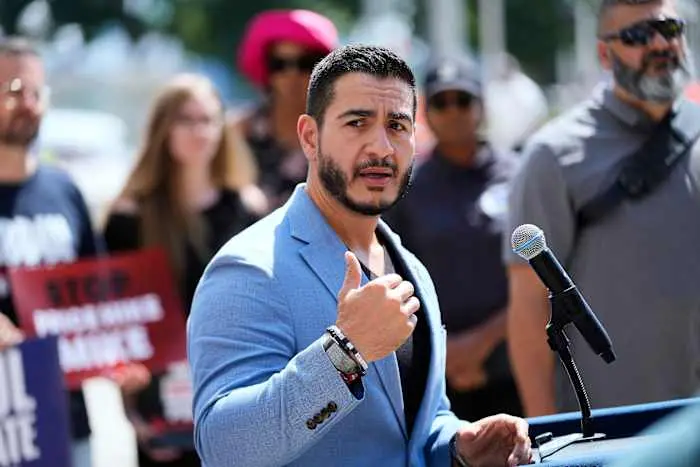

SAUGATUCK, Mich. — When Democratic organizers gathered in West Michigan’s highly contested congressional district, their objective was clear: channel voter anxiety over the cost of living under President Donald Trump into a unified mid-term message. Instead, the gathering rapidly devolved into a microcosm of the existential debate currently fracturing the Democratic Party nationwide.
At a local event designed to project solidarity, a constituent publicly confronted U.S. Representative Hillary Scholten. The voter rebuked the moderate congresswoman for withholding her endorsement of Abdul El-Sayed, the newly minted Democratic nominee for the U.S. Senate.
"Your inflammatory rhetoric has nothing to do with creating a better economic future for the people of West Michigan, and everything to do with protecting the pipeline of our tax dollars to Israel," the attendee declared.
The exchange exposed a glaring vulnerability for Democrats ahead of the high-stakes November elections. While party strategists believe economic pressures under the current administration offer a viable path to reclaiming congressional majorities, deep-seated internal divisions over foreign policy, identity, and progressive alignments are threatening to derail their messaging. Nowhere are these tensions more pronounced than in Michigan—a critical battleground state where a bitter Senate primary has left behind raw emotional and ideological wounds.
Executive Overview
Michigan has long served as a national bellwether, but in the 2026 cycle, it has become the primary theater for an ideological civil war within the Democratic Party. The nomination of Abdul El-Sayed—who stands to become the first Muslim U.S. Senator in American history—following a fiercely contested primary victory over centrist Representative Haley Stevens, has upended traditional campaign strategies.
El-Sayed’s victory was propelled by a coalition of progressive activists, young voters, and the state’s substantial Arab-American and Muslim populations, many of whom have grown increasingly alienated by the federal government’s policy toward Israel. However, his rise has triggered a significant backlash from moderate Democrats, Jewish advocacy groups, and established party leaders who view his foreign policy rhetoric and controversial political associations as liabilities.
At the center of the storm is El-Sayed’s association with Hasan Piker, a highly popular and polarizing leftist online commentator. Piker’s incendiary remarks regarding American Jewish institutions and foreign policy have drawn sharp condemnation from high-profile Democrats, both locally and nationally. Consequently, key figures within the state party, including Representative Scholten and Attorney General Dana Nessel, have conspicuously withheld their endorsements of the Senate nominee.
With Republican nominee Mike Rogers waiting in the wings, Michigan Democrats face a daunting challenge: reconcile their warring factions or risk losing a vital Senate seat in November.
Detailed Chronology
[March 2026] ------------------> [August 2026] ---------------> [Mid-August 2026] ------------> [Late August 2026]
Attack on Temple Israel;         El-Sayed wins bruising       Scholten confronted;          Lansing Convention;
El-Sayed's "hurt people" comment  primary over Stevens        Nessel & Gottheimer speak out  Party issues unity letter
The Seeds of Division: The March Synagogue Controversy
The roots of the current impasse trace back to March 2026, following an act of vandalism and attempted arson at Temple Israel, a prominent synagogue in the Detroit suburbs. In a video statement addressing the incident, El-Sayed condemned the attack but included the phrase "hurt people hurt people"—a remark intended to contextualize the cycle of violence stemming from the Middle East conflict.
The comment was immediately criticized by Jewish community leaders and moderate Democrats, who argued it rationalized domestic antisemitic violence. Michigan Attorney General Dana Nessel, who is Jewish, publicly criticized the statement, warning that political leaders must never "make excuses" for acts of domestic terror.
The Bruising Primary: El-Sayed vs. Stevens
Throughout the spring and summer of 2026, the Democratic Senate primary escalated into an expensive and deeply personal proxy war. Representative Haley Stevens, backed by traditional pro-Israel political action committees and moderate party donors, framed herself as a pragmatic legislator capable of appealing to suburban swing voters. El-Sayed countered with an aggressive grassroots campaign focused on healthcare reform, economic populism, and an immediate halt to U.S. military aid to Israel.
El-Sayed’s victory in early August sent shockwaves through the party establishment, demonstrating the formidable organizing power of Michigan’s progressive and anti-war coalitions, but leaving the state party apparatus deeply fractured.
The Piker Flashpoint
Following the primary, El-Sayed’s campaign sought to consolidate support, but his ongoing association with internet streamer Hasan Piker quickly became a lightning rod. Piker, who boasts millions of followers on platforms like Twitch, has a long history of provocative statements, including past assertions that American foreign policy was a root cause of the September 11 attacks.
The controversy reached a fever pitch in mid-August when Piker argued on a live broadcast that American Jewish institutions were engaging in "dangerous propaganda" by conflating Jewish identity with monolithic support for the state of Israel. He warned that if American Jews continued to project a singular investment in Israel, "eventually someone is going to come around and take action… against American Jews."
The response from mainstream Democrats was swift and severe. Senator Cory Booker of New Jersey publicly condemned Piker, labeling his comments "dangerous, hateful, and antisemitic." The fallout immediately bled into the Michigan Senate race, providing moderate Democrats with a justification to maintain their distance from El-Sayed.
Supporting Context & Metrics
The division within the Michigan Democratic Party is not merely ideological; it is deeply rooted in the state’s complex demographic and electoral math.
Demographic Divergence
Michigan is home to one of the largest Arab-American populations in the United States, concentrated heavily in metro Detroit cities like Dearborn and Hamtramck. This voting bloc, historically reliable for Democrats, has shown a strong willingness to break with the party over its foreign policy stances.
Conversely, the state also possesses a politically active and historically influential Jewish population, primarily situated in Oakland County suburbs. For decades, the road to statewide victory for Michigan Democrats required building a coalition that united both of these communities. The current rift threatens to make such a coalition structurally impossible.
| Voter Group / Region | Key Demographic Factor | Core Political Priority (2026) |
|---|---|---|
| Metro Detroit Suburbs (Oakland County) | Significant Jewish population, moderate swing voters | Domestic security, combating antisemitism, economic stability |
| Wayne County (Dearborn/Hamtramck) | High concentration of Arab-American & Muslim voters | Foreign policy reform, immediate ceasefire, progressive representation |
| West Michigan (Saugatuck/Grand Rapids) | Suburban moderates, agricultural/manufacturing base | Cost of living, inflation under the Trump administration |
The Electoral Math
In a state where statewide elections are frequently decided by less than two percentage points, even minor drops in turnout or ticket-splitting could prove catastrophic for Democrats.
- The Rogers Threat: Republican nominee Mike Rogers, a former U.S. Representative and House Intelligence Committee Chairman, is running a disciplined campaign focused almost exclusively on inflation, border security, and economic recovery. Rogers stands to benefit immensely if suburban moderates, alienated by El-Sayed’s progressive platform and foreign policy stances, decide to split their tickets or opt out of the Senate race altogether.
- The Turnout Dilemma: If El-Sayed moderates his rhetoric to appeal to the suburbs, he risks depressing turnout among the highly energized young progressive and Arab-American voters who carried him through the primary.
Official Statements
The rhetoric from both sides of the Democratic aisle highlights the depth of the polarization, with some leaders calling for absolute solidarity and others demanding accountability before offering endorsements.
The Progressive and Campaign Stance
Abdul El-Sayed has repeatedly sought to redirect the political conversation toward systemic economic issues while defending his right to build a broad coalition. Speaking at a campaign event in Ann Arbor, he expressed frustration with what he termed the media’s obsession with online personalities:
"You would think if you turn on any media that this whole campaign is about a streamer in California. I’m less interested in going to the sort of tabloid version of our politics where we cover this like, who’s in, who’s out, who’s up, who’s down, who’s talking to who?"
Addressing the holdouts within his own party, El-Sayed remarked:
"There are a few people who are still nursing wounds or grievances from the primary. I get it. Losing is hard."
Hasan Piker, defending his remarks in a telephone interview, argued his comments were misinterpreted:
"I’m just a platform, I’m just a megaphone for people’s anger and frustration. Even if I was going to go away tomorrow, I don’t think this problem would go away for our politicians."
The Moderate and National Backlash
Representative Hillary Scholten, defending her decision to withhold an immediate endorsement, placed the burden of party unity squarely on the nominee:
"I think it’s up to the top of the ticket to unify the top of the ticket."
National figures have been far less diplomatic. Representative Josh Gottheimer of New Jersey stated unequivocally on CNN:
"There’s no way I’m ever coming out for El-Sayed, right now. He has refused to back off his views towards Jewish Americans."
Senator Cory Booker took to social media to directly challenge the rhetoric originating from El-Sayed’s campaign circle:
"Hasan Piker’s dangerous and hateful language targeting Jewish Americans has no place in our civic discourse. Suggesting that Jewish Americans bear responsibility for hatred or violence directed against them is wrong, dangerous, and antisemitic."
The Calls for Unity
Despite the fierce rhetoric, some established Michigan Democrats are desperately trying to broker a truce. Representative Debbie Dingell, a master of local coalition building, expressed exhaustion over the persistent focus on campaign surrogates:
"I am done. So don’t any reporter ask me again about Hasan Piker. It’s not what November is about. I don’t agree with Hasan Piker on a lot of stuff."
Representative Jamie Raskin of Maryland, a prominent Jewish progressive who traveled to Michigan to campaign alongside El-Sayed, framed the conflict as a standard, albeit difficult, post-primary healing process:
"The Democratic Party is a big, sometimes an unruly family, but we’re all going to be together in the end."
Future Outlook
As Michigan Democrats prepare for their upcoming state convention in Lansing, party leaders are taking extraordinary measures to prevent public displays of discord. State Party Chair Curtis Hertel, along with the party’s statewide nominees, recently issued a joint letter to delegates warning that "disruptive behavior or harassment of any kind will not be tolerated" during the proceedings.
However, papering over these divisions at a convention may not suffice in a general election campaign. The next three months will test whether a major political party can successfully run a dual-track campaign: mobilizing an angry, anti-war progressive base while simultaneously retaining moderate, suburban voters concerned about inflation and social stability.
If El-Sayed successfully bridges this gap, he will write a new playbook for progressive candidates in swing states. If he fails, and the seat falls to Republican Mike Rogers, the Michigan Senate race of 2026 will likely be remembered as the moment the Democratic coalition fractured under the weight of its own internal contradictions.

0 Comments