

Executive Overview
In a sweeping regulatory shift that has sent shockwaves through Florida’s law enforcement community, state agencies and municipal police departments are scrambling to comply with an executive directive from Governor Ron DeSantis ordering the immediate removal of automated license plate reader (ALPR) cameras from all state-maintained roadways, including major interstates. The sudden policy enforcement, executed via the Florida Department of Transportation (FDOT), marks a dramatic pivot in the state’s approach to public surveillance, traffic monitoring, and local policing autonomy.
The mandate has laid bare a growing ideological and operational rift between state executive leadership and local law enforcement agencies. While the DeSantis administration frames the directive as a necessary defense of individual privacy and a curb on the unchecked expansion of localized mass surveillance grids, municipal police chiefs and county sheriffs view the technology as an indispensable tool for modern policing.
From small municipalities like the City of Alachua—which is currently dismantling nine of its critical highway cameras—to larger urban centers like Gainesville, which recently deactivated its entire network of Flock-style LPR cameras, the practical implications of this order are immediate and profound. As these high-tech networks go dark along Florida’s busiest transit corridors, questions are mounting over the future of highway drug interdiction, missing persons investigations, and the legal boundaries of state preemption over local public safety initiatives.
Detailed Chronology
The transition from widespread adoption of ALPR technology to its rapid, state-mandated dismantlement unfolded over several years of rapid technological integration, culminating in the sudden regulatory crackdown in late August and early September of 2026.
+-----------------------------------------------------------------------------+
|                                  TIMELINE                                   |
+-----------------------------------------------------------------------------+
| 2020–2025: Rapid adoption of Flock Safety and ALPR systems by Florida law   |
|            enforcement agencies, funded by municipal budgets and state grants.|
+-----------------------------------------------------------------------------+
| Mid-2025:  Privacy advocacy groups raise alarms over unregulated data        |
|            sharing and long-term retention of vehicle movement profiles.   |
+-----------------------------------------------------------------------------+
| Late Aug   FDOT issues a quiet but firm administrative directive targeting   |
| 2026:      unpermitted and non-compliant surveillance hardware on state     |
|            rights-of-way.                                                   |
+-----------------------------------------------------------------------------+
| Sept 3,    Gainesville Police Department officially turns off and disables   |
| 2026:      all Flock-style LPR cameras following direct FDOT orders.        |
+-----------------------------------------------------------------------------+
| Sept 8,    City of Alachua Police Department begins dismantling nine        |
| 2026:      LPR cameras situated along state-controlled roadways.            |
+-----------------------------------------------------------------------------+
The Rise of the Municipal Surveillance Grid
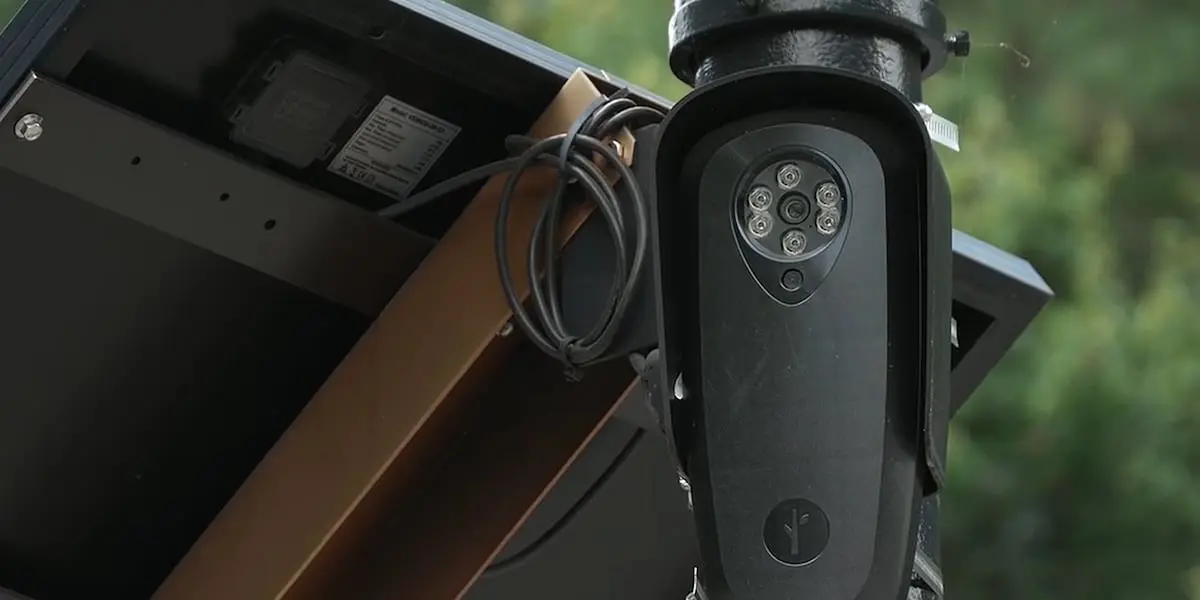
Beginning in the early 2020s, Florida became one of the fastest-growing markets for private surveillance firms, most notably Flock Safety. Marketed as a low-cost, high-efficiency solution to property crime and vehicle theft, these solar-powered cameras were rapidly deployed on utility poles, traffic lights, and highway overpasses. Local city councils and county commissions eagerly approved contracts, frequently bypassing extensive public debate in favor of promises of reduced response times and higher clearance rates for felony investigations.
The FDOT Crackdown
The legal mechanism used to halt this expansion was not a new legislative bill, but rather a strict enforcement of existing state right-of-way regulations. In late August 2026, the Florida Department of Transportation (FDOT), acting under direct guidance from the Governor’s office, issued a memorandum declaring that any electronic surveillance equipment installed on state-maintained roads—including U.S. highways, state roads, and interstate systems—without explicit, highly regulated state permits was in violation of administrative codes.
The Domino Effect in Alachua County
The practical fallout of the state’s directive manifested rapidly in north-central Florida:
- Gainesville’s Total Shutdown: On September 3, 2026, the City of Gainesville announced it had deactivated its entire network of Flock-style license plate readers. The city’s decision came after receiving clear notification from FDOT that these systems were non-compliant with state roadway policies.
- Alachua’s Forced Compliance: Following Gainesville’s lead, the City of Alachua Police Department began the process of identifying and removing nine of its own LPR cameras. These units, strategically positioned to monitor high-speed corridors entering and exiting the city, fell directly within state-controlled rights-of-way.
Supporting Context & Metrics
To understand the scale of this policy shift, it is necessary to examine the technical mechanics of the technology in question, the jurisdictional divisions of Florida’s road networks, and the conflicting data points put forward by proponents and critics of the systems.
How Flock-Style LPRs Operate
Unlike traditional traffic cameras that record continuous video feeds, automated license plate readers are highly specialized, motion-activated optical sensors integrated with machine-learning software.
+-------------------------------------------------------------------------+
|                       LPR DATA TRANSMISSION PATH                        |
+-------------------------------------------------------------------------+
| [Vehicle Passes Camera]                                                 |
|          │                                                              |
|          ▼                                                              |
| [High-Speed Optical Capture]                                            |
|          │ (Reads plate, state, vehicle make, color, unique features)   |
|          ▼                                                              |
| [LTE Cellular Transmission]                                             |
|          │ (Encrypted data sent to cloud-based database)                 |
|          ▼                                                              |
| [Database Cross-Referencing]                                            |
|          │ (Instantly checked against NCIC / State Hotlists)            |
|          ▼                                                              |
| [Real-Time Alert Dispatch]                                              |
|            (Sent to local patrol units within 15–30 seconds)            |
+-------------------------------------------------------------------------+
This decentralized, interconnected network allowed a small-town police department in Florida to instantly flag a vehicle stolen in Georgia, or track a suspect wanted by federal authorities, the moment they crossed municipal boundaries.
The Jurisdictional Patchwork
The Governor’s directive does not ban LPR cameras entirely; rather, it bans them from state-maintained roads. This distinction has created a complex, fragmented map of surveillance coverage:
- State-Maintained Roads (Banned): Interstates (e.g., I-75, I-95, I-4), U.S. Highways (e.g., U.S. 441, U.S. 301), and state-numbered roads (e.g., State Road 26). These are the primary arteries for long-distance travel, drug trafficking, and interstate crime.
- Locally Maintained Roads (Allowed): City streets, residential avenues, and county-maintained roads. While cameras can legally remain here, their effectiveness is severely diminished because they can no longer capture the initial entry of suspect vehicles into a region via major highways.
The Statistical Debate: Safety vs. Liberty
The debate over LPR removal is characterized by two vastly different sets of metrics.
The Law Enforcement Argument (Efficacy Metrics)
Before the state crackdown, local police departments frequently published metrics showcasing the utility of LPRs:
- Stolen Vehicle Recovery: Municipalities using integrated LPR networks reported up to a 45% increase in the recovery of stolen vehicles within the first year of installation.
- Amber and Silver Alerts: LPR systems provided instantaneous alerts when vehicles associated with abducted children or missing elderly individuals passed a camera, reducing rescue times from hours to minutes.
- Investigative Efficiency: Detectives estimated that a single LPR camera could accomplish the investigative work of dozens of man-hours by instantly verifying whether a suspect’s vehicle was near a crime scene.
The Privacy Advocacy Argument (Civil Liberties Metrics)
Conversely, organizations like the American Civil Liberties Union (ACLU) and the Electronic Frontier Foundation (EFF) have highlighted the systemic risks of these networks:
- Mass Data Harvesting: In typical deployments, over 99.9% of the license plate scans collected by LPRs belong to law-abiding citizens who are not suspected of any crime.
- Extended Retention Windows: Many municipalities retained this travel history data for 30, 90, or even 365 days, creating a permanent, searchable database of private citizens’ movements.
- Lack of Oversight: Audits in several states revealed that officers occasionally misused LPR databases for personal reasons, such as tracking estranged partners or monitoring political activists, due to lax internal logging and auditing procedures.
Official Statements
The enforcement of the FDOT order has drawn varied responses from local officials, who must now navigate the loss of a primary investigative tool while maintaining public safety.
Alachua Police Chief Jesse Sandusky
In the City of Alachua, Police Chief Jesse Sandusky confirmed that his department is actively reviewing its operational policies to ensure total compliance with the state’s directive. Despite his commitment to following the law, Sandusky made no secret of his disappointment regarding the loss of the technology.
"Our priority is, and always will be, the safety of the citizens of Alachua. While we are fully complying with the Governor’s order and the FDOT regulations by removing these nine cameras from state roads, there is no denying that this technology has been a highly effective force multiplier for our officers. These cameras allowed us to solve crimes faster, recover stolen property, and locate missing persons with unprecedented speed. We will adapt, but this is undeniably a significant loss to our technological toolkit."
— Chief Jesse Sandusky, Alachua Police Department
State Executive Rationale
While Governor Ron DeSantis’s office has not issued a detailed legislative white paper on this specific administrative enforcement, representatives from the administration and FDOT have consistently emphasized the principles of regulatory oversight, constitutional privacy, and the prevention of unauthorized surveillance grids on state-owned infrastructure.
According to state officials familiar with the directive, the rapid deployment of these cameras by private vendors on state utility poles bypassed the rigorous permitting, public bidding, and constitutional vetting processes required for permanent state infrastructure. The administration has expressed concerns that allowing private corporations to build out a contiguous, cloud-based tracking network on state property poses significant risks to the constitutional privacy rights of Floridians.
Future Outlook
The removal of LPR cameras from Florida’s state roads marks the beginning of a new chapter in the ongoing struggle between technological advancement in policing and the preservation of civil liberties.
The Emergence of "Security Blind Spots"
As the cameras are dismantled along major corridors like Interstate 75 and key state highways, law enforcement agencies warn of immediate "blind spots." Criminal syndicates, human traffickers, and cargo thieves who utilize major highway networks may find it easier to traverse the state without triggering automated alerts. Police departments will likely have to rely more heavily on traditional patrol methods, physical surveillance, and manual license plate lookups, which are significantly slower and more resource-intensive.
Private Surveillance Workarounds
In response to the state-level ban on public rights-of-way, industry analysts predict a shift in how surveillance companies market their products. Companies like Flock Safety may pivot toward partnerships with private entities. By placing LPR cameras on private commercial properties—such as shopping center entrances, gas stations, and private parking lots overlooking state roads—surveillance networks can bypass FDOT jurisdiction entirely while still capturing high-volume traffic data.
Potential Legislative Battles
The friction between state executive orders and local municipal authority is expected to spill over into upcoming legislative sessions in Tallahassee. Home-rule advocates and law enforcement lobbying groups are already preparing to push for a standardized, state-approved permitting process that would allow local agencies to reinstall LPRs on state roads under strict regulatory guidelines, such as:
- Mandating a maximum 30-day data deletion window.
- Restricting data access to active felony investigations only.
- Requiring annual independent audits of system usage to prevent abuse.
Ultimately, Florida’s aggressive stance against highway surveillance serves as a landmark precedent. As other states watch the fallout of this decision, the balance between utilizing cutting-edge technology to solve crimes and protecting the fundamental right to travel without state surveillance remains one of the most contentious policy debates of the modern era.

0 Comments