

By Senior Geopolitical Correspondent
ISLAMABAD — In a week marked by escalating military brinkmanship, economic threats, and backchannel diplomacy, the capital of Pakistan has emerged as a critical focal point for efforts to avert an all-out regional war in the Middle East.
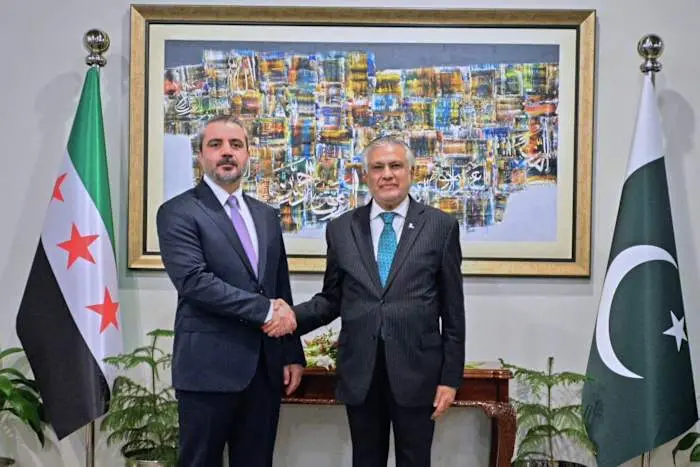
On Thursday, August 20, 2026, the geopolitical chessboard shifted rapidly. Iran’s leadership forcefully dismissed U.S. President Donald Trump’s threats of unprecedented economic isolation, labeling them as desperate attempts to distract from American domestic financial instability. Simultaneously, Syrian Foreign Minister Asaad Hassan al-Shibani arrived in Islamabad for high-stakes consultations with Pakistani Foreign Minister Ishaq Dar. This diplomatic flurry occurs against a grim backdrop: the expiration of a critical bilateral peace memorandum, recent Israeli airstrikes in northern Syria, and the somber repatriation of Pakistani civilian mariners killed in a Houthi missile strike in the Bab el-Mandeb Strait.
1. EXECUTIVE OVERVIEW: THE ISLAMABAD CONFLUENCE
The Middle East stands at its most dangerous crossroads in decades. The conflict, colloquially termed the "Iran War," has expanded far beyond localized borders, drawing in global superpowers, regional proxies, and critical maritime trade corridors. As Washington and Tehran exchange threats of mutual destruction and economic strangulation, Pakistan—a nuclear-armed state bordering Iran with deep strategic ties to both the United States and the Gulf monarchies—is attempting to play the role of mediator.
                    [ UNITED STATES ]
                           │
             Economic Threats & Sanctions
                           │
                           ▼
[ SYRIA ] ◄── Allies ── [ IRAN ] ◄─── (60-Day MoU Expired) ───► [ PAKISTAN ]
   │                                                                 │
Airstrikes (Israel)                                            Diplomatic Hub
   │                                                                 │
   └───────────────────────► [ MIDDLE EAST CRISIS ] ◄────────────────┘
The arrival of Syrian Foreign Minister Asaad Hassan al-Shibani in Islamabad on Thursday underscores the gravity of the situation. Syria, a staunch ally of Iran and a frequent target of Israeli military actions, is seeking to solidify regional alignments as the United States threatens "Economic Warfare and Isolation on an unprecedented scale."
For Pakistan, the crisis is not merely a distant diplomatic puzzle; it is an immediate national security and economic threat. The repatriation on Thursday of the bodies of two Pakistani merchant sailors killed by a Houthi missile attack on a commercial vessel in the Red Sea serves as a stark reminder of the human and economic toll this conflict inflicts on neutral nations. Consequently, Islamabad’s political and military leadership is working frantically to revive a lapsed June memorandum of understanding that previously kept the United States and Iran from crossing the threshold of total war.
2. DETAILED CHRONOLOGY OF THE ESCALATION
To understand the current crisis, one must trace the rapid sequence of events over the preceding forty-eight hours:
Wednesday, August 19, 2026: The Spark in Washington
President Donald Trump delivers a sweeping address and subsequent social media declarations, warning Tehran of "crushing economic measures" if it does not capitulate to U.S. security demands. Trump promises "Economic Warfare and Isolation on an unprecedented scale," signaling a return to a hyper-aggressive "maximum pressure" campaign, backed by potential maritime blockades and secondary sanctions targeting any nation trading with the Islamic Republic.
Thursday Morning, August 20, 2026: The Iranian Counter-Strike
Iranian Foreign Minister Abbas Araghchi issues a sharp rebuttal via social media and state media channels. Araghchi rejects the economic threats, declaring that "economic terrorism" will only steel Iranian resolve, foster greater domestic hostility toward the West, and ultimately result in further American foreign policy failures. He accuses the Trump administration of using foreign policy aggression to divert the American public’s attention from systemic domestic financial vulnerabilities.
Thursday Midday: Syrian Envoy Lands in Islamabad
Syrian Foreign Minister Asaad Hassan al-Shibani lands at Nur Khan Airbase in Islamabad. He is immediately whisked away to the Ministry of Foreign Affairs to meet with his Pakistani counterpart, Ishaq Dar. The visit occurs just days after Israeli fighter jets launched precision airstrikes against the Abu Duhur air base in northern Syria. While the strikes caused significant structural damage, Syrian officials confirm there were no casualties, though the attack has heightened regional anxieties.
+-----------------------------------------------------------------------+
|                      TIMELINE OF KEY EVENTS                           |
+-----------------------------------------------------------------------+
|  Aug 19: President Trump threatens "crushing economic measures."      |
|  Aug 20 (AM): Iranian FM Araghchi denounces "economic terrorism."     |
|  Aug 20 (PM): Syrian FM al-Shibani arrives in Islamabad for talks.    |
|  Aug 20 (PM): Pakistani sailors killed in Houthi attack repatriated.  |
+-----------------------------------------------------------------------+
Thursday Evening: Repatriation and Condemnation
The bodies of two Pakistani crew members, alongside six injured survivors of a Houthi missile strike on a Tanzanian-flagged vessel in the Bab el-Mandeb Strait, arrive in Karachi. Pakistani Foreign Minister Ishaq Dar issues a strongly worded statement condemning the attack, thanking Saudi Arabia for its swift medical intervention, and reiterating that the safety of international seafarers is non-negotiable.
3. SUPPORTING CONTEXT & GEOPOLITICAL METRICS
Pakistan’s Diplomatic Tightrope
Pakistan’s position in this conflict is uniquely complex. Geographically, Islamabad shares a volatile 900-kilometer border with Iran, making any conflict in neighboring Balochistan highly destabilizing. Economically, Pakistan relies heavily on financial assistance, remittances, and energy investments from Saudi Arabia and the United Arab Emirates—both of whom are historical rivals of Iran, though they have recently pursued their own fragile detentes with Tehran.
Furthermore, Pakistan’s military and intelligence apparatus maintains deep, albeit historically turbulent, ties with the United States. Islamabad cannot afford to alienate Washington, yet it cannot tolerate a collapsed, war-torn state on its western flank.
The Expired June Memorandum of Understanding (MoU)
At the heart of Pakistan’s current diplomatic push is the expiration of a 60-day deadline established under a June memorandum of understanding.
| Memorandum Metric | Details |
|---|---|
| Brokers | Pakistan, with assistance from key regional intermediaries (including Oman and Qatar) |
| Primary Objective | De-escalate military posturing and establish backchannel communication lines |
| Key Term | 60-day operational freeze on escalatory kinetic actions and new sanctions |
| Current Status | Expired; efforts are underway to renew the mandate |
With this deadline now lapsed, the buffer preventing direct U.S.-Iranian kinetic clashes has dissolved, leading directly to President Trump’s renewed threats of "economic warfare."
The Maritime Security Crisis
The human cost of this geopolitical gridlock was brought home to Pakistan this week. The Bab el-Mandeb Strait, a narrow chokepoint connecting the Red Sea to the Gulf of Aden, has become a gauntlet of asymmetric warfare.
The Houthi movement in Yemen, aligned with Iran’s "Axis of Resistance," has continuously targeted commercial shipping. The attack on the Tanzanian-flagged vessel, which resulted in the deaths of two Pakistani mariners, highlights how neutral, developing nations bear the brunt of global trade disruptions.
According to maritime shipping analysts, insurance premiums for vessels traversing the Red Sea have spiked by over 400% since the onset of the conflict, forcing major shipping conglomerates to reroute vessels around the Cape of Good Hope, adding weeks to transit times and billions of dollars to global supply chain costs.
4. OFFICIAL STATEMENTS & DIPLOMATIC RHETORIC
The rhetoric emanating from the key actors in this crisis reflects deeply entrenched positions, leaving little immediate room for compromise.
The United States: Maximum Pressure 2.0
President Donald Trump’s rhetoric has focused on total economic dominance. In his statements leading up to Thursday, Trump asserted:
"Iran will face Economic Warfare and Isolation on an unprecedented scale. We will deploy crushing economic measures that will make their previous financial struggles look minor. They must choose between acting like a normal nation or watching their economy collapse under the weight of absolute isolation."
Iran: Defiance and Counter-Accusations
Iranian Foreign Minister Abbas Araghchi took to social media to reject the American president’s assertions, framing the threats as a symptom of domestic weakness:
"These failed policies of economic terrorism will only stir more hostility among Iranians and bring more failures to the United States. President Trump’s threats aim to divert the attention of the U.S. public from their own domestic financial crises. Economic terrorism threatens not just Iran, but the global economy and the national sovereignty of countries around the world."
   "These failed policies of economic terrorism will only stir
    more hostility among Iranians and bring more failures to the US."

   — Abbas Araghchi, Iranian Foreign Minister (August 20, 2026)
Pakistan: The Voice of Moderation and Grief
In Islamabad, Foreign Minister Ishaq Dar balanced diplomatic urgency with national mourning. Following his meetings with Syrian Foreign Minister al-Shibani and the repatriation of the deceased sailors, Dar stated:
"Pakistan condemns the attack on innocent civilian seafarers in the strongest possible terms. The safety and security of seafarers must be ensured at all times. We are deeply grateful to the Kingdom of Saudi Arabia’s Foreign Ministry for their swift cooperation and medical assistance to our injured citizens. On the diplomatic front, Pakistan remains in active contact with both Washington and Tehran. We are urging both sides to return to the negotiating table. The expiration of the June MoU must not lead to war; we must build a bridge back to dialogue."
5. FUTURE OUTLOOK & STRATEGIC FORECAST
As the international community watches the developments in Islamabad, three potential scenarios emerge for the coming weeks:
Scenario A: Diplomatic Breakthrough and MoU Renewal (40% Probability)
Under this scenario, Pakistan, utilizing its unique diplomatic channels and backed by quiet support from Beijing and Riyadh, successfully convinces Washington and Tehran to extend the expired June memorandum of understanding. This would freeze further sanctions and proxy attacks, allowing for the resumption of low-level, backchannel negotiations in Muscat or Geneva.
Scenario B: Escalation of Economic Warfare and Proxy Clashes (45% Probability)
If Trump’s administration enacts the promised "crushing economic measures," Iran is likely to respond asymmetrically. This would involve increased Houthi attacks in the Bab el-Mandeb and potential disruptions in the Strait of Hormuz, through which 20% of the world’s petroleum passes. Syria would remain a battleground, with Israel continuing its preemptive strikes on Iranian-linked infrastructure.
Scenario C: Direct Kinetic Conflict (15% Probability)
Should backchannel diplomacy fail entirely and an American or allied naval vessel be sunk in the Red Sea or Persian Gulf, the risk of direct U.S. military strikes on Iranian coastal defense sites, radar installations, and nuclear facilities would skyrocket. This would trigger a wider regional war, dragging in Lebanon, Syria, Iraq, and potentially destabilizing the entire global economy.
Conclusion
The meetings in Islamabad this week are far more than routine bilateral exchanges. They represent a desperate, highly coordinated effort by regional actors to prevent a catastrophic escalation. Whether Pakistan’s diplomatic tightrope walk succeeds depends heavily on whether Washington and Tehran view the expired June memorandum as a relic of the past or as a vital exit ramp from the brink of war.
Reported by AP Correspondents in Islamabad, Tehran, and Washington. Compiled and analyzed by the Global Security Desk.

0 Comments