

Executive Overview
As the Florida State Seminoles gear up for the 2026 college football season, anticipation surrounding the program is navigating a transitional phase. Yet, tucked away on the special teams roster is a player whose biography reads like an adventure novel combined with a modern digital media masterclass. Daniel Hughes, a 28-year-old graduate transfer punter from the University of New Mexico, has effortlessly staked a compelling claim as the most interesting man in college football.
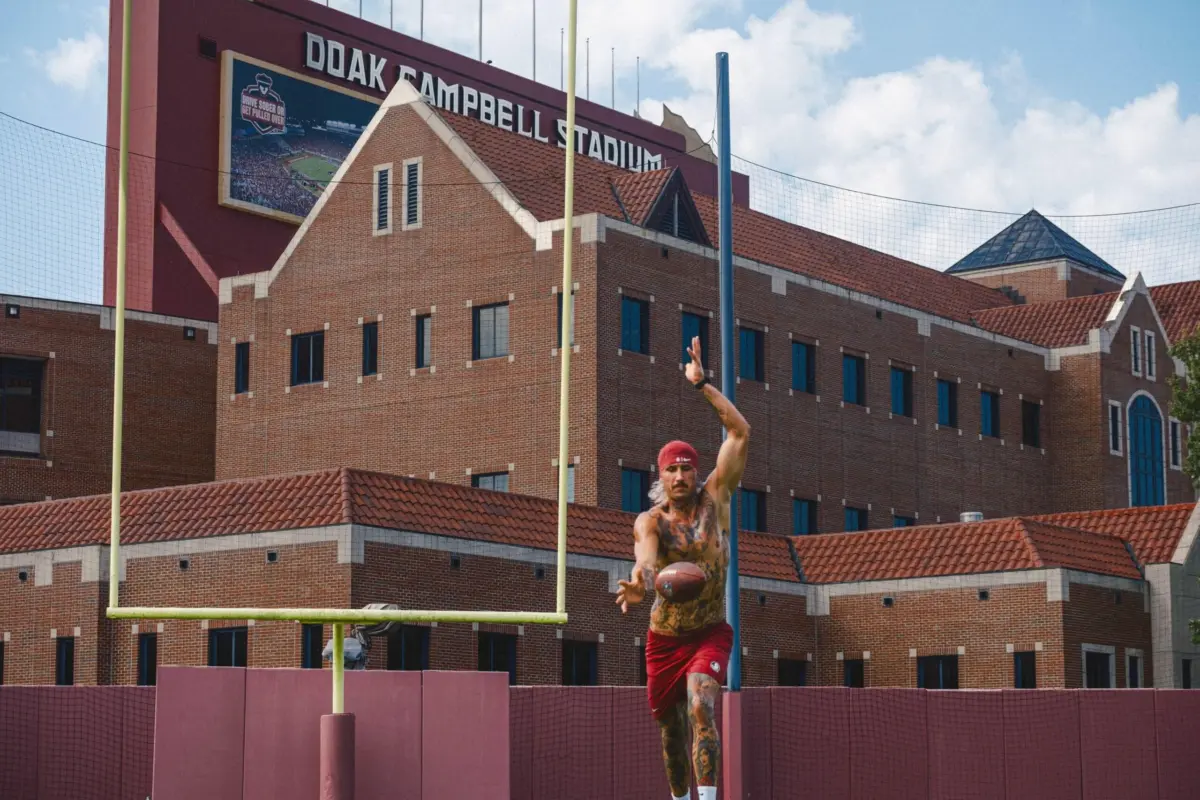
Standing imposing at 6-foot-5 and 219 pounds, sporting a striking physique covered in extensive tattoos, and rocking a Targaryen-esque platinum-blonde dye job, Hughes cuts a figure that demands attention. But his visual aesthetic is merely the surface layer of a remarkably unconventional path. A decade ago, Hughes was a teenage dropout in Australia working grueling shifts as a carpenter, eventually building a successful business and achieving financial stability by his late teens. Realizing that monetary comfort did not equate to personal fulfillment, he walked away from his trade, returned to secondary school, and pivoted into the hyper-competitive pipeline of elite American football punting.
Today, Hughes occupies a fascinating dual identity: he is a legitimate FBS-level weapon on the gridiron—recently named to the prestigious Ray Guy Award watch list—and a burgeoning digital creator boasting tens of thousands of dedicated followers across Instagram and TikTok. Offering an authentic, behind-the-scenes look at the rigorous life of a Division I athlete, his social media presence has transformed him into an unmissable fixture around Tallahassee. As Hughes prepares to cap off his collegiate eligibility in garnet and gold, his journey serves as a testament to reinvention, raw athleticism, and the power of unapologetic authenticity in the modern collegiate landscape.
Detailed Chronology: From Australian Carpentry to American Gridirons
To understand how Daniel Hughes ended up booming punts inside Doak Campbell Stadium, one must trace a timeline defined by radical pivots, delayed gratification, and an unwavering desire to test his limits.
The Early Exit and the Trade
The foundation of Hughes’ work ethic was forged early, albeit far away from the American gridiron. Growing up in Australia, Hughes found himself disillusioned with traditional academic structures. At just 16 years old, he made the consequential decision to drop out of Year 10—the equivalent of a sophomore year in American high schools. Rather than drifting, he immediately threw himself into the workforce, entering a rigorous carpenter apprenticeship.
By the time he was 19, Hughes was a fully qualified carpenter. Displaying an entrepreneurial streak early on, he launched his own construction business. The enterprise flourished, yielding a level of financial success that most teenagers and young adults only dream of. He was making a lucrative living, achieved the milestone of retiring his mother, and built a life of undeniable material comfort.
The Awakening and the Return to School
Yet, beneath the veneer of professional and financial success, a quiet dissatisfaction settled in. Comfort, Hughes realized, was not synonymous with happiness. Deep down, a childhood ambition lingered: he had always harbored a fierce desire to test himself as a professional athlete.
"I was not happy with what I was doing," Hughes reflects candidly. "I was making a really good living, retired my mom. I was really comfortable. But money doesn’t buy happiness, and I always want to be a professional athlete."
Driven by this epiphany, Hughes made a radical choice. At an age when most individuals are locking into their career paths, he reversed course. He re-enrolled in secondary school to complete his Year 12 requirements, earning the high school diploma necessary to clear academic thresholds for American collegiate sports. Simultaneously, he sought out ProKick Australia, the renowned training academy that has systematically revolutionized the American punting landscape by supplying top-tier Australian rules football converts to NCAA programs.
Beating the Clock in the Punting Pipeline
Entering ProKick, Hughes was acutely aware of the statistical realities of the sport. The typical Australian punter enters the collegiate system in their early twenties and wraps up their career around age 25 or 26. At the time, Hughes was staring down an older timeline, fully cognizant that by the time he exhausted his eligibility, he would be knocking on the door of 30.
Nevertheless, confidence in his physical traits overruled any demographic concerns. "About 25, 26, you sort of finish up your career sort of like towards 30," Hughes recalled of his initial assessment. "I’d seen ProKick and I saw athletes that were over here that were half the athlete that I am. I was like, ‘I can kick a ball, man.’ So, I reached out to them."
The gamble paid off. His raw leg strength and natural coordination translated seamlessly to American punting mechanics. His journey first brought him to the junior college ranks at the City College of San Francisco, where he adapted to the speed, rules, and nuances of the American game. From there, he earned an FBS opportunity at the University of New Mexico, anchoring the special teams unit during a historic turnaround for the Lobos. Now, at 28 years old, Hughes has landed at Florida State for his final year of collegiate eligibility, a seasoned veteran in every sense of the word.
Supporting Context & Metrics: Punting Prowess Meets Digital Stardom
While Hughes’ backstory provides compelling narrative fodder, his presence on the Florida State roster is rooted entirely in athletic merit. He is not a novelty act; he is a statistically proven weapon whose performance on the field warrants serious national attention.
The New Mexico Breakthrough
Hughes’ lone season in Albuquerque under first-year head coach Jason Eck was instrumental in the Lobos’ dramatic resurgence. New Mexico rattled off a stunning five-win improvement in 2024, surging to a nine-win campaign that tied the program’s record for victories in a single season—a benchmark that had stood since 1982.
Operating under high-pressure scenarios, Hughes proved to be a master of field position. He finished the season ranked 29th in the Football Bowl Subdivision (FBS) in average yards per punt, booming the ball at a 45.4-yard clip. However, traditional punting averages often fail to tell the whole story, as a booming kick returned for a touchdown can sabotage the defensive effort.
The Metric That Matters: Net Punting
Within coaching circles, net punting—calculated as average punt distance minus the average punt return yardage allowed—is the gold standard for evaluating a punter’s true impact. In this critical metric, Hughes truly elite status emerged. Among all FBS punters with 30 or more attempts last season, Hughes ranked an exceptional seventh nationally, boasting a net average of 43.0 yards.
Despite anchoring a statistic that directly influences defensive success, Hughes remains remarkably humble, consistently redirecting individual praise toward the collective special teams unit.
"Net punting is a unit statistic," Hughes emphasized. "It’s not a Daniel Hughes or a punter statistic. So it was a unit statistic. I just played my role in that stat."
The Digital Empire: Authenticity in the Age of NIL
Off the field, Hughes has engineered an entirely separate brand of success. During his stint at City College of San Francisco, he launched a social media account to document his cross-continental journey. Modest growth followed during his season at New Mexico, but his digital footprint has experienced a meteoric explosion this offseason following his arrival in Tallahassee.
Today, Hughes commands an engaged and rapidly expanding audience, boasting over 50,000 followers on Instagram and upwards of 25,000 on TikTok. Far from a static archive of football highlights, his content offers a multifaceted window into his life. Followers are treated to day-in-the-life vlogs, behind-the-scenes glimpses of locker room culture, and candid reflections on the trials and triumphs of a non-traditional student-athlete.
This digital visibility has transformed his day-to-day existence in Tallahassee. In a college town dominated by athletic fandom, Hughes is an impossible figure to miss.
"The community is great. I can’t go to Publix or Whole Foods now without getting recognized," Hughes said with a laugh. "It’s always really positive encounters… people saying, ‘Hey man, I was going through a really dark time and your content has brought me into now going to the gym and just doing some really good things now.’ So, in terms of the community stuff, it’s always positive. But yeah, I can’t really leave the house now without getting recognized."
Hughes attributes this organic connection to a strict adherence to authenticity. In an era where digital spaces are often saturated with heavily curated, hyper-manufactured personas, Hughes’ approach is refreshingly grounded.
"My content is very genuine and authentic," he notes. "There’s no like, ‘Oh my god, look at me. I’m going to fake this.’ It’s ‘this is what I’m going through in life right now. How can I portray that to the Florida State fans and my community as well?’"
Official Statements: High Praise from the Coaching Staff
The transition from New Mexico to Florida State has brought high expectations, and the Seminoles’ coaching staff is well aware of the caliber of specialist they have secured. Adam Scheier, FSU’s newly minted special teams coordinator who previously coached against Hughes while on staff at UNLV, did not hesitate to lavish praise upon his veteran punter.
For Scheier, special teams is not an afterthought; it is an obsession rooted in tactical dominance. Recounting a lighthearted conversation that underscores his philosophy, Scheier highlighted how central Hughes is to the defensive game plan.
"Those guys joke all the time, right? I’ve got three things that are really important to me in life: my wife, my kids, and net punt," Scheier said. "So it will carry over. We will make an emphasis of attacking that unit as an opportunity to flip the field, because our job at the end of the day is to play great defense, and the way you do that is you move the ball as far down the field as you possibly can, give your defense as long a field to defend as possible, and I think it’ll carry over."
Scheier’s confidence is bolstered by exhaustive film study of Hughes’ previous body of work. Having schemed against him in competitive conference play, Scheier recognized immediately that Florida State had acquired a premier leg.
"I watched his stuff, and he’s a very talented punter," Scheier noted. With Hughes now anchoring the unit—and having secured a well-deserved spot on the Ray Guy Award watch list—the Seminoles possess a proven asset capable of consistently changing the geometry of a football game.
Future Outlook: Embracing the Tallahassee Twilight
As the calendar ticks closer to the opening kickoff of the 2026 season, Daniel Hughes finds himself savoring the culmination of an odyssey that few athletes could ever dream of orchestrating. While he acknowledges that his content creation schedule may slow down slightly as the intensity of the football season demands absolute focus, his mindset remains locked on maximum preparation and deep appreciation for the present moment.
The parallels between the cultural momentum he experienced during his breakout year at New Mexico and the atmosphere bubbling inside the Florida State program are striking, fueling optimism for another potential team-wide leap under the Seminoles’ banner.
For Hughes, every morning begins with a profound sense of gratitude. The 5:00 AM drives to the facility, the grueling special teams meetings, the physical toll of practice—none of it feels like work to a man who spent his late teens sawing timber and mapping out construction blueprints.
He speaks with a palpable sense of wonder about the upcoming traditions awaiting him in Tallahassee, recalling conversations with teammates like star wide receiver/tight end hybrid Duce Robinson.
"I was talking with Duce Robinson last week, and he was like, ‘I’m so excited for you to see the warchant for the first time,’" Hughes shared. "I think the first time when we come out of that tunnel, that’s when I’d be like, I’m at Florida State."
Until that tunnel opens and the roar of Doak Campbell Stadium washes over him, Hughes continues to prepare in the shadows, letting his leg do the talking while his digital diary captures history in real-time. In a sport overflowing with compelling storylines, the 28-year-old Australian carpenter-turned-punter stands out not just as a fascinating anomaly, but as a living reminder that it is never too late to pick up a new trade—or master a new field.

0 Comments