

Executive Overview
In the modern landscape of collegiate athletics, the traditional metrics of wins, losses, and recruiting stars have been thoroughly upended. With the dawn of the Name, Image, and Likeness (NIL) era and the normalization of direct pay-for-play mechanics, the business of college football has transformed into an unforgiving corporate ledger. Today, maximizing the return on investment (ROI) for massive coaching contracts and multi-million-dollar rosters is just as crucial as drawing up a winning game plan on a Saturday afternoon.
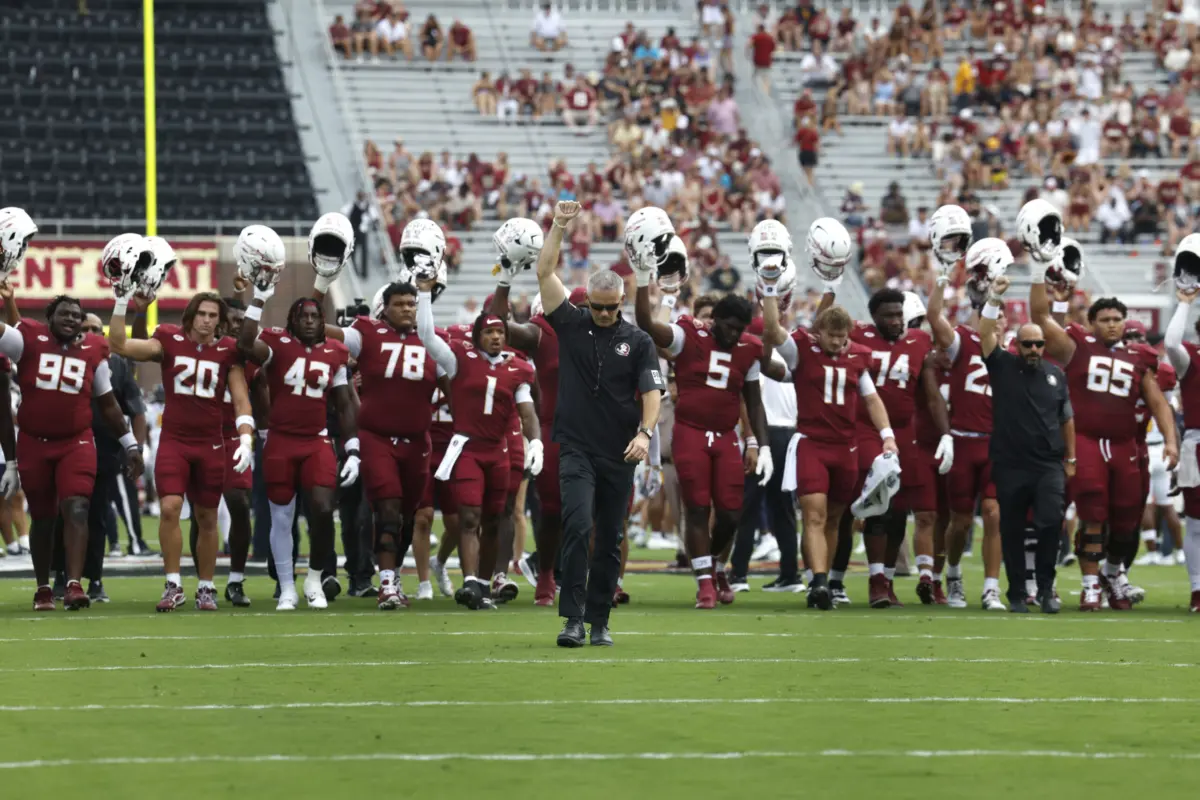
No program currently encapsulates this precarious financial tightrope quite like Florida State University. When the FSU administration elected to bring head coach Mike Norvell back for his seventh campaign, it ignited a fierce debate across the college football landscape regarding fiscal responsibility. Critics argued the university was throwing good money after bad, doubling down on a lucrative contract despite diminishing returns on the field. Norvell himself inadvertently underscored this shift in economic philosophy at the introductory press conference for John Garrett, highlighting the transaction-heavy nature of contemporary roster-building:
"In years past, it used to be who had the talent to play here, and then you would go and recruit them. Now, you’re placing a value on what the individual is. Does this guy have the talent to play at Florida State? Alright, well, what is the value of that individual?"
As the 2026 college football season approaches, recent data from national evaluations—including The Athletic’s comprehensive coaching and quarterback tiers, paired with On3’s NIL player valuations—suggests that Florida State is struggling to extract proper value from its substantial financial outlays. While athletic director Michael Alford and the FSU administration have poured massive resources into the program, questions loom large over how those dollars have been allocated. From an overpaid head coach lingering in Tier 5 to a curious discount at the game’s most important position, the Seminoles are banking on high-risk, high-cost gambles. For 2026 to be deemed a success, Norvell and his staff must prove not only that they can win football games, but that their astronomical price tags are entirely justified.
Detailed Chronology: The Road to the 2026 Financial Crossroads
To understand how Florida State arrived at this delicate juncture, one must trace the timeline of decisions that shaped the roster and coaching staff leading into the 2026 season. The trajectory of the program has undergone significant turbulence, transitioning from high-flying aspirations to a sobering re-evaluation of asset management.
The Aftermath of the Previous Season and Retention
At the conclusion of the prior campaign, the FSU administration faced a defining crossroads. Speculation ran rampant regarding Norvell’s future in Tallahassee. Yet, despite mounting fan frustration and a stagnant offensive output, school leadership opted for continuity, retaining Norvell for his seventh year at the helm. This decision locked the university into one of the most expensive coaching commitments in the country.
In the wake of that retention, the program immediately turned its attention to roster construction under the new economic rules of college football. FSU invested an impressive sum—surpassing $20 million, according to reports by The Athletic and CBS Sports—into assembling its 2026 roster. While this figure falls short of the absolute blue-blood superpowers spending at the very top of the sport, it still dwarfs the budgets of the vast majority of Atlantic Coast Conference (ACC) competitors.
Summer Evaluations and Roster Reveal
As the offseason progressed into the summer months, national analysts began casting a critical eye over the roster moves made by Norvell and de facto general manager John Garrett. In July, The Athletic released its much-anticipated college football quarterback rankings and coaching tiers. The timing could not have been more illuminating—or more uncomfortable—for the Seminoles.
In late July, the quarterback tiers slotted FSU starter Ashton Daniels deep in Tier 5, ranking him 60th overall nationally. This revelation shocked local observers, especially when juxtaposed against the aggressive portal shopping FSU had engaged in earlier. The spring window saw the Seminoles bring several high-profile signal-callers to campus, including DJ Lagway (formerly of Baylor) and Anthony Colandrea (formerly of Nebraska), both of whom commanded substantial NIL valuations. Yet, when the dust settled, Daniels emerged as the primary starter, leaving analysts to question the logic behind the distribution of funds.
By mid-August, the coaching tiers dropped, dealing another blow to FSU’s perceived organizational value. Norvell plummeted into the fifth tier, sparking intense scrutiny over his standing relative to his peers. As fall camp rolled into its final weeks, attention shifted away from boardroom metrics and toward the field, where offensive line coach Herb Hand and the rest of the staff attempted to solidify a shaky unit ahead of the season opener.
Supporting Context & Metrics: Where the Money Goes Wrong
The core issue facing Florida State is not a total lack of financial support from its boosters and administration, but rather a profound inefficiency in how capital is deployed. In an era where every dollar spent must correlate with productivity, FSU’s ledger reveals glaring disconnects between cost and output.
The Coaching Tier Disconnect
According to The Athletic’s August coaching tiers, Mike Norvell was placed squarely in the fifth tier—marking a steep two-tier drop from his ranking in 2024. More alarming than the qualitative drop, however, is the quantitative compensation attached to it. Norvell stands as the 11th-highest-paid head coach in all of college football.
Within his specific tier, Norvell is by far the most expensive operator. The grouping features coaches such as Billy Napier (James Madison), Bill O’Brien (Boston College), and Deion Sanders (Colorado). While Sanders matches Norvell in the $10 million-plus salary club, the rest of the tier drops off precipitously. For instance, Virginia’s Tony Elliott checks in as the next-highest-paid coach in that tier at $4.7 million—good for 50th nationally.
+--------------------+-------------------------+--------------------+
| Coach / Program    | Tier (*The Athletic*)   | Approximate Salary |
+--------------------+-------------------------+--------------------+
| Mike Norvell (FSU) | Tier 5 (Down 2 spots)   | $10M+ (11th in CFB)|
| Deion Sanders (COL)| Tier 5                  | $10M+              |
| Tony Elliott (UVA) | Tier 5                  | $4.7M (50th in CFB)|
| Billy Napier (JMU) | Tier 5                  | Lower Tier Average |
| Bill O’Brien (BC)  | Tier 5                  | Lower Tier Average |
+--------------------+-------------------------+--------------------+
It requires no advanced degree in economics to recognize the glaring mismatch. Florida State is paying elite, top-tier compensation for production and coaching reputation that national evaluators currently categorize among middle-to-lower tier peers.
Quarterback Investment and Valuation Anomalies
The financial discrepancies extend past the coaching staff and directly onto the gridiron via NIL valuations. According to On3’s player valuation metrics, starting quarterback Ashton Daniels carries an estimated $1 million valuation. However, The Athletic’s quarterback rankings slotted Daniels in Tier 5 at 60th overall, ranking him behind relative unknowns such as FAU’s Caden Veltkamp.
This valuation becomes even more perplexing when examining FSU’s offseason quarterback acquisitions. The Seminoles courted high-priced talent like DJ Lagway and Anthony Colandrea, both boasting estimated $2 million valuations and placement in Tier 4 (ranking 18 to 21 spots higher than Daniels). By opting for a budget-conscious or mismanaged resolution at the game’s most critical position while spending heavily elsewhere, FSU’s leadership created a structural imbalance.
Skill Positions vs. The Trenches
While FSU went relatively economical at starting quarterback, they aggressively splashed cash across their skill positions. Wide receiver Duce Robinson earned a coveted spot on the All-ACC preseason team alongside a $1 million NIL valuation, while Texas running back transfer Tre Wisner was tagged at $650,000.
Yet, this heavy investment in flash skill players highlights a baffling oversight: the offensive line. For an offense designed to stretch the field, run a complex scheme, and protect its investment under center, shoring up the trenches is paramount. However, left tackle Xavier Chaplin—a prized transfer from Auburn—was listed at a modest $700,000, merely $50,000 more than Wisner, a running back slated to share touches with the immensely talented Ousmane Kromah.
Official Statements and Local Perspectives
As the pressure mounts in Tallahassee, members of the coaching staff have attempted to project calm and confidence to the local media. Speaking to reporters following a grueling practice session, offensive line coach Herb Hand addressed the ongoing uncertainty surrounding the starting five upfront:
"Every day you have guys that show up a little bit better and some guys, maybe, don’t have the best practice. That can be fluid at times. So, I think we’re getting there. We’ll be fine by the time we get ready to kick it off."
While Hand’s optimism is a standard hallmark of preseason coach-speak, the fluidity of the offensive line just weeks before kickoff underscores the underlying anxiety. A patchwork line trying to block for a Tier 5 quarterback while relying on high-priced skill players is a recipe for volatility.
From an administrative perspective, athletic director Michael Alford and his superiors made a calculated, high-stakes gamble when they chose to retain Norvell. They weighed the financial penalty of a massive buyout against the potential stability of continuity. However, that stability now comes with an expiration date on patience. The fan base and university boosters are no longer content with mere participation; they demand tangible validation that multi-million-dollar expenditures yield commensurate on-field excellence.
Future Outlook: The Paradigm Shift in Tallahassee
Ultimately, the crisis facing Florida State transcends traditional win-loss evaluations. In the modern financial ecosystem of college football, value is king. To contextualize the challenge, consider peer programs: Notre Dame head coach Marcus Freeman commands a salary roughly $300,000 less than Norvell, yet his Fighting Crocs are routinely positioned as legitimate College Football Playoff contenders. If FSU exceeds external expectations and claws its way to an 8–4 record in 2026, it may satisfy casual observers, but it will do little to quell the financial critics questioning the $10 million price tag attached to Norvell’s office.
The margin for error in Tallahassee has vanished. Michael Alford’s administration hitched its wagon to Norvell’s vision, pouring over $20 million into a roster defined by high-cost skill players, bargain-bin quarterbacking decisions, and unproven trench depth. For the 2026 season to be recorded as a true success, Mike Norvell must shatter the narrative dictated by his fifth-tier ranking. He must prove beyond a shadow of a doubt that his coaching prowess matches his exorbitant salary, and that Florida State’s aggressive financial investments are finally building a championship-caliber foundation rather than an expensive house of cards.

0 Comments