

Executive Overview
In a landmark revelation that reshapes the geopolitical and security landscape of the Middle East, the International Atomic Energy Agency (IAEA) has confirmed that the ousted regime of Bashar al-Assad was actively constructing a covert nuclear reactor designed specifically to produce weapons-grade fissile material.
Speaking from Vienna during the opening session of the IAEA Board of Governors meeting, Director General Rafael Mariano Grossi disclosed that the technical configuration of the clandestine facility was highly optimized for the production of plutonium—the primary fuel utilized in sophisticated nuclear warheads. This confirmation dismantles decades of denials by the Damascus regime, which had consistently dismissed international intelligence reports pointing to a covert military nuclear program.
+-------------------------------------------------------------------------+
|                      KEY DISCOVERY METRICS                              |
+-------------------------------------------------------------------------+
| • Undisclosed Material: ~73 Metric Tons of Natural Uranium Metal         |
| • Fuel Configuration: Clad Uranium Fuel Rods (Reactor-Ready)             |
| • Primary Proliferation Concern: Plutonium Production Capability        |
| • Key External Partner: Democratic People's Republic of Korea (DPRK)    |
| • Current Status: Under Active IAEA Safeguards & Camera Surveillance    |
+-------------------------------------------------------------------------+
The breakthrough came in the wake of the Assad government’s collapse, which prompted transition authorities in Damascus to seek international legitimacy by granting UN inspectors unprecedented access to previously off-limits military installations. During an investigative mission, IAEA inspectors physically breached false walls and navigated highly restricted, narrow subterranean passages to discover a hidden stockpile of approximately 73 metric tons of natural uranium metal in the form of clad fuel rods.
While natural uranium is not directly usable in a weapon without enrichment or irradiation, the sheer volume and chemical form of the cache indicate it was manufactured to fuel a production reactor capable of yielding weapons-grade plutonium.
Detailed Chronology
The revelation of Syria’s hidden nuclear infrastructure is the culmination of a high-stakes, decades-long intelligence and diplomatic saga. The timeline spans clandestine partnerships, preemptive military strikes, systemic international stonewalling, and a sudden post-regime opening.
  [Early 2000s] ────────► [Sept 2007] ────────► [2008 - 2025] ───────► [July 2026] ───────► [Aug 2026]
  Clandestine             Israeli Strike       Systemic Syrian         Transition Govt      IAEA Inspectors
  Cooperation             Destroys             Stonewalling &          Discloses Secret     Breach Secret
  with DPRK               Al-Kibar Reactor     Denials of Program      Site in Letter       Walls to Find Fuel
The Genesis of Covert Ambitions (Early 2000s–2007)
Under the absolute rule of Bashar al-Assad, Syria embarked on a highly classified program to acquire a military nuclear capability. Damascus bypassed traditional international procurement channels, establishing a covert partnership with the Democratic People’s Republic of Korea (DPRK).
With North Korean technical assistance, Syria began constructing a gas-cooled, graphite-moderated reactor in the remote eastern province of Deir el-Zour, at a site known as Al-Kibar. The design of the Al-Kibar reactor was virtually identical to North Korea’s Yongbyon reactor—a facility specifically optimized for breeding weapons-grade plutonium rather than generating commercial electricity.
The 2007 Preemptive Strike and the Era of Denial
On September 6, 2007, Israeli fighter jets executed Operation Orchard, a preemptive airstrike that completely destroyed the Al-Kibar facility shortly before it was scheduled to go operational. In the immediate aftermath, the Assad regime scrambled to cover up the site’s true nature.
The remains of the reactor were bulldozed, covered with soil, and paved over. For nearly two decades, Damascus steadfastly denied the existence of a nuclear program, refusing to grant the IAEA necessary access to verify the site or investigate the origin of anthropogenic uranium particles subsequently detected by inspectors.
The Fall of Assad and the July 17 Breakthrough
The geopolitical equation changed dramatically following the ouster of the Assad regime. Desperate to rebuild relations with the international community and secure relief from paralyzing economic sanctions, the transition government in Damascus reversed decades of non-cooperation.
On July 17, 2026, the new Syrian authorities dispatched a confidential letter to the IAEA. The communication officially disclosed the existence of a highly sensitive, previously undeclared site and invited the agency to inspect the location and verify any nuclear material stored therein.
The August 2026 Inspection and Physical Breach
In August 2026, a specialized team of senior IAEA inspectors, led by Director General Grossi, arrived in Syria. The mission was marked by dramatic physical discoveries. Inspectors had to physically "tear down walls" and squeeze through extremely narrow, hidden corridors inside a fortified facility to reach a secret vault.
Inside, they discovered an uninventoried, chaotic stockpile of wooden and metal crates containing dozens of tons of reactor-ready uranium fuel rods. Simultaneously, inspectors examined newly exposed cooling infrastructure at a related site, confirming that its engineering and layout were entirely consistent with a weapons-production nuclear reactor.
Supporting Context & Metrics
The discovery of 73 metric tons of natural uranium metal is of immense technical significance to nuclear non-proliferation experts. Understanding the science of this material reveals the exact nature of the Assad regime’s military ambitions.
The Physics of the Threat: Plutonium vs. Uranium
To build a nuclear weapon, a state requires either highly enriched uranium (HEU) or plutonium-239 ($^239textPu$). The Assad regime chose the plutonium route, which is often favored by covert programs because the required production reactor can be fueled by natural uranium rather than enriched uranium.
- Natural Uranium Metal: Contains approximately 99.3% Uranium-238 ($^238textU$) and only 0.7% of the fissionable isotope Uranium-235 ($^235textU$). It cannot sustain a chain reaction in a standard light-water reactor.
- The Role of the Reactor: When natural uranium metal fuel rods are placed inside a graphite-moderated, gas-cooled reactor (such as the one destroyed at Al-Kibar), the abundant $^238textU$ atoms absorb stray neutrons. This process transmutes the $^238textU$ into $^239textPu$.
- Reprocessing: Once the fuel rods are irradiated, they are removed from the reactor and chemically processed ("reprocessed") to extract pure plutonium-239, which can then be fashioned into the core of an implosion-type nuclear weapon.
Fuel Cladding and Reactor Readiness
The IAEA confirmed that the 73 tons of natural uranium metal were discovered in the form of "fuel rods with cladding." Cladding is the outer metal layer—typically made of a zirconium alloy, aluminum, or magnesium-alloy (Magnox)—that encases the uranium core.
   +-------------------------------------------------------------+
   |             ANATOMY OF A CLAD NUCLEAR FUEL ROD              |
   +-------------------------------------------------------------+
   |                                                             |
   |   [================= URANIUM METAL CORE =================]   |
   |   ^                                                     ^   |
   |   +------------------ OUTER CLADDING -------------------+   |
   |         (Protects fuel & contains fission products)         |
   |                                                             |
   +-------------------------------------------------------------+
The presence of cladding is highly significant: it proves that the uranium had already undergone advanced metallurgical fabrication. It was not raw ore or simple yellowcake; it was finished, reactor-ready fuel, prepared specifically to be inserted directly into a reactor core.
Official Statements
The revelations have triggered intense diplomatic activity, with officials in Vienna and Damascus addressing the volatile transition of nuclear assets.
IAEA Director General Rafael Mariano Grossi
During his press conference on the opening day of the IAEA Board of Governors meeting in Vienna, Grossi emphasized the severity of the historical proliferation threat while maintaining a focus on current security:
"The configuration and the technical features of the nuclear reactor under construction in Syria during the leadership of ousted former President Bashar Assad were very efficient in the production of fissile material that could be directly used for the fabrication of nuclear weapons."
"Of course, that was never declared, that was always denied, so, and again, intentions cannot be judged, but that was a very serious proliferation concern that we had, and this has been difficult work. The important thing is that this material now is under safeguards. We are not requesting them to do this or to do that [regarding removal]. For us what’s important is that we know all the time where this material is until the last gram."
Syrian Foreign Minister Asaad al-Shibani
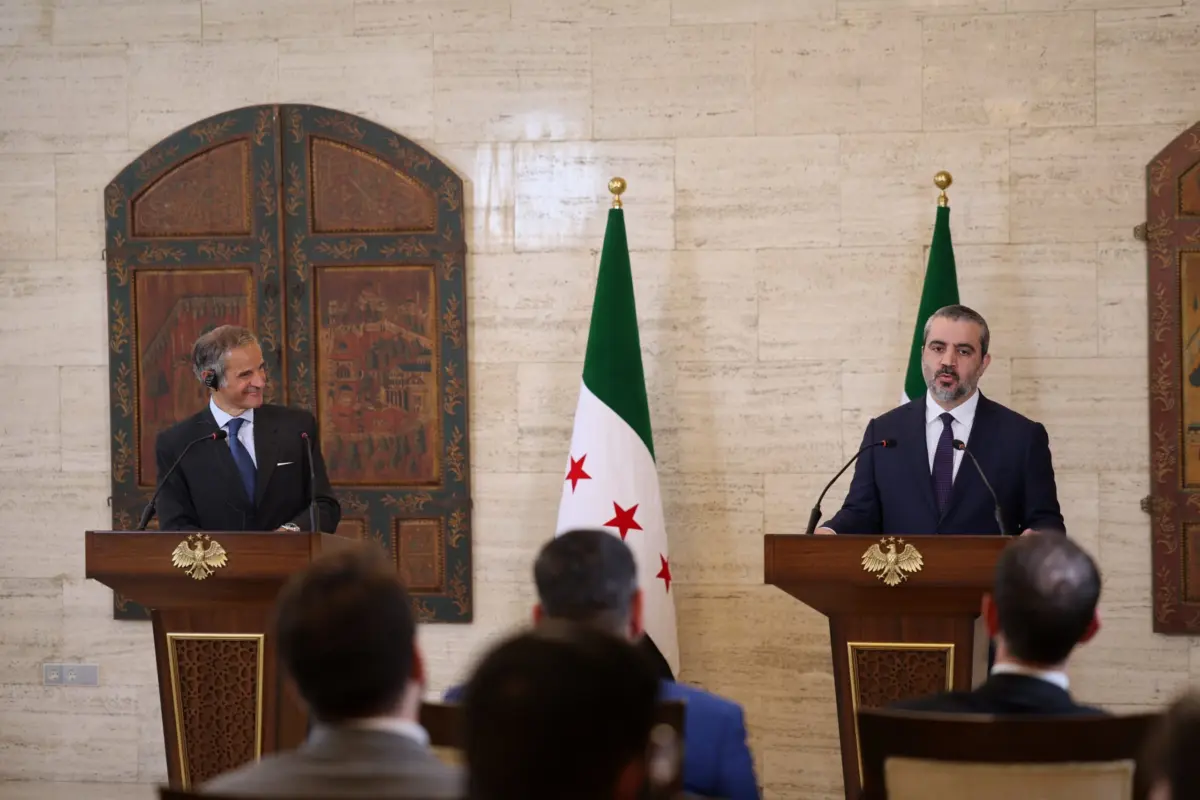
Appearing alongside Grossi during a joint press conference in Damascus, Syrian Foreign Minister Asaad al-Shibani signaled a complete break from the secrecy of the Assad era:
"The new government of Syria is committed to absolute transparency, international law, and our obligations under the Non-Proliferation Treaty. By opening these long-hidden sites to the IAEA, we are demonstrating our desire to close this dark chapter of covert programs and build a cooperative relationship with the international community."
Logan Mintz, Nuclear Threat Initiative (NTI)
Logan Mintz, a director for nuclear materials security at the Washington-based Nuclear Threat Initiative, provided critical analysis regarding the immediate risks and logistics of the discovery:
"While natural uranium metal is not directly usable for a nuclear weapon, it represents a massive proliferation risk because it could be diverted to a covert weapons program that further processes it into plutonium.
Once deemed safe to move, the material should ideally be transported in certified containers to a third country that can safely and securely disposition it into a more chemically stable and more widely used form, such as commercial reactor fuel. As with any transport of nuclear material, this movement would require robust security to prevent theft or sabotage by non-state actors operating in the region."
Future Outlook
The uncovering of Assad’s hidden nuclear infrastructure resolves a decades-old mystery, but it also presents the international community with immediate security challenges.
Securing the Material in a Volatile State
The primary short-term concern is the physical security of the 73 metric tons of uranium metal. Although the IAEA has installed round-the-clock surveillance cameras and applied physical seals to the storage site, Syria remains in a delicate state of political transition.
The presence of various armed factions, remnants of the old regime, and transnational terrorist networks makes the long-term storage of weapons-grade precursor materials inside the country highly risky.
The Logistics of Removal
Negotiations are expected to begin regarding the safe extraction of the fuel rods from Syria. The process will require:
- Diplomatic Agreements: Identifying a consenting third-party state—likely a recognized nuclear-weapon state or a highly secure European nation—willing to accept the material.
- Technical Repackaging: Transferring the clad fuel rods into highly specialized, accident-resistant transport casks.
- Secure Transit: Coordinating a heavily armed multi-national escort to transport the material from its current inland location to a secure port or airfield, minimizing the risk of interception.
Redefining Middle Eastern Proliferation History
The official verification of Syria’s weapons-grade reactor configuration fundamentally alters the historical analysis of nuclear proliferation in the Middle East. It fully vindicates the controversial 2007 Israeli airstrike and underscores the historical reality of a North Korea-Syria nuclear proliferation pipeline.
As inspectors continue to analyze the newly accessible Syrian archives and facilities, the international community may soon gain deeper insights into how close the Assad regime actually came to joining the global nuclear weapons club.

0 Comments