

Executive Overview
A devastating early-morning collision at a major intersection in Ocala, Florida, has left two people dead and two others hospitalized, prompting a comprehensive investigation by local law enforcement and raising renewed questions about traffic safety on the city’s high-speed arterial roads.
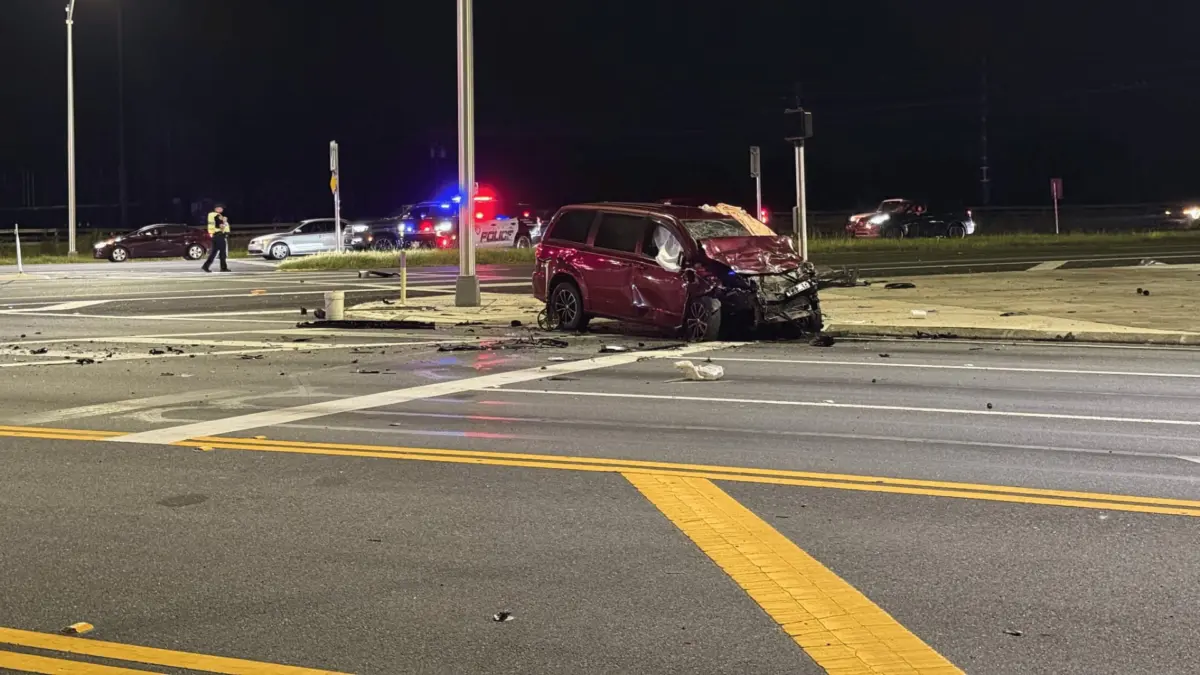
The incident, which occurred in the pre-dawn hours of Tuesday, involved a high-velocity impact between a minivan and a sport utility vehicle (SUV) at the intersection of Southeast Maricamp Road and 36th Avenue. According to preliminary reports from the Ocala Police Department (OPD), the violent crash resulted in the immediate deaths of a man and a woman who were traveling in the SUV. Two other male occupants involved in the crash were rushed to a regional trauma center, with at least one suffering from life-threatening, traumatic injuries.
The fatal crash forced emergency management personnel and police officers to close off a major portion of Southeast Maricamp Road for several hours. The closure disrupted morning commuter traffic as specialized Traffic Homicide Investigators meticulously mapped the debris field, documented physical evidence, and worked to reconstruct the dynamics of the collision. While the roadway has since been fully reopened to public transit, the underlying cause of the accident remains the subject of an active, multi-jurisdictional investigation.
This tragedy highlights a worrying trend of severe motor vehicle collisions within Marion County, a region characterized by rapid population growth, sprawling suburban developments, and high-speed transit corridors that intersect with local municipal streets.
Detailed Chronology of the Incident
The Pre-Crash Environment
In the quiet, early hours of Tuesday, conditions along Southeast Maricamp Road were typical for a weekday morning. At approximately 2:45 a.m., traffic was minimal. The intersection of Southeast Maricamp Road (State Road 464) and 36th Avenue, usually a bustling hub of commercial and commuter activity during daylight hours, was dark, illuminated only by overhead streetlights and the signals governing the intersection.
The Collision
At exactly 2:45 a.m., a minivan and an SUV converged at the intersection. The exact directional paths of both vehicles prior to the impact are still being analyzed by crash reconstructionists. However, the force of the collision was catastrophic.
Upon impact, the structural integrity of both vehicles was severely compromised. The SUV, carrying a male and a female passenger, bore the brunt of the kinetic energy transfer, causing severe cabin intrusion that instantly trapped the occupants inside. The minivan, occupied by two men, sustained extensive front-end damage, scattering engine components, shattered safety glass, and automotive fluids across multiple lanes of the intersection.
[Intersection: SE Maricamp Rd & 36th Ave]
       |             |
       |    [36th]   |
-------+-------------+-------
  <-- Minivan     SUV -->   [Maricamp Rd]
-------+-------------+-------
       |             |
       |             |
The Immediate Emergency Response
The sound of the high-impact collision echoed through the surrounding residential and commercial developments, prompting immediate calls to the Marion County Public Safety Communications Center.
Within minutes, units from the Ocala Police Department, Ocala Fire Rescue (OFR), and Marion County Fire Rescue (MCFR) arrived at the scene. First responders were met with a scene of utter devastation:
- The SUV: Both the male and female occupants were found unresponsive within the heavily damaged cabin. Paramedics quickly assessed the victims, but due to the extreme trauma sustained during the impact, both were pronounced deceased at the scene.
- The Minivan: The two male occupants of the minivan were found alive but suffering from severe injuries. Firefighters utilized specialized extrication equipment, commonly known as the "Jaws of Life," to cut through the mangled metal of the vehicle and free the trapped passengers.
- Medical Transport: Once extricated, both men were stabilized at the scene by paramedics. They were subsequently rushed via ground ambulance to a local trauma-level hospital. One of the men was admitted with critical, traumatic injuries, requiring immediate surgical intervention, while the other remains under close observation with serious, non-life-threatening injuries.
Scene Management and Road Closures
Recognizing the severity of the incident, Ocala Police officers immediately cordoned off the intersection, establishing a secure perimeter to protect the integrity of the physical evidence.
Southeast Maricamp Road was shut down in both directions from the intersection of 36th Avenue, forcing detour protocols for early-morning commuters and commercial transport trucks. The road closure remained in effect for several hours as the Ocala Police Department’s Traffic Homicide Unit conducted its forensic investigation.
By mid-morning, once the vehicles were towed, hazardous fluid spills mitigated, and debris cleared, authorities officially lifted the temporary road closures, restoring normal traffic flow to the corridor.
Supporting Context & Metrics: Traffic Safety in Marion County
To understand the broader implications of Tuesday’s fatal crash, it is essential to examine the historical and structural safety metrics of the intersection and the surrounding region.
The Geography of Maricamp Road and 36th Avenue
Southeast Maricamp Road is a critical six-lane divided highway that connects the city center of Ocala with the densely populated unincorporated communities of Silver Springs Shores. The speed limit along this stretch of road ranges from 45 to 55 mph. However, local residents and traffic safety advocates have long noted that actual travel speeds often exceed the posted limits, particularly during late-night and early-morning hours when traffic density is low.
The intersection at 36th Avenue is highly complex, featuring:
- Multiple dedicated left and right-turn lanes.
- High-volume pedestrian crosswalks.
- High-speed approaches from both the east and west.
When high-speed limits are combined with a lack of visual cues in the dark, intersections like this one become highly susceptible to severe, right-angle (T-bone) or head-on collisions, which carry a much higher rate of mortality compared to rear-end collisions.
Regional Traffic Safety Statistics
According to historical data compiled by the Florida Department of Highway Safety and Motor Vehicles (FLHSMV), Marion County consistently ranks among the higher-risk counties in the state of Florida for traffic-related fatalities.
| Metric | Marion County Annual Average (Approx.) | State of Florida Context |
|---|---|---|
| Total Annual Traffic Crashes | 6,500 – 7,200 | High density relative to population |
| Annual Traffic Fatalities | 80 – 110 | Frequently in the top tier of mid-sized counties |
| Injuries from Crashes | 4,500 – 5,000 | Heavy burden on local trauma centers |
| Late-Night/Early-Morning Crashes | ~15% of total crashes | Disproportionately represent over 40% of fatal incidents |
This statistical reality points to systemic challenges in regional traffic management, driver behavior, and roadway design. Early-morning crashes (occurring between midnight and 5:00 a.m.) are particularly lethal due to a combination of factors:
- Impairment: A higher statistical likelihood of drivers operating vehicles under the influence of alcohol or controlled substances.
- Fatigue: Driver fatigue and microsleeps, which severely delay reaction times, preventing drivers from braking prior to impact.
- Speeding: Empty roadways encourage drivers to exceed speed limits, exponentially increasing the kinetic energy involved in a crash.
Official Statements and Investigative Protocols
In the wake of the tragedy, local authorities have emphasized their commitment to a thorough and scientific investigation to determine the exact sequence of events that led to the double fatality.
Ocala Police Department Statement
An official spokesperson for the Ocala Police Department released a preliminary statement detailing the department’s response:
"The Ocala Police Department expresses its deepest condolences to the families of the individuals who lost their lives in this tragic incident. Our Traffic Homicide Unit is working diligently to piece together the events of Tuesday morning. We are looking at all possible contributing factors, including speed, vehicle mechanics, roadway conditions, and potential driver impairment. We ask for the community’s patience as our investigators conduct this vital work."
The OPD has also issued a public appeal, urging any motorists who may have been in the area of Southeast Maricamp Road and 36th Avenue around 2:45 a.m. on Tuesday, or who may have functional dashcam footage, to contact the department’s traffic division immediately.
Forensic and Investigative Procedures
The investigation into a double-fatality crash is highly systematic and typically takes several weeks, if not months, to complete. The OPD Traffic Homicide Unit utilizes several advanced forensic tools:
- 3D Laser Mapping: Investigators use terrestrial LiDAR scanners to create a highly accurate three-dimensional digital twin of the crash scene. This preserves the exact location of tire marks, gouges in the asphalt, debris, and final vehicle resting positions.
- Event Data Recorders (EDRs): Commonly referred to as vehicle "black boxes," EDRs are retrieved from both the minivan and the SUV. These devices provide critical pre-crash telemetry data, including vehicle speed, steering angles, brake application, and seatbelt usage in the seconds leading up to the impact.
- Toxicology and Autopsy: The District 5 Medical Examiner’s Office will conduct routine autopsies and toxicological screenings on the deceased to determine if physical impairment or medical emergencies played a role in the collision.
Future Outlook: Infrastructure and Traffic Remediation
As the Ocala community mourns the loss of two of its residents, municipal leaders and urban planners are facing pressure to address the persistent safety challenges of the city’s major thoroughfares.
                    [COMMUNITY IMPACT]
                            |
           +----------------+----------------+
           |                                 |
[Engineering Solutions]            [Enforcement & Education]
  - Adaptive Traffic Signals         - High-Visibility Patrols
  - Intersection Lighting Upgrades   - Late-Night Speed Stings
  - Speed-Calming Design             - Public Awareness Campaigns
Proposed Engineering and Infrastructure Solutions
The intersection of Southeast Maricamp Road and 36th Avenue has been identified in past regional planning documents as an area requiring ongoing monitoring. In light of this recent tragedy, local transportation officials are expected to review several potential safety enhancements:
- Adaptive Traffic Signal Control: Implementing smart traffic signals that adjust timing dynamically based on real-time traffic flow, reducing the likelihood of drivers rushing to catch yellow lights.
- Enhanced Intersection Lighting: Upgrading the existing high-pressure sodium streetlights to high-output LED fixtures to significantly improve nocturnal visibility for drivers approaching the intersection.
- Speed-Calming Measures: Exploring architectural interventions, such as highly visible reflective striping, rumble strips on high-speed approaches, and prominent electronic speed-feedback signs.
Enforcement and Public Safety Initiatives
In tandem with structural engineering changes, the Ocala Police Department is expected to increase high-visibility traffic enforcement patrols along the Maricamp Road corridor, particularly during the high-risk late-night and early-morning hours. These patrols will focus on curbing excessive speeding, distracted driving, and driving under the influence.
Ultimately, this tragic event serves as a stark reminder of the fragile nature of road safety and the collective responsibility shared by urban planners, law enforcement, and individual drivers to ensure that such preventable losses of life are minimized in the future. As the investigation continues, the findings will likely serve as a catalyst for meaningful change in Ocala’s approach to traffic management and community safety.

0 Comments