

Executive Overview
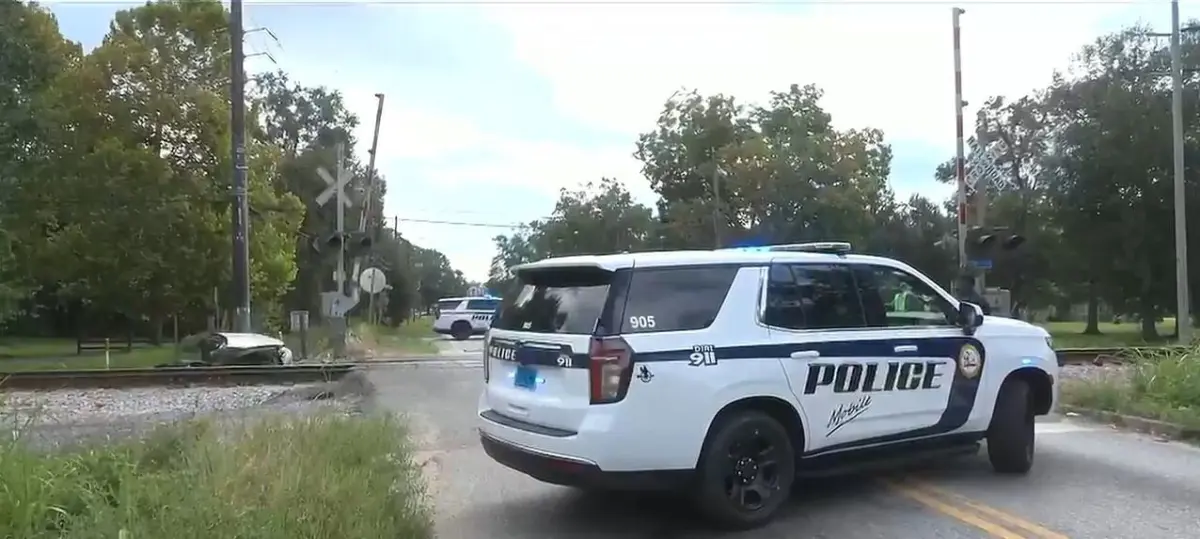
MOBILE, Ala. — A devastating collision at a railroad crossing in the unincorporated community of Theodore, just south of Mobile, has claimed the lives of a local couple and left a young family shattered. The incident, which occurred on a Thursday morning just before 11:00 a.m., involved an oncoming Amtrak passenger train and a passenger vehicle attempting to navigate a guarded rail intersection. The impact was catastrophic, completely shearing the vehicle in half and leaving behind a debris field that stretched down the tracks.
Authorities identified the victims as 41-year-old James Cobb and his 44-year-old fiancée, Suzanne Wages. According to the Mobile Police Department, preliminary findings indicate that the vehicle attempted to bypass lowered safety crossing arms to beat the oncoming train. The tragedy compounds a grim timeline for the local municipality, marking the second fatal rail-crossing incident at this exact location within a single year.
The human cost of the accident extends far beyond the mangled steel of the crossing. Cobb and Wages left behind a young son who, in a heart-wrenching twist of fate, celebrated his seventh birthday on the very day his parents were killed. The crash has reverberated deeply through the community, prompting emotional accounts from eyewitnesses who knew the family personally, fierce debates over infrastructure safety measures, and renewed, urgent warnings from law enforcement regarding the extreme dangers of attempting to outrun high-speed rail traffic.
Detailed Chronology: A Morning Shattered
The sequence of events on that fateful Thursday morning unfolded with terrifying speed, transforming a routine day into an unimaginable nightmare for residents and first responders in Theodore.
The Final Hours
Roughly 45 minutes before the collision, James Cobb was seen by lifelong family friend Leonard Whitfield, assistant pastor of the Mount Airy Missionary Baptist Church. Whitfield, who has known Cobb since infancy, recalled crossing paths with him at a local gas station. Cobb was casually pumping gas into his vehicle, exhibiting the warm, approachable demeanor that those close to him had come to treasure.
"I seen him about 45 minutes prior to this incident," Whitfield remembered. "He was pumping gas in his car, and I spoke to him, hollered at him. He’ll throw his hand up and look and give you that smile."
Cobb was described by his pastor as a remarkably respectful man hailing from a deeply cherished family. Little did Whitfield or anyone else in the community know that these fleeting moments at the gas station would be their final memories of a devoted father and his partner.
The Collision
Shortly before 11:00 a.m., Whitfield was driving on his way to a local barbershop. As he navigated his route over the railroad tracks in Theodore and executed a right turn, the tranquility of the morning was violently shattered.
"I came over the railroad track, made a right turn. I heard a loud boom," Whitfield recounted.
That single, explosive sound marked the moment the Amtrak passenger train—travelling at high velocity toward Mobile—collided with Cobb’s vehicle. According to investigators and witnesses, the force of the impact was so monumental that it physically sliced the automobile in half. One wreckage half remained pinned near the initial crossing point, while the momentum of the locomotive dragged the other half a considerable distance down the tracks.
Emergency services rushed to the scene following a flurry of 911 calls. First responders arrived to find a scene of utter devastation. Hours after the collision, shattered automotive components, personal items, and twisted metal remained strewn across the ballast, serving as a grim testament to the violence of the impact.
The Grim Identification
As police secured the perimeter and initiated their preliminary investigation, the horrifying reality of the tragedy began to close in on those who arrived at the scene. Whitfield, who had heard the explosion moments earlier, quickly learned that the victims inside the vehicle were people he held dear.
The Mobile Police Department formally identified the deceased occupants on Friday as James Cobb and Suzanne Wages. The loss immediately reverberated through local social circles, hitting the Mount Airy Missionary Baptist Church congregation particularly hard. The couple’s surviving son, who had turned seven years old that very day, was thrust into an unthinkable reality, robbed of both parents on the anniversary of his birth.
Supporting Context & Metrics: The Danger Zone in Theodore
The intersection where Cobb and Wages lost their lives is no stranger to tragedy. The crossing, situated within a busy and growing transit corridor in the Mobile metropolitan area, has become a focal point for municipal safety concerns following a string of fatal accidents.
A Pattern of Lethality
The Thursday morning crash marks the second fatal collision at this specific Theodore railroad crossing in 2026. The recurring nature of these deadly incidents has raised alarms among residents, civil engineers, and local safety advocates.
In February of the same year, the crossing was the site of a horrifyingly similar catastrophe. A vehicle carrying 31-year-old Brittany Williams and her 8-year-old daughter bypassed the crossing arms and was struck by an oncoming Amtrak train. Both Williams and her daughter were killed instantly.
The occurrence of two catastrophic, double-fatality crashes at the exact same geographic coordinates within a span of months has thrust the intersection under intense public scrutiny. Community members are demanding to know why this particular crossing continues to claim lives, pointing to a potentially dangerous combination of human behavior, high-speed rail schedules, and inadequate physical infrastructure.
The Reality of Modern Rail Speed
A critical factor emphasized by law enforcement is the nature of the rail traffic moving through the Theodore corridor. Unlike slower freight trains that rumble through industrial and residential zones, allowing motorists ample time to process their movements, passenger services like Amtrak operate on significantly accelerated schedules.
According to Mobile Police Department spokesman Blake Brown, the speed differential catches many local motorists off guard. "This train goes a lot faster than some of the other freight trains that move through the area," Brown noted during a press briefing addressing the crisis.
This velocity diminishes the margin of error for drivers. When a vehicle attempts to navigate a crossing as warning systems activate, the time between the initial descent of the gate arms and the arrival of the locomotive is measured in mere seconds. Attempting to calculate or beat that window leaves zero room for miscalculation.
Official Statements: Law Enforcement and Community Response
As the community grapples with the grief of losing James Cobb, Suzanne Wages, and the victims of the February crash, city officials and community leaders are speaking out to address the systemic safety failures and human behaviors contributing to these disasters.
Mobile Police Department Weighs In
Blake Brown, speaking on behalf of the Mobile Police Department, provided crucial details regarding the mechanical status of the crossing at the time of the collision. Contrary to speculation that equipment failure might have played a role, investigators confirmed that all standard-issue warning systems were fully functional.
"The safety equipment at the railroad crossing was operating as normal when the crash happened," Brown confirmed. "The crossing arms were down at the time. A vehicle was not wanting to wait, tried to go around the arms, and that vehicle was struck by the train."
Brown elaborated on the sheer violence of the impact, reiterating the structural failure of the vehicle. "It’s our understanding that the vehicle was completely cut in half by the train, and we’ve got two victims that are deceased who are inside of that vehicle."
In response to the recurring tragedies, the city has amplified its public safety messaging. The Mobile Police Department, alongside municipal agencies, has repeatedly deployed public service announcements (PSAs) aimed at deterring motorists from taking fatal shortcuts at rail crossings.
"We put out PSAs ourselves. I know the city also put out some other information, as well," Brown said. His message to the public was blunt and unyielding: "Don’t try to outrun a train. Don’t try to go under the arms. They’re there for a reason."
Community Grief and Infrastructure Demands
The official warnings, however, are viewed by some community members as insufficient in the face of persistent human error. Assistant Pastor Leonard Whitfield argued that relying solely on public awareness campaigns and traditional lowering arms is failing to protect distracted, rushed, or impatient drivers.
Whitfield called for a paradigm shift in how dangerous intersections are engineered, proposing the installation of more aggressive, dynamic security measures. Rather than relying on standard wooden or fiberglass crossing arms that can be easily driven around, Whitfield advocated for heavy-duty physical barriers—such as retractable bollards or reinforced gates that rise directly from the roadway surface to physically block vehicles from entering the tracks.
"Things like this are avoidable," Whitfield reflected, his voice heavy with sorrow. "We just need to be alert, be patient, and do what’s right, especially when we’re dealing with trains. But we also need to look at what more we can do to protect people from themselves."
Meanwhile, inquiries directed toward Amtrak regarding their operational protocols, locomotive telemetry, and visibility enhancements along the Mobile corridor remained unanswered as of late Thursday, with local affiliates awaiting official statements from the passenger rail corporation.
Future Outlook: Preventing Future Tragedies in Mobile County
The double tragedy in Theodore has catalyzed an urgent dialogue among city planners, transportation authorities, and residents regarding the future of rail safety in Mobile County. As local authorities finalize their investigation into the crash, several critical paths forward are emerging to prevent further loss of life.
Infrastructure Audits and Engineering Solutions
The immediate pressure falls on local and federal transportation departments to conduct comprehensive safety audits of the Theodore crossing and similar intersections throughout the region. While traditional crossing gates, flashing red lights, and audible bells represent the baseline standard mandated by the Federal Railroad Administration (FRA), the recurrence of fatal "bypass" accidents suggests that baseline measures may no longer be adequate for high-speed passenger corridors.
Civil engineers point to several advanced engineering interventions utilized in other high-risk metropolitan areas across the United States:
- Median Separators (Channelization): Installing non-traversable highway medians extending back from the crossing for several hundred feet, physically preventing motorists from driving into the opposing lane to circumvent lowered gates.
- Four-Quadrant Gate Systems: Upgrading standard two-gate crossings to four-quadrant systems that completely seal off both lanes of traffic in both directions, making it nearly impossible for a vehicle to squeeze past.
- Advanced Intrusion Detection: Implementing radar or laser-based detection systems that alert oncoming trains if a vehicle stalls or becomes trapped on the tracks between closed gates.
Public Education and Behavioral Modification
While engineering solutions can mitigate risk, transportation safety experts emphasize that behavioral modification remains the ultimate hurdle. The temptation to bypass crossing arms—often driven by commuter fatigue, strict scheduling pressures, or simple impatience—continues to override basic survival instincts.
The City of Mobile and local law enforcement agencies are expected to ramp up educational outreach campaigns, partnering with schools, community organizations, and local media outlets to drive home the physical realities of rail physics. Educational initiatives will likely focus on dispelling common myths, such as the illusion that a train can stop quickly or that a motorist can accurately judge the speed and distance of an oncoming locomotive.
Supporting the Bereaved Family
Amidst the policy debates and infrastructure planning, the immediate human tragedy remains at the forefront of the community’s collective consciousness. Friends, congregants, and local organizations are rallying around the family of James Cobb and Suzanne Wages, focusing particularly on providing emotional and financial support for their orphaned seven-year-old son on what should have been a day of celebration, now marred by unimaginable sorrow.
As the community of Theodore attempts to heal from its latest wound, the twisted metal at the railroad crossing serves as a haunting reminder of the fragility of life—and the unforgiving consequences of a split-second decision on the tracks.

0 Comments