
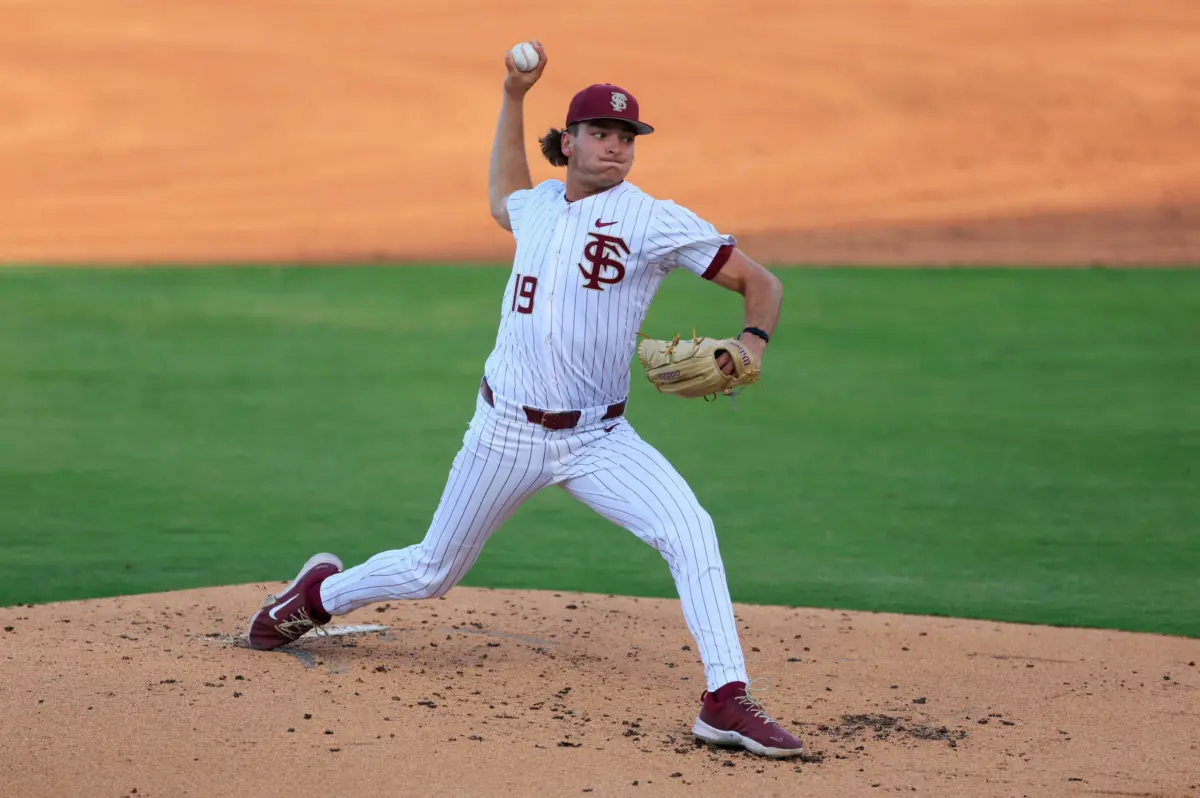

Executive Overview
In the modern landscape of collegiate athletics, the intersection of the MLB Draft and the NCAA transfer portal has accelerated roster turnover, creating a transactional environment where loyalty is frequently sidelined by signing bonuses and immediate professional aspirations. Yet, college baseball occasionally yields a narrative that challenges this status quo—a story anchored in unfinished business, personal conviction, and the enduring allure of a historic program.
For right-handed pitcher John Abraham, the conclusion of the 2026 Florida State Seminoles season appeared to mark the definitive end of his tenure in Garnet and Gold. Having blossomed from a heavily utilized freshman reliever into a D1 Baseball Second-Team All-American by his junior campaign, Abraham’s trajectory pointed squarely toward the professional ranks. His meteoric rise mirrored the broader resurgence of FSU baseball under head coach Link Jarrett, a renaissance that included a trip to the College World Series in Omaha in 2024 and a harrowing, agonizingly close push in 2025.
However, when the 2026 MLB Draft came and went without Abraham’s name being called, the baseball community was left stunned. What seemed like an unfathomable draft snub was, in reality, the byproduct of calculated decisions, market disconnections, and a player unwilling to settle for undervalued professional offers. Rather than entering the professional minor league trenches under unfavorable contract terms, Abraham opted to utilize his leverage in a different arena: returning to Tallahassee for his senior year.
This unexpected homecoming is not merely a stroke of good fortune for a Seminoles roster looking to reload; it represents a fundamental shift in Abraham’s career trajectory. To maximize his draft stock for the 2027 cycle, the former lockdown reliever is undergoing a rigorous offseason transition into a starting pitcher. Combined with a star-studded transfer portal class headlined by elite left-hander Cayden Suchy and a veteran core choosing legacy over early departures, Abraham’s return positions Florida State’s pitching staff as a terrifying focal point for the upcoming season. This is the inside story of how one of college baseball’s premier arms chose to run it back in Tallahassee, aiming to complete a journey that began three years ago.
Detailed Chronology: From Tampa Freshman to All-American Reliever
To understand the weight of John Abraham’s decision to return for his senior season, one must examine the incremental evolution of his collegiate career. Hailing from Tampa, Florida, Abraham arrived on campus ahead of the 2024 season with a live arm and raw potential. In an era where young pitchers are frequently mishandled or overwhelmed by the speed of the Atlantic Coast Conference (ACC), Abraham immediately carved out a trusted role.
As a freshman, the right-hander made 25 appearances, serving as a vital piece of the bullpen machinery that propelled Link Jarrett’s squad all the way to Omaha. While he experienced the typical freshman growing pains, the trial by fire proved invaluable. He learned the nuances of high-leverage collegiate pitching, absorbing the intense expectations that come with wearing the Florida State uniform.
The developmental curve steepened heading into 2025. Abraham once again appeared in over 20 games, cementing himself as a high-trust option for Jarrett’s bullpen. The Seminoles put together another stellar campaign, falling just one win short of returning to the College World Series. By this point, Abraham’s confidence and repertoire were coalescing.
The breakthrough arrived in 2026. Shedding the inconsistency that occasionally plagued his early career, Abraham put it all together to become one of the most dominant relievers in the country. He finally harnessed the command of his electric, high-velocity fastball and devastating, wipeout changeup, rendering opposing hitters largely helpless. His stellar performance earned him prestigious D1 Baseball Second-Team All-American honors.
Yet, the season’s final chapter was complicated. A late-season injury derailed some of his momentum, and a difficult postseason showing for the Seminoles—highlighted by an abrupt exit in the Tallahassee Regional—left a sour taste in the program’s mouth. Despite the abrupt playoff elimination, Abraham’s overall body of work and year-over-year progression made him a virtual lock to hear his name called in the MLB Draft, signaling the expected departure of a prized junior.
The Draft Snub and the Inside Story
In professional baseball, a player’s junior year is universally regarded as their primary "leverage year." With only one year of remaining college eligibility to bargain with, juniors typically hold the upper hand in negotiations; if a Major League organization fails to meet a player’s signing bonus valuation, the player can simply return to campus, re-establish their value, and try again the following year.
Thus, when the 2026 MLB Draft concluded without John Abraham being selected, industry analysts and fans were left grasping for explanations. Had the late-season injury exposed medical red flags? Had scouts soured on his delivery?
The mystery was finally solved when Abraham spoke to the local Tallahassee media for the first time since the conclusion of the previous season. Pulling back the curtain on the behind-the-scenes mechanics of the draft, Abraham revealed a much different reality: the draft was not a rejection of his talent, but a rejection of the business terms presented to him.
"I had a big summer. I went to the MLB Draft Combine. All my intentions were on going to the draft," Abraham explained candidly. "কিন্তু when it came to the draft, I felt like I was kind of disrespected by the offers they were giving me. FSU gave me an opportunity that I couldn’t turn down. I’m more than happy to be here."
By refusing to sign below his perceived market value, Abraham flipped the traditional collegiate narrative. Rather than accepting an undervalued professional contract out of a sense of obligation, he chose to bet on himself. Florida State’s collective infrastructure, coaching staff, and developmental pipeline presented an alternative path that made staying in school far more lucrative for his long-term professional stock than signing a discounted minor league deal.
Supporting Context & Metrics: Building the 2027 Pitching Factory
Abraham’s decision to return creates a domino effect across the entire Florida State roster, most notably altering the strategic composition of the pitching staff. Following the conclusion of the 2026 season, the Seminoles faced a daunting reality: they lost all three of their weekend starting pitchers from a rotation that had ranked among the finest in the nation. For a program harboring legitimate national championship aspirations, replacing an entire weekend rotation is an existential challenge.
Enter the Abraham position change. Following the draft, baseball insider Brett Nevitt reported that Abraham would transition from his established role as a bullpen stopper into a full-time starting pitcher. This evolution is vital. Moving a pitcher with Abraham’s velocity, secondary offerings, and competitive makeup into the rotation immediately stabilizes the front end of FSU’s pitching plans.
However, the front office and coaching staff did not stop with internal position shifts. Head coach Link Jarrett and pitching coach Micah Posey attacked the transfer portal with surgical precision, assembling an elite talent influx. The crown jewel of this transfer class is left-handed pitcher Cayden Suchy, widely regarded by publications like D1 Baseball as the top pitching transfer in the entire collegiate landscape.
When combining Suchy’s elite repertoire with Abraham’s transition to the rotation, Florida State’s pitching staff transforms from a question mark into the undisputed anchor of the team. The sheer potency of the upcoming staff is underlined by raw metrics that have left returning players in awe. As Abraham noted when discussing the fall workouts:
"The first thing that sticks out is that everybody throws hard on our staff this year. It’s pretty impressive. I’ve never been on a staff with eight guys who throw 95+."
In modern college baseball, velocity paired with refined command is the currency of the realm. With a bullpen and rotation boasting that level of sheer firepower, FSU has the raw ingredients to dominate opponents while the lineup and defensive units iron out their respective identities during the fall and early spring.
Official Statements and the Culture of "Re-Recruiting"
The retention of John Abraham is not an isolated incident; it is part of a broader, highly intentional philosophy championed by Link Jarrett. In an era defined by the easy transactional nature of the transfer portal, keeping elite juniors from bolting for the professional ranks requires an environment that players actively want to inhabit.
Addressing the media, Jarrett articulated the modern philosophy of roster construction, coining a phrase that highlights the changing nature of collegiate coaching:
"We talk about re-recruiting your own players," Jarrett said. "It speaks volumes about what they feel here: the development, the fans, the growth, the schedule, the visibility, the things that are in place for them here. It’s very unique. So to grab some of those guys back and see them again, they’re excited and they’re experienced. It’s quite the perk for the roster because you could have very easily lost seven or more players to the draft, and they chose to stay here."
This retention philosophy successfully salvaged a core group of veterans who have chosen to plant roots in Tallahassee for four consecutive years—a staggering longevity metric in contemporary college sports. Alongside Abraham, foundational pillars such as infielder Cal Fisher, outfielder Brody DeLamielleure, and left-handed pitcher Payton Manca have all returned for their senior campaigns under Jarrett.
This senior leadership group serves as the cultural compass for the program. In a game where young talent enters the program with immense expectations every autumn, having battle-tested veterans who understand the culture, the pressure, and the standard of Florida State baseball is invaluable. Abraham himself emphasized the deliberate, foundational work taking place during the fall practice schedule:
"We’re guiding them every day, trying to help them out. The biggest thing with us is to have a good culture. That’s what the fall is for. It’s for working and also having a good culture, setting the foundation."
Future Outlook: The Road Back to Omaha
As the calendar turns toward the grueling grind of the 2027 college baseball season, the narrative surrounding Florida State is one of calculated redemption. The bitter taste of the 2026 postseason exit has been replaced by the focused energy of a roster that realizes it possesses all the necessary components to make a deep run into June.
For John Abraham personally, the upcoming season represents a masterclass in risk mitigation and career repositioning. By stepping away from the draft table and returning to campus, he has engineered a win-win scenario:
- The Starter Evaluation: By proving he can navigate a collegiate lineup multiple times through the order as a starting pitcher, he removes any lingering scout skepticism regarding his durability and pitch mix longevity, potentially driving his draft stock significantly higher than the fourth-round or late-round valuation offered to him as a reliever.
- Leadership Legacy: He solidifies his status as a program legend—a player who weathered the highs of Omaha and the lows of regional exits, choosing to finish his story on his own terms rather than a professional organization’s discount rate.
- Team Success: He anchors a rotation that, alongside portal sensation Cayden Suchy and a bullpen featuring eight arms touching 95+ mph, promises to give the Seminoles elite pitching depth every single day of the week.
The modern era of college athletics often tries to convince observers that sports are purely transactional—that players are mercenaries chasing the highest immediate payout, and programs are merely stepping stones. John Abraham and his fellow returning seniors at Florida State have provided a refreshing counter-narrative. They have proven that development, fan connection, cultural alignment, and the pursuit of a championship ring still hold immense weight.
As fall ball transitions into spring lights at Dick Howser Stadium, the Garnet and Gold faithful can rest easy knowing that one of the nation’s premier arms is back on the mound. John Abraham didn’t get the professional send-off he initially envisioned last summer, but in staying behind to build a new pitching legacy, he just might author an even better ending to his collegiate career.

0 Comments