

Executive Overview
In an unprecedented escalation of tensions between the executive branch and the nation’s central bank, President Donald Trump issued a sweeping and aggressive ultimatum on Friday, threatening to completely sever trade relations with any nation running a trade deficit with the United States unless the Federal Reserve immediately slashes interest rates.
The extraordinary threat, broadcast via social media, followed the release of a surprisingly robust August employment report that revealed the U.S. economy added 162,000 jobs—a figure that vastly outpaced most professional economic forecasts. Rather than being welcomed as an unqualified economic victory, the blockbuster jobs report immediately triggered widespread apprehension across global financial markets. Economists and institutional investors alike interpreted the surprisingly strong labor market data as a clear indicator that inflationary pressures remain unyielding, thereby increasing the probability that the Federal Reserve will raise, rather than lower, benchmark interest rates during its upcoming policy meeting.
The intersection of aggressive fiscal protectionism, burgeoning industrial onshoring, and monetary policy friction has created a high-stakes standoff in Washington. The Trump administration attributes the dramatic surge in employment directly to its aggressive tariff regime and domestic manufacturing incentives, arguing that monetary policy authorities are out of touch with the ground-level reality of an industrial renaissance. Conversely, independent economists caution that the administration’s demands—paired with persistent wage stagnation and a complex global trade matrix—risk sparking severe economic instability. This comprehensive report breaks down the sequence of events, analyzes the underlying macroeconomic metrics, examines official statements from key stakeholders, and explores the broader outlook for the American economy.
Detailed Chronology of Events
Friday Morning: The Truth Social Ultimatum
The sequence of events that rattled international financial capitals began early Friday morning. Following the release of the Bureau of Labor Statistics (BLS) employment data at 8:30 a.m. EST, President Trump took to Truth Social to voice his deep-seated frustration with the Federal Reserve’s monetary trajectory.
For months, the White House has publicly and privately pressured the central bank to ease monetary policy, arguing that high interest rates stifle domestic investment, disadvantage American exporters, and place an undue burden on consumers and businesses. However, Friday’s post marked a drastic escalation. The President stated unequivocally that if the Federal Reserve fails to cut interest rates, his administration will systematically cease trading with every country that maintains a trade deficit with the United States.
Because the United States runs trade deficits with the vast majority of its major trading partners—including economic powerhouses like the European Union, China, Mexico, and Vietnam—such a policy would effectively mean an immediate and total embargo on the vast majority of international commerce, a prospect that sent immediate shockwaves through global supply chains and diplomatic circles.
The Immediate Market Reaction
Within minutes of the President’s social media post and the digestion of the morning’s jobs report, domestic and international financial markets reacted negatively. Wall Street indices opened sharply lower, erasing early-morning optimism.
Traders and institutional analysts rapidly recalculated their expectations for the Federal Reserve’s next move. For weeks, market consensus had tentatively priced in the possibility of a modest rate cut, or at least a prolonged pause, to counteract softening spots in the broader economy. However, the August employment data—showing a massive beat on job creation—forced a recalibration. Market participants concluded that a scorching job market would give Federal Reserve Chairman Jerome Powell and the Federal Open Market Committee (FOMC) sufficient justification to maintain high interest rates, or even institute another hike, to keep inflation anchored near the central bank’s elusive 2% target.
The Oval Office Press Interaction
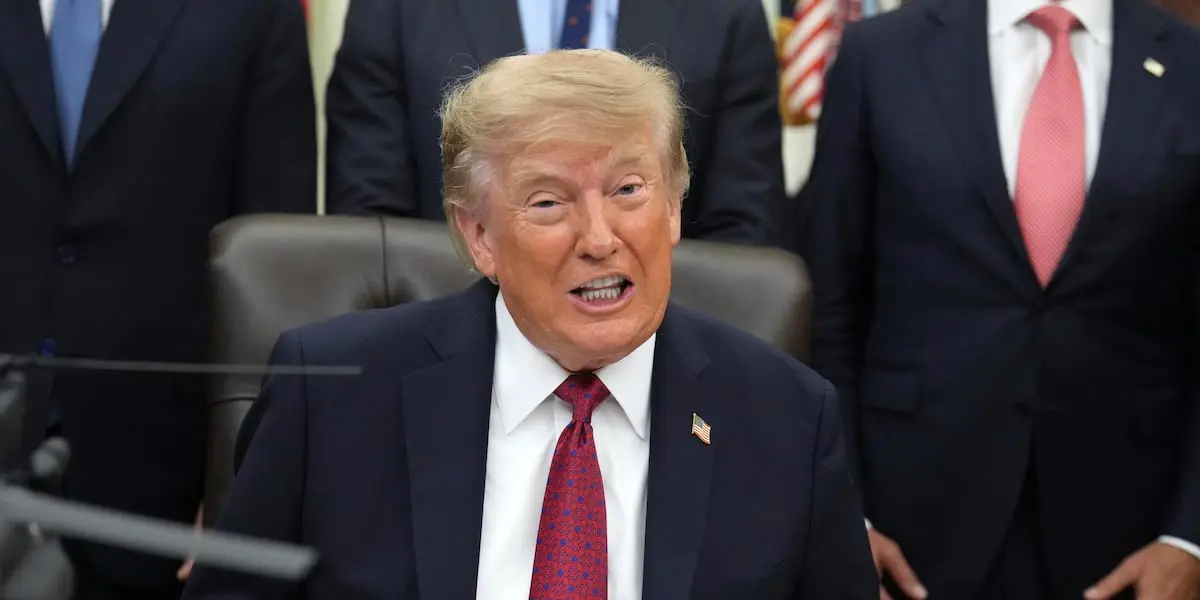
Later in the afternoon, President Trump addressed the developments during an extensive and wide-ranging press interaction inside the Oval Office. Visibly energized by the employment figures yet exasperated by the subsequent market downturn, the President remarked on the paradox of positive economic indicators triggering negative financial market performance.
"It’s been amazing. And today, they announced 162,000 jobs, new jobs, which was about five times more than the projection," President Trump observed to reporters gathered in the West Wing. "And sadly, I said, the numbers doing so good. The country is doing so well. Watch the stock market will go down because we have good numbers, because everyone—every time you have good numbers, the stock market goes down."
The President’s remarks underscored a core philosophical divide between the White House and Wall Street. While the administration views raw job creation and localized industrial construction as the definitive yardsticks of national economic health, financial markets remain hyper-focused on liquidity, borrowing costs, and the risk of overheating.
Supporting Context & Metrics: Decoding the August Jobs Report
To fully understand the gravity of the administration’s threats and the reaction of the financial sector, one must examine the underlying data of the August employment report released by the Bureau of Labor Statistics.
Job Creation Surges Past Projections
The U.S. economy added 162,000 jobs in August, a figure that more than doubled the median estimates of most professional economists, who had projected a much more modest gain of roughly 75,000 to 80,000 jobs. This performance represents the highest monthly job growth mark recorded since March and stands in stark contrast to the revised upward figures of the preceding months, most notably recovering from the sluggish 21,000 jobs added in July.
Sector Breakdown: Hospitality Leads the Charge
A detailed examination of the employment gains reveals where the growth is concentrated:
- Leisure and Hospitality: This sector captured the lion’s share of August’s job gains. Bars, restaurants, hotels, and entertainment venues aggressively ramped up hiring to meet resilient consumer demand and fill lingering staffing gaps.
- Manufacturing and Construction: Reflecting the administration’s policy focus, construction and localized industrial development also reported robust figures, bolstered by structural incentives and corporate investments in domestic facilities.
Unemployment Rate Stability
Despite the influx of new workers entering the labor force, the national unemployment rate remained entirely unchanged at 4.1 percent. This stability indicates that the labor market is absorbing workers at a healthy clip without triggering mass layoffs or sudden spikes in joblessness, reinforcing the narrative of a remarkably resilient broader economy.
The Wage-Inflation Disconnect
However, beneath the surface of top-line job growth figures lies a persistent economic challenge that complicates the national picture: wages failed to keep pace with inflation.
While employment opportunities expanded, the average hourly earnings growth did not outstrip the persistent rise in the cost of living. Consequently, the purchasing power of the American consumer continues to experience erosion. Families find that even with employment secured, their take-home pay buys fewer goods and services than it did in previous years. This disconnect between nominal job creation and real purchasing power forms a central argument for both critics of current economic trends and policymakers wrestling with the true cost of inflation.
Official Statements and Policy Rationales
The White House Perspective: Tariffs and Onshoring
National Economic Council (NEC) Director Kevin Hassett stepped forward to champion the administration’s economic strategy, attributing the strong August reading directly to the structural policies implemented by President Trump, most notably the aggressive use of tariffs.
"People, because of the tariffs, are onshoring production. We have almost 90,000 people building factories right now, which is an unheard-of number. And so there’s just lots and lots of good news in this report," Hassett asserted during a media briefing.
The administration’s core economic thesis relies on the transformative power of protectionist trade measures. By imposing sweeping tariffs on foreign imports, the White House aims to make domestic manufacturing economically competitive once again. According to NEC figures, capital is flowing back into the United States at historic rates, with vast numbers of construction workers engaged in building new domestic manufacturing plants, semiconductor fabrication facilities, and supply chain hubs. From the administration’s viewpoint, high interest rates levied by the Federal Reserve actively undermine this industrial renaissance by making domestic capital borrowing prohibitively expensive for the very corporations building these new facilities.
The Central Bank and Wall Street Viewpoint
On the other side of the policy aisle, the Federal Reserve operates under a statutory dual mandate: achieving maximum employment and stable prices. While the employment side of the mandate is undeniably robust—as evidenced by the August report—the price stability side remains a point of intense vulnerability.
Central bankers fear that a labor market adding 162,000 jobs monthly, combined with expansive fiscal policies and trade protectionism, will sustain upward pressure on prices. When demand outstrips supply and wages attempt to catch up with embedded inflation, businesses frequently pass increased labor and tariff costs directly onto consumers. To prevent an inflationary spiral, classical monetary theory dictates that the Federal Reserve must maintain restrictive borrowing costs to cool aggregate demand.
The fundamental clash, therefore, is structural:
- The Executive Branch wants low interest rates to fuel cheap capital, encourage borrowing for factory construction, and lower debt-servicing costs, utilizing tariffs to manage external trade balances.
- The Federal Reserve maintains high interest rates to cool aggregate demand, suppress inflation, and anchor long-term price stability, viewing unmanaged economic acceleration as a primary driver of currency devaluation and cost-of-living crises.
Future Outlook: Economic and Geopolitical Implications
As Washington digests the fallout from Friday’s events, analysts, economists, and policymakers are forced to look ahead to the potential trajectories of this high-stakes standoff. The implications of President Trump’s ultimatum stretch far beyond domestic political posturing; they threaten to reshape global commerce and monetary governance.
1. The Feasibility and Impact of Trade Embargoes
Threatening to cease trade with every nation that maintains a trade deficit with the United States is a proposition of staggering economic proportions. Because the U.S. runs a structural trade deficit with the vast majority of the global economy—importing more consumer electronics, raw materials, and manufactured goods than it exports—a blanket cessation of trade would instantly sever supply chains for American retailers, technology companies, and automotive manufacturers. Economists warn that such a move, if executed, would likely trigger an immediate domestic recession, widespread product shortages, and retaliatory measures that could devastate U.S. agricultural and service sector exports. Most international trade experts view the threat as an extreme negotiating tactic designed to pressure the Federal Reserve rather than a policy destined for immediate implementation, yet the mere articulation of such a policy creates profound uncertainty for global markets.
2. The Federal Reserve’s Independence Under Pressure
The escalating rhetorical pressure from the White House places the Federal Reserve in an intensely difficult position. By tying monetary policy decisions to threats of total trade disruptions, the executive branch challenges the traditional institutional independence of the central bank. If the Federal Reserve caves to political pressure and cuts interest rates despite robust employment data and inflation concerns, critics will argue that the central bank has compromised its credibility and submitted to political coercion. Conversely, if the Fed holds firm or raises rates—ignoring the administration’s warnings—it risks provoking immediate retaliatory trade actions from the White House, plunging the nation into a constitutional and economic crisis.
3. Markets on Edge Ahead of the FOMC Meeting
In the immediate term, all eyes remain fixed on the upcoming meetings of the Federal Open Market Committee. Wall Street traders will parse every public statement issued by Federal Reserve officials for clues regarding their reaction to the August jobs report. Volatility is expected to remain elevated across equity, bond, and currency markets as investors price in the dual risks of stubborn inflation and unprecedented trade policy volatility.
Conclusion
The convergence of a surprisingly strong August employment report, aggressive protectionist trade maneuvering, and an ongoing war of words between the White House and the Federal Reserve marks a critical juncture in modern American economic history. As the nation navigates these turbulent waters, the fundamental question remains whether institutional checks and balances can weather the storm, or if a collision between monetary tightening and executive trade policy will fundamentally alter the trajectory of the world’s largest economy.

0 Comments