
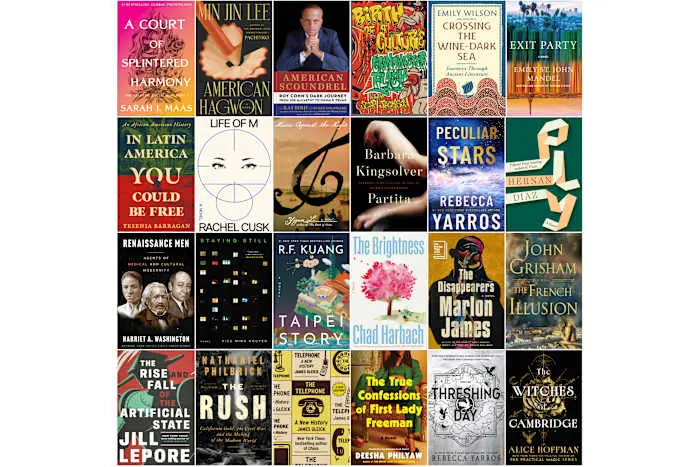

As the autumn leaves begin to fall and the political landscape heats up with high-stakes midterm election campaigns, the publishing industry is experiencing a profound shift in consumer appetite. While news cycles are dominated by congressional clashes and campaign trails, the literary marketplace is charting a dramatically different course. According to industry analysts, retail data trackers, and major publishing executives, fiction, intimate memoirs, and historical deep dives are set to eclipse traditional political nonfiction this season.
For years, the political memoir and the rapid-fire Washington exposé served as the undisputed heavyweights of the fall publishing season. Propelled by intense partisan divides and the unprecedented news cycles of the Trump and Biden eras, books dissecting the inner workings of the White House routinely commanded front-table displays and dominated bestseller lists. However, a noticeable fatigue has set in among readers. Industry experts attribute this cool-down to an accelerated news ecosystem that moves faster than the traditional publishing pipeline can print, leaving specific political analyses feeling dated almost the moment they hit shelves.
Instead of turning to Washington for drama, readers are heavily investing in a robust, star-studded fiction lineup, deeply personal celebrity retrospectives, and timeless poetic and historical reflections. From Pulitzer Prize winners returning with highly anticipated follow-ups to powerhouse names in fantasy and literary fiction releasing milestone volumes, the upcoming literary season offers a diverse, rich tapestry designed to provide an intellectual and emotional escape from the relentless barrage of contemporary headlines.
DETAILED CHRONOLOGY & LITERARY HIGHLIGHTS
The Fiction Resurgence: Heavyweights and Breakouts
The fiction landscape is anchored by a remarkable convergence of literary royalty. Barbara Kingsolver and Hernan Diaz—who famously shared the global spotlight three years ago as co-recipients of the Pulitzer Prize for Fiction—are once again slated to dominate critical and commercial conversations. Kingsolver’s Partita, her first novel since her Dickensian masterpiece Demon Copperhead, explores the complex psyche of a former musical prodigy pulled back into the orbit of her past. Meanwhile, Diaz follows his acclaimed Trust with Ply, a dystopian and sharply observant novel following a young thief navigating a chaotic, fragmented future society.
Reflecting on this shared moment, Diaz emphasizes that literature should not be viewed as a zero-sum game. "I don’t think literature is a race or a tennis tournament," Diaz notes. "I think the more good books that are out there, the richer the conversation becomes and the more readers are engaged."
The commercial fiction sphere is equally dominated by the titans of "romantasy." Rebecca Yarros and Sarah J. Maas are both releasing major works that are guaranteed to drive massive retail foot traffic. Maas delivers A Court of Splintered Harmony, the sixth volume in her powerhouse A Court of Thorns and Roses series, while Yarros offers Threshing Day, a collection of 13 short stories expanding on her Empyrean universe, alongside a standalone novel, Peculiar Stars, about a woman stranded on an island who uncovers unexpected facets of her identity.
International and literary acclaim further bolsters the season. Nobel laureate Jon Fosse returns with Vaim Hotel, while the Booker Prize longlist brings forward contenders such as Marlon James with The Disappearers, Emma Cline with Switzy, and Rebecca Perry with May We Feed the King.
Furthermore, a series of long-awaited literary returns are generating significant buzz. Min Jin Lee’s American Hagwon marks her first novel since her 2017 historical epic Pachinko. Emily St. John Mandel follows her speculative classic Station Eleven with Exit Party, a haunting narrative of futuristic societal breakdown. Chad Harbach, whose debut novel The Art of Fielding captivated readers in 2011, returns with The Brightness, tracing the intertwined lives of two close friends. Additional new fiction works from Yiyun Li, Edwidge Danticat, Kate Atkinson, R.F. Kuang, and John Grisham’s latest legal thriller, The French Illusion, ensure that readers across all genres will find substantial narrative depth.
Memoirs of Icons: Stage, Screen, and Society
The memoir category this season is defined less by political calculations and more by profound personal reflection, particularly from a trio of Oscar-winning cinematic legends. Sylvester Stallone’s The Steps takes its title from his iconic, triumphant run in Rocky, using the metaphor to frame a life of grit and determination. Michael Douglas’s One Helluva Ride serves as a candid corrective to the often-distorted legends of Hollywood fame. Dustin Hoffman’s Look at Me is framed by publishers as an intimate exploration of art, ambition, family dynamics, and the quiet mysteries of a creative life.
The spectrum of non-political memoirs also features significant cultural voices. Feminist icon Gloria Steinem reflects on her formative, unexpected early years in An Unexpected Life. Former NFL quarterback Colin Kaepernick chronicles his journey of athletic sacrifice and intense social activism in The Perilous Fight. Television titan Chuck Lorre, the creative genius behind Two and a Half Men and The Big Bang Theory, pulls back the curtain on the television industry in Situm. Tragically, the season is also marked by the posthumous release of My Book of Days by Grey’s Anatomy star Eric Dane, arriving just months after his passing from ALS.
Poetry’s Modern Renaissance
Poetry is experiencing an unexpected commercial and cultural revival, significantly aided by cinematic adaptations. Christopher Nolan’s cinematic exploration of Homeric themes has sent classic editions of The Odyssey soaring up bestseller charts. Capitalizing on this momentum, renowned translator Emily Wilson releases Crossing the Wine-Dark Sea, a collection of sharp essays bridging classical Greek tragedies and contemporary culture—examining everything from the historical framing of Helen of Troy to the modern cultural touchstones of Cardi B and Megan Thee Stallion.
Simultaneously, contemporary poets are confronting profound personal and collective grief. Former U.S. Poet Laureate Joy Harjo publishes Cloud Runner, an emotionally raw collection grappling with the incomprehensible loss of her daughter, Rainy Ortiz. Jennifer Franklin explores the brilliant yet tragic mind of Lucia Joyce, daughter of literary giant James Joyce, in A Fire in Her Brain. Additional poetry collections from Layli Long Soldier, Tina Chang, Patricia Lockwood, and the career-spanning anthology Other Legacies complete a season that proves verse remains a vital medium for processing the human condition.
Historical Reckonings and Social Analysis
While current-events political books face a slump, historical investigations and systemic social analyses are thriving. Kai Bird, co-author of the biography that inspired Nolan’s Oppenheimer, returns with American Scoundrel, an unflinching look at Roy Cohn, the notorious lawyer, political fixer, and early mentor to Donald Trump. Historian Nathaniel Philbrick revisits the 19th-century gold rush in The Rush, while science writer James Gleick charts the profound evolution of human communication in The Telephone: A New History.
Deep anxieties regarding democratic stability have also inspired vital historical warnings. Works such as Timothy W. Ryback’s 53 Days and Victor Sebestyen’s Weimar Germany dissect the mechanics behind the fall of democracy in 1930s Europe. These are joined by contemporary critiques, including Naomi Klein and Astra Taylor’s End Times Fascism and Pulitzer Prize winner Jill Lepore’s The Rise and Fall of the Artificial State.
Cultural and racial histories round out the non-fiction offering. Celeste Headlee’s Freedom’s Daughters, Grandmaster Flash and Robert "Scoop" Jackson’s authoritative rap history Birth of a Culture, and Stephanie Phillips’ musical retrospective We Were Here provide critical windows into the architects of modern American culture. Furthermore, Pulitzer winner Alan Taylor examines the 1831 rebellion led by Nat Turner in Tower Hill, and Harriet A. Washington highlights overlooked Black medical pioneers in Renaissance Men.
SUPPORTING CONTEXT & METRICS
The bifurcation of the publishing market—where fiction and timeless memoirs are flourishing while current-affairs nonfiction stagnates—reflects a broader psychological shift among American consumers.
According to data compiled by retail analytics firms like Circana, sales of political nonfiction peaked dramatically during the height of the first Trump administration and the initial years of the COVID-19 pandemic. During those cycles, consumer demand for rapid investigative exposés and insider White House accounts was insatiable. However, the subsequent years have seen a steady, measurable cooling of these categories.
Industry analysts point to several contributing factors:
- News Cycle Fatigue: The modern information ecosystem operates at a hyper-accelerated velocity via social media and 24-hour cable news. By the time a traditional 300-page political book is edited, printed, and distributed, the specific news cycle it addresses has often evolved entirely.
- Voter Burnout: With midterm elections driving saturation-level political discourse across television, radio, and digital advertising, consumers are increasingly seeking leisure reading that offers psychological respite rather than partisan reinforcement.
- The "Romantasy" and Fiction Engine: Conversely, fiction—particularly driven by digital book communities like BookTok—has proven remarkably resilient. Series-driven fantasy and high-literary fiction continue to capture younger demographics and sustain consistent multi-week sales momentum that far outpaces standard political commentaries.
OFFICIAL STATEMENTS & INDUSTRY INSIGHTS
Leading figures within the retail and analytical publishing sectors have offered clear assessments of the current market dynamics:
"The energy in political books seems to be subdued. I think folks are just ranted out."
— Kristen McLean, Analyst and Vice President for Client Insights, Circana
McLean’s observation underscores a widespread sentiment that consumers are actively seeking emotional recovery from continuous political agitation. This perspective is reinforced by retail leadership on the ground:
"I think the (news) cycle is moving a bit too quickly for a lot of the very specific political books to catch on."
— Shannon DeVito, Senior Director of Books, Barnes & Noble
DeVito notes that this rapid shift has naturally altered buying habits, steering consumers toward projects with broader, more enduring human resonance. For instance, analyzing veteran journalist Bob Woodward’s pivot away from his traditional exposes of sitting presidents toward his retrospective memoir Secrets: A Reporter’s Memoir, DeVito observes:
"Because he’s going more into his own life, I expect he’ll have a different and broader audience than for his other books."
FUTURE OUTLOOK
As the publishing industry navigates the remainder of the year and looks ahead to early next season, the trajectory is clear. While former President Joe Biden’s Promise Me, America, Michael Lewis’s institutional probe Blockers, and select specialized titles will undoubtedly capture headlines, they will operate as exceptions to a broader industry rule.
The immediate future of retail publishing belongs to immersive storytelling, generational literary milestones, and deeply personal human narratives. Publishers have successfully adapted to consumer fatigue by pivoting resources toward high-concept fiction, expansive fantasy series, and historical frameworks that provide perspective without resorting to partisan immediacy.
Ultimately, as the political machinery of the nation gears up for the midterms, readers are signaling that while they must live through the news of the day, their leisure hours are reserved for stories that explore the enduring, universal complexities of the human heart, imagination, and history.

0 Comments