
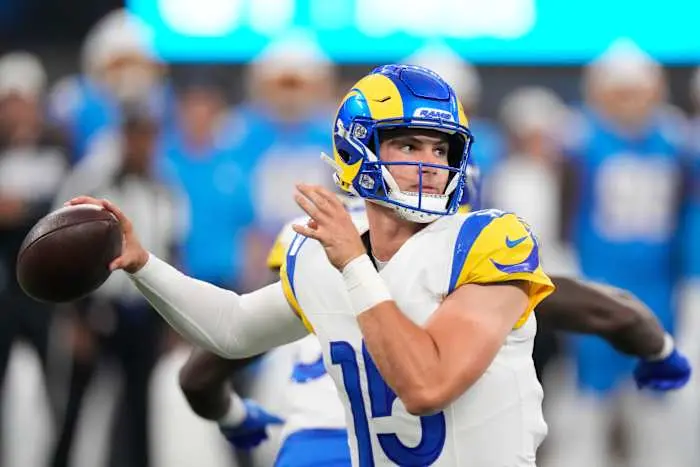

Executive Overview
INGLEWOOD, Calif. — Under the balmy twilight of Southern California, SoFi Stadium played host to a cross-town exhibition clash that offered a fascinating glimpse into the contrasting philosophies, depth charts, and preparations of two NFL franchises bracing for high-stakes campaigns. In their final tune-up of the 2026 NFL preseason on Thursday, August 27, the Los Angeles Rams edged the Los Angeles Chargers 20-18, successfully capping off a flawless 3-0 August.
For Rams head coach Sean McVay, the objective was crystal clear: prioritize health, evaluate the deep end of the roster, and preserve his frontline stars for a grueling, globetrotting regular-season schedule. True to his long-standing preseason strategy, McVay rested all of his presumptive starters, even going so far as to hold out primary backup quarterback Bennett Stenson. This left the offensive engine in the hands of unheralded reserves, most notably signal-caller Ty Simpson.
Conversely, Chargers head coach Jim Harbaugh opted for a more traditional, albeit brief, look for his first-string unit, allowing star quarterback Justin Herbert to get his feet wet before quickly retreating to the safety of the sideline. While the star power departed the field early, the contest devolved into a compelling, hard-fought evaluation of bubble players fighting for roster survival, special teams miscues, and late-game defensive stands.
The game ultimately swung on execution in the margins. Kicker Harrison Mevis proved reliable for the Rams with a pair of 27-yard field goals, while an 11-yard touchdown pass from Simpson to Brennan Presley in the second quarter permanently shifted the momentum. Though the Chargers mounted a late-game surge sparked by a dynamic 34-yard rushing touchdown from Gregory Desrosiers and a successful two-point conversion engineered by quarterback DJ Uiagalelei, the Rams’ defense held firm to preserve the victory.
As the dust settles on the preseason, the stakes instantly skyrocket for both organizations. The Rams are now faced with an unprecedented logistical hurdle—packing their bags for a historic international journey to Melbourne, Australia, where they will open their regular-season slate against the San Francisco 49ers. Meanwhile, the Chargers turn their focus inward, looking to correct lingering special teams anomalies and fine-tune their roster ahead of a Week 1 home date against the Arizona Cardinals at SoFi Stadium, the very venue that will host Super Bowl LX on February 14, 2027.
Detailed Chronology: How the Preseason Finale Unfolded
First Quarter: Star Power Flashes Early Before Reserves Take Over
The tone of the evening was established right at the coin toss when referee Shawn Hochuli delivered a succinct, highly practical plea to the team captains: "Everyone stay healthy, please."
With McVay holding all his cards close to his chest, the Rams fielded a heavily rotated lineup. The Chargers, however, gave their faithful a brief thrill by deploying Justin Herbert and several key offensive weapons for the opening series. It did not take long for the exhibition nature of the game to yield high-impact volatility. Early in the first quarter, pressure from the Rams’ front seven dislodged the football from Herbert’s grasp, resulting in a crucial fumble.
The turnover handed the Rams prime field position, and rookie kicker Harrison Mevis promptly capitalized, splitting the uprights from 27 yards out to draw first blood and put the Rams up 3-0.
Herbert, unfazed by the early setback, wasted zero time responding. On the very next drive, operating with pinpoint precision, the star quarterback dialed up a deep shot on the second play from scrimmage. He found wide receiver Quentin Johnston streaking downfield for a explosive 65-yard touchdown strike. The breathtaking play—marking the second-longest reception of Johnston’s professional career—took a mere 14 seconds off the clock, completely flipping the field position and handing the Chargers a 7-3 advantage.
The remainder of the opening frame featured a masterclass in bend-don’t-break defense. The Rams engineered a methodical, consuming drive that drained 9 minutes and 41 seconds off the clock, marching all the way inside the Chargers’ 1-yard line. However, the blue-and-gold defensive front stiffened magnificently on fourth down, stuffing the run and forcing a turnover on downs. The goal-line stand sparked an exuberant celebration on the Chargers’ sideline, where newly minted defensive coordinator Chris O’Leary enthusiastically chest-bumped veteran safety Tony Jefferson.
Second Quarter: Simpson Lifts the Rams Ahead
As the second quarter commenced, the Chargers cycled through their quarterback depth chart, inserting Trey Lance under center. Lance’s initial series failed to generate traction, culminating in a shanked, dismal 20-yard punt by JK Scott that gifted the Rams short fields once again.
Capitalizing on the short-field opportunity, the Rams turned to third-string quarterback Ty Simpson. The young signal-caller engineered an efficient, decisive march down the field, capped by an 11-yard scoring strike to fourth-string wide receiver Brennan Presley. The touchdown reclaimed the lead for the Rams at 10-7.
Simpson commanded the huddle with poise throughout the first half, completing 18 of his 23 pass attempts for 119 yards, demonstrating a firm grasp of McVay’s complex scheme despite working with an entirely second- and third-string supporting cast.
As the half wound down, the Chargers squandered an opportunity to level the score when historically reliable kicker Cameron Dicker—widely regarded as one of the most accurate placekickers in NFL history—pushed a 49-yard field goal attempt wide. The miss sent the Chargers into the locker room trailing 13-7, following another successful 27-yard field goal by Mevis. Dicker’s preseason struggles, which included two missed extra-point attempts across three games, began to draw murmurs of concern from the coaching staff.
Third Quarter: Dicker Regains Footing as Defences Grind
Coming out of the intermission, both coaching staffs utilized the third quarter to dig deep into their respective depth charts, sorting through fringe roster battles.
Cameron Dicker managed to redeem himself partially midway through the third frame, slicing into the Rams’ lead by converting a 34-yard field goal to narrow the deficit to 13-10.
However, the quarter was marred by mounting attrition. The physical nature of the exhibition caught up to both squads, highlighted on the injury front when Chargers wide receiver Dalevon Campbell exited the contest after appearing to suffer a foot injury during a mid-field collision. Despite the physical toll, both defenses clamped down, forcing punts and trading field position as the game transitioned into a gritty trench battle.
Fourth Quarter: Late Fireworks and a Desrosiers Surge
The Rams appeared to put the game out of reach early in the fourth quarter. Quarterback Matthew Caldwell orchestrated an impressive, sustained drive that culminated in an 8-yard touchdown pass to tight end/receiver Dean Connors, stretching the Rams’ advantage to 20-10.
Refusing to fold, the Chargers mounted a furious late-game rally. Sparked by explosive plays on the perimeter, the offense broke through when running game specialist Gregory Desrosiers exploded through a seam for a brilliant 34-yard touchdown run, instantly breathing life into the home crowd.
Trailing by just two points at 20-18, Chargers coach Brandon Staley (or rather, the offensive staff executing the two-point conversion strategy) dialed up a crucial play. Third-string quarterback DJ Uiagalelei executed the play-call to perfection, lofting a pass to receiver Evan Svoboda for the successful two-point conversion.
The dramatic sequence pulled the Chargers within a single possession, setting up a frantic final two minutes. Unfortunately for the Chargers, their late-game comeback bid stalled out. The Rams’ defense dug in its heels, neutralizing the final possession and running out the clock to secure the 20-18 victory and preserve their unblemished preseason record.
Supporting Context & Metrics: Analyzing the Numbers
While preseason statistics rarely tell the full story of a team’s championship ceiling, the data generated from Thursday night’s matchup offers profound insights into roster depth, efficiency, and lingering vulnerabilities.
Key Team Statistics & Game Flow
- Final Score: Los Angeles Rams 20, Los Angeles Chargers 18
- Preseason Records: Rams finish 3-0; Chargers finish 1-2.
- Time of Possession Battle: The Rams highlighted their ability to control the clock, evidenced by their marathon 9-minute, 41-second drive in the opening half that severely limited the Chargers’ offensive rhythm.
- Passing Efficiency: Ty Simpson anchored the Rams’ offensive attack efficiently, completing 78.2% of his passes (18-of-23) for 119 yards and a touchdown, avoiding costly turnovers.
- Big-Play Index: The game’s most explosive offensive play belonged to Justin Herbert and Quentin Johnston, whose 65-yard connection showcased the deep-threat capability the Chargers desperately hope to unlock during the regular season.
Roster Battle Standouts
For the Rams, the emergence of Ty Simpson as a reliable emergency option under center provides immense peace of mind. Furthermore, kicker Harrison Mevis solidified his standing within the organization by converting both of his field-goal attempts from 27 yards out under varying degrees of pressure.
For the Chargers, the primary takeaway centers on special teams execution. Cameron Dicker’s struggles—missing a 49-yard field goal just before halftime, compounded by two missed extra points earlier in the preseason—will undoubtedly force special teams coordinator Ryan Ficken into the film room to iron out mechanical inconsistencies before Week 1.
Official Statements & Postgame Reactions
Speaking to the media in his customary postgame press conference, Rams head coach Sean McVay expressed satisfaction with his team’s disciplined approach throughout August, while immediately pivoting his focus to the unprecedented logistical challenge awaiting his squad.
"Our guys did a phenomenal job of competing, staying disciplined, and executing within our system tonight without leaning on our front-line guys," McVay stated. "Preseason is about evaluation, conditioning, and escaping with your health. We accomplished those goals across the board this month. Now, the real work begins. Heading down under to Melbourne is a unique test for our culture and our preparation, but our guys are locked in."
On the other side of the stadium, Chargers coach Jim Harbaugh offered a measured assessment of his team’s performance, emphasizing the need for sharper execution in all three phases of the game as they transition from exhibition play to real-world stakes.
"We had moments of exceptional brilliance tonight—that connection between Justin and Quentin was elite—but we also left too many plays on the field and hurt ourselves with operational details," Harbaugh remarked. "You can’t give up big chunks of field position or miss fundamental assignments against elite competition and expect to win consistently. We’ve got two weeks to clean the slate, get healthy, and get our minds right for Arizona."
Future Outlook: The Road to the Regular Season
With the preseason officially in the rear-view mirror, both Los Angeles franchises face vastly different, high-intensity trajectories as they prepare for the 2026 NFL regular season.
Los Angeles Rams: The Journey Down Under
The Rams will enjoy a very brief window of recovery before embarking on one of the most unique travel itineraries in NFL history. In just two weeks, McVay’s squad will board a long-haul flight to Melbourne, Australia.
There, they will open their regular-season campaign on Wednesday, September 10, against the San Francisco 49ers. As the reigning preseason champions and an early consensus favorite to hoist the Vince Lombardi Trophy—especially with Super Bowl LX scheduled to be played in their home facility, SoFi Stadium, on February 14, 2027—the pressure on the Rams will be immense from opening kickoff.
The coaching staff will monitor the health of quarterback Matthew Caldwell, who exited late in Thursday’s game following a keeper, though initial evaluations suggest no long-term structural damage.
Los Angeles Chargers: Defending Home Turf
The Chargers have a slightly more traditional runway into the regular season. They will return to the practice fields in El Segundo to correct their special teams miscues and evaluate the severity of wide receiver Dalevon Campbell’s third-quarter foot injury.
The Chargers are set to open their regular season at home on Sunday, September 13, hosting the Arizona Cardinals at SoFi Stadium. For Harbaugh and his coaching staff, the primary directive over the next fortnight will be translating the flashes of offensive dynamism—such as Herbert’s deep-ball prowess and Desrosiers’ rushing burst—into a four-quarter identity capable of navigating the brutal landscape of the AFC West.

0 Comments