

Executive Overview
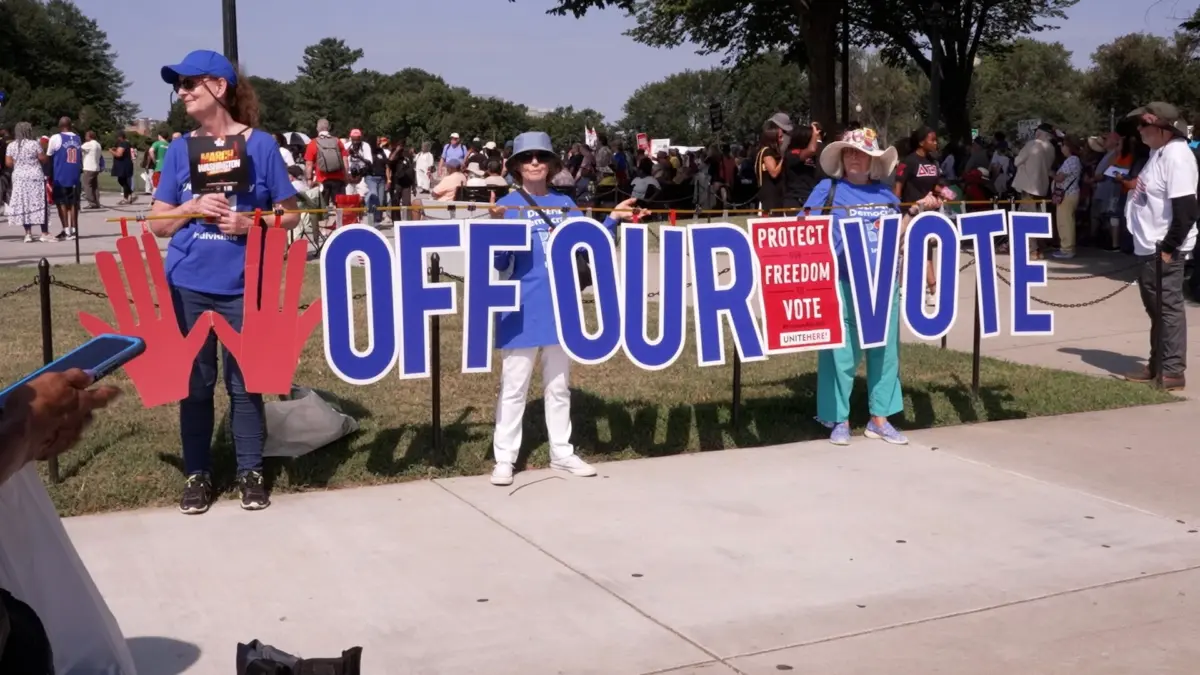
WASHINGTON — On a brisk and resolute Friday morning, the National Mall bore witness to a profound convergence of history, urgency, and civic mobilization. Thousands of demonstrators from across the United States converged upon the historic steps of the Lincoln Memorial to mark the 63rd anniversary of the legendary 1963 March on Washington—the very site where Dr. Martin Luther King Jr. delivered his immortal “I Have a Dream” speech.
However, the mood of the gathering was distinct from a purely celebratory commemoration. Instead, the assembly served as an urgent call to action, framed by mounting anxieties over the erosion of civil liberties, recent legislative rollbacks, and a transformative judicial landscape.
Organized by the National Action Network (NAN), spearheaded by the Reverend Al Sharpton, and co-convened with the Drum Major Institute—led by Martin Luther King III and Andrea Waters King—the mobilization drew citizens spanning multiple generations. From veterans of the historic Civil Rights Movement, including surviving members of the 1963 Birmingham campaign, to Gen-Z activists picking up the mantle, the crowd stood united against what they characterized as an aggressive, coordinated rollback of the voting rights hard-won six decades ago.
At the heart of the outcry is a contentious April Supreme Court ruling that severely limited the application of the landmark Voting Rights Act of 1965. This judicial decision has catalyzed a wave of aggressive congressional redistricting across several states, leading to the elimination of numerous minority-majority districts. Civil rights advocates warn that these map redraws systematically dilute the political power of Black and brown communities, threatening the very architecture of American representative democracy.
Featuring addresses from prominent civil rights leaders, grassroots organizers, and high-ranking federal lawmakers—including House Minority Leader Representative Hakeem Jeffries (D-N.Y.)—the rally served as both a stark warning to political institutions and a defiant declaration that the pursuit of full equality remains unfinished.
Detailed Chronology of the Demonstration
Morning: The Convergence at the National Mall
The day’s events commenced before dawn as buses carrying delegates from dozens of states rolled into the nation’s capital. By mid-morning, a sea of placards, banners, and Americans of all backgrounds had blanketed the grounds stretching from the Washington Monument to the base of the Lincoln Memorial.
The choice of location was intentional and symbolic. Sixty-three years prior, the original March on Washington for Jobs and Freedom established a high-water mark for the American civil rights struggle, laying the moral foundation for the Civil Rights Act of 1964 and the Voting Rights Act of 1965. As modern protesters stood beneath the towering marble statue of Abraham Lincoln, speakers drew direct parallels between the institutional roadblocks faced by activists in the 1960s and the sophisticated, modern legal and legislative maneuvers suppressing minority votes today.
Midday: Mobilization and Testimonies
As the midday sun beat down on the National Mall, the program commenced with powerful testimonies from everyday citizens whose lives have been defined by the arc of the civil rights struggle.
Eunice Johnson, who traveled from Maryland to attend the rally, articulated the deep sense of betrayal felt by many older Americans. “We all grew up in an era where we fought so hard for our rights,” Johnson reflected, her voice carrying over the amplification systems. “And slowly but surely, everything is being eroded. We cannot afford to sit quietly and watch decades of progress dismantled.”
Her sentiment was echoed by fellow Maryland resident Margret Brown, whose memories stretch back to the segregated American South. “I’m from the South, lived through Jim Crow, so… I see so much happening now that could put us right back in that spot,” Brown warned. For Brown and many others in attendance, the re-emergence of voter suppression tactics is not a theoretical policy debate, but a visceral reminder of a deeply painful past.
Also lending his voice to the afternoon’s proceedings was Terry Collins, an Alabama native and proud member of the historic 1963 Birmingham Foot Soldiers. Having faced the firehoses and police dogs of the Jim Crow era, Collins emphasized the necessity of uncompromising public resistance. “If we don’t make an impact and let people know how serious this is,” Collins stated, “the corrections won’t be made.”
Afternoon: High-Profile Addresses and Calls to Action
As the afternoon progressed, the rally transitioned into a series of high-profile political and ideological addresses. House Minority Leader Hakeem Jeffries took to the podium to contextualize the current moment within the broader sweep of American history.
“We certainly have come a long way in the United States of America, but we still have a long way to go,” Jeffries told the rapt crowd, linking the defense of the ballot box to the foundational ideals of the nation.
The keynote address was delivered by the event’s chief architect, the Reverend Al Sharpton. Standing before the massive crowd, Sharpton delivered a fiery speech that sought to re-energize the national progressive base.
“We’re in Washington, D.C., to proclaim the dream is still alive,” Sharpton declared to roaring applause. He challenged lawmakers, the judiciary, and the executive branch alike, demanding federal legislative action to override state-level voter disenfranchisement and restore the full protections of the 1965 Voting Rights Act.
Supporting Context & Metrics: The Legal and Political Battlefield
To fully understand the gravity of the 63rd-anniversary mobilization, one must examine the legal and demographic battlefield that has emerged over the past several months. The primary catalyst for Friday’s demonstration was the Supreme Court’s landmark ruling in April, which fundamentally altered the application of Section 2 of the Voting Rights Act of 1965.
The April Supreme Court Ruling and its Aftermath
In a controversial decision, the nation’s highest court limited the extent to which race can be utilized as a dominant factor when states draw congressional and legislative voting districts. While proponents of the ruling argue it curbs unconstitutional racial gerrymandering, civil rights organizations and legal experts view it as a crippling blow to minority representation.
The immediate consequence of the ruling has been a flurry of redistricting activity across the American South and Midwest. Several state legislatures have moved swiftly to redraw congressional maps, resulting in the elimination or significant alteration of multiple minority-majority districts—geographic areas specifically designed to ensure that Black and Hispanic voters have a fair opportunity to elect candidates of their choice.
According to data compiled by nonpartisan voting rights monitors, these map changes threaten to dilute minority political power in states with sizable populations of color, including Alabama, Georgia, Louisiana, and Texas.
Yolanda Flowers, an attendee from Alabama representing the Southern Christian Leadership Conference (SCLC), captured the localized impact of these judicial decisions. “I’ve been concerned about the redistricting because of the unfairness of it,” Flowers noted, pointing out how state-level political actors are utilizing judicial cover to diminish the electoral footprint of minority communities.
The Broader Legislative Landscape
Beyond redistricting, the rally served as a referendum on a broader suite of voting restrictions enacted across numerous states since the 2020 election cycle. These include:
- Stricter Voter Identification Requirements: Laws mandating specific forms of government-issued photo ID while restricting accepted alternatives often possessed by low-income and minority citizens.
- Mail-in Voting Restrictions: Limitations on ballot drop boxes, reduced early voting windows, and increased bureaucratic hurdles for mail-in ballot applications.
- Voter Roll Purges: Aggressive state-led initiatives to clean voter registration rolls, which critics argue disproportionately disenfranchise transient, low-income, and minority voters.
Civil rights groups argue that these localized measures, combined with the recent Supreme Court ruling, represent a multi-pronged assault designed to systematically depress turnout among core Democratic and progressive demographics.
Official Statements and Organizational Perspectives
The coalition behind Friday’s mobilization represents a vast network of historic civil rights institutions and modern political advocacy groups.
National Action Network (NAN)
As the primary organizing body, the National Action Network emphasized that the 63rd anniversary of the March on Washington could not merely be an exercise in historical nostalgia. In pre-rally briefs, NAN leadership stressed that the memory of Dr. King and the thousands who marched in 1963 must serve as a tactical blueprint for contemporary political resistance.
Rev. Sharpton reiterated throughout the week that the fight for voting rights is inextricably linked to economic justice, criminal justice reform, and the preservation of democratic institutions. "You cannot honor the dream while destroying the ballot," Sharpton asserted during his organizational roll-out.
The Drum Major Institute
Co-convened by Martin Luther King III and Andrea Waters King, the Drum Major Institute focused its messaging on the generational duty to protect democratic norms. In joint statements leading up to the Friday rally, the leadership underscored that civil rights achievements are never permanent and require constant, active defense by each successive generation.
“My father and the leaders of 1963 marched so that future generations could inherit a more perfect union,” Martin Luther King III noted in previous advocacy statements. “It is our solemn obligation to ensure that the tools of democracy are not stripped away from our children and grandchildren.”
Legislative Responses
On Capitol Hill, congressional Democrats used the momentum of the march to renew calls for federal legislative intervention. Lawmakers, including Rep. Hakeem Jeffries, highlighted the urgent need to pass comprehensive federal voting rights legislation—such as updated iterations of the Freedom to Vote Act and the John Lewis Voting Rights Advancement Act—which would establish national standards for voting access and restore the pre-clearance provisions of the 1965 Voting Rights Act that were previously gutted by the judicial branch.
However, face-to-face with a deeply polarized Congress, the path forward for federal voting reform remains fraught with partisan gridlock, elevating the importance of grassroots mobilization and judicial advocacy.
Future Outlook: What Lies Ahead for the Voting Rights Movement?
As the crowds dispersed from the National Mall on Friday evening, leaving behind echoing chants and neatly folded banners, the central question facing the American civil rights movement was clear: What comes next?
1. Legal Challenges in Lower Courts
Civil rights legal defense funds, including the NAACP Legal Defense and Educational Fund (LDF) and the American Civil Liberties Union (ACLU), are preparing for a protracted legal battle. Armed with data detailing the discriminatory impact of the post-April redistricting maps, these organizations are filing a wave of lawsuits in federal district courts, arguing that the newly drawn maps violate Section 2 standards even under the Supreme Court’s narrower interpretation.
2. Mobilization for Upcoming Electoral Cycles
With critical midterm and local elections on the horizon, organizers from the National Action Network and allied groups are pivoting toward aggressive voter registration, education, and mobilization campaigns. Recognizing that legal battles take time, civil rights leaders emphasized that the most immediate defense against voter suppression is overwhelming civic participation. Volunteers pledged to return to their home states to launch hyper-local campaigns aimed at educating voters on new ID requirements, tracking registration status, and establishing robust ballot-curing operations.
3. Sustaining the Coalition
Perhaps the most significant legacy of the 63rd-anniversary mobilization is the reinforcement of a cross-generational coalition. By uniting veterans of the 1963 civil rights movement with modern grassroots activists, the event successfully bridged historical memory with contemporary urgency.
As Eunice Johnson and Terry Collins prepared to board their respective buses back to Maryland and Alabama, their message to the nation was singular: the march on Washington did not end in 1963, nor did it conclude on the steps of the Lincoln Memorial on Friday afternoon. The struggle for the ballot box—and the soul of American democracy—remains an ongoing, daily commitment.

0 Comments