

Executive Overview
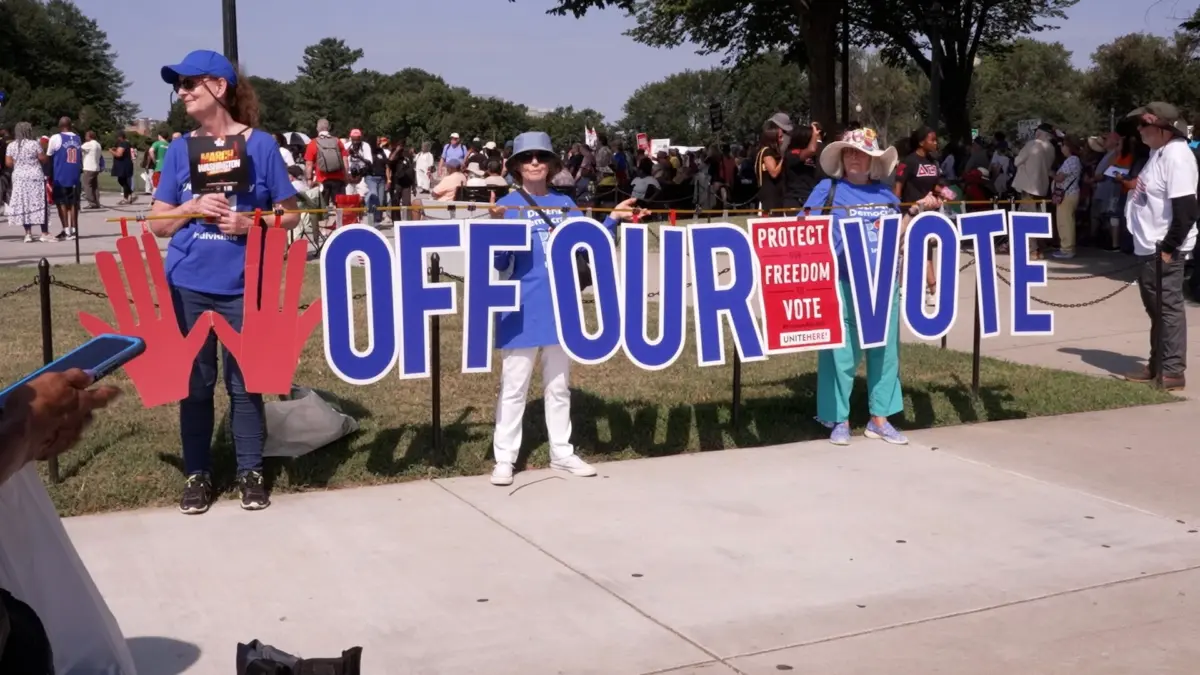
WASHINGTON — Beneath the stoic gaze of Abraham Lincoln, thousands of demonstrators converged on the National Mall on Friday, transforming the historic grounds into a vibrant sea of activism and urgency. Marking the 63rd anniversary of the legendary 1963 March on Washington—where civil rights icon Dr. Martin Luther King Jr. delivered his immortal "I Have a Dream" speech—the modern-day gathering was born out of a profound sense of anxiety and resolve.
Far from a mere retrospective celebration, Friday’s demonstration served as an urgent call to action. Across the nation, civil rights advocates, community leaders, and everyday citizens mobilized to sound the alarm against what they characterize as an aggressive, systemic erosion of voting rights. The demonstration comes at a precarious legal and political juncture, galvanized by recent judicial rollbacks, controversial redistricting battles, and the systematic weakening of the foundational legislation that birthed modern American ballot access.
Organized by the National Action Network (NAN), spearheaded by the Reverend Al Sharpton, alongside the Drum Major Institute—led by Martin Luther King III and Andrea Waters King—the mobilization drew intergenerational crowds from every corner of the United States. Veterans of the original 1960s civil rights movement stood shoulder-to-shoulder with Gen Z activists, all united by a singular message: the democratic gains hard-won over half a century ago are actively being dismantled, and the fight for equal representation requires immediate, unyielding defense.
Detailed Chronology of the Mobilization
The day’s events unfolded with the precision and emotional resonance characteristic of America’s most storied civil rights demonstrations.
Morning Convergence and Historic Parallels
As the morning sun broke over the capital, buses chartered from southern states, midwestern cities, and northeastern metropolitan hubs began disgorging thousands of participants near the base of the Washington Monument. By mid-morning, a dense, energized crowd had blanketed the grounds stretching from the World War II Memorial down to the steps of the Lincoln Memorial—the very geographic focal point where, six decades prior, a quarter-million people marched for jobs and freedom.
Unlike the humid August day in 1963, Friday’s rally was met with the crisp urgency of contemporary political reality. Chants of "No justice, no peace, no voting rights, no peace" echoed off the marble facades of the federal city. Banners bearing slogans referencing the Voting Rights Act of 1965, alongside modern demands for federal ballot protections, rippled above the heads of attendees clad in commemorative t-shirts and ancestral civil rights memorabilia.
Afternoon Program and Key Addresses
The official program commenced with interfaith prayers and musical tributes that bridged the historical chasm between the mid-20th-century civil rights movement and 21st-century social justice advocacy. Speaker after speaker took to the podium to contextualize the current legislative crisis within the broader arc of American history.
Rev. Al Sharpton took center stage to anchor the emotional core of the afternoon, addressing an ocean of watchful faces.
"We’re in Washington, D.C., to proclaim the dream is still alive," Sharpton declared, his voice carrying across the National Mall through banks of loudspeakers. "We did not come to bury the dream, but we came to warn those who are trying to legislate it into a nightmare that we are still here, and we remember how to march!"
House Minority Leader Rep. Hakeem Jeffries (D-N.Y.) followed, delivering a measured yet impassioned address that tied legislative obstruction in Congress to the broader judicial landscape.
"We certainly have come a long way in the United States of America, but we still have a long way to go," Jeffries told the rapt audience. He underscored that the right to vote remains the prerequisite for all other civil and human rights, warning that voter suppression tactics represent an existential threat to representative democracy.
As the afternoon waned, attendees broke into smaller affinity groups, holding impromptu teach-ins, voter registration drives, and strategy sessions on the lawns flanking the Lincoln Memorial Reflecting Pool, ensuring the mobilization extended beyond rhetoric into tactical mobilization.
Supporting Context & Metrics: The Legal and Political Battlefield
The impetus for Friday’s massive gathering did not materialize in a vacuum; it is the direct response to a seismic shift in American jurisprudence and state-level policy that has unfolded over the past several years.
The April Supreme Court Ruling
At the heart of the demonstrators’ grievances is a landmark April Supreme Court ruling that fundamentally reinterpreted and constricted key provisions of the landmark Voting Rights Act of 1965 (VRA). For decades, Section 2 of the VRA served as the primary legal bulwark against discriminatory voting maps, prohibiting voting practices or procedures that discriminate on the basis of race, color, or membership in a language minority group.
The high court’s recent decision, however, placed stringent new limits on the utilization of race when drawing congressional and legislative districts. Legal scholars note that the ruling has effectively hamstrung civil rights lawyers attempting to challenge gerrymandered maps that deliberately splinter minority communities. Consequently, several states across the Sun Belt and the South have rapidly moved to overhaul their congressional maps, eliminating numerous minority-opportunity districts.
The Threat of Vote Dilution
Data compiled by voting rights watchdogs indicates that the judicial rollback has placed dozens of congressional seats in states such as Alabama, Louisiana, Georgia, and Texas under immediate threat of racial dilution. When minority voting power is systematically fragmented—a practice historically known as "cracking"—communities of color are systematically stripped of their ability to elect candidates of their choice, effectively neutralizing their political voice in federal lawmaking.
For the attendees gathered on the National Mall, these legal abstractions translate into immediate, lived anxieties.
"I’ve been concerned about the redistricting because of the unfairness of it," explained Yolanda Flowers, an attendee from Alabama representing the Southern Christian Leadership Conference (SCLC). "When maps are drawn behind closed doors to purposely silence Black and brown voters, it makes a mockery of the ballot box. We are watching the clock turn backward."
Voices from the Ground: Personal Testimonies
The profound weight of Friday’s mobilization was best captured by the diverse array of individuals who made the pilgrimage to Washington, D.C. Their stories reflect a spectrum of generational memory, ranging from those who survived the violent oppression of the Jim Crow era to younger organizers charting the next phase of the freedom struggle.
Living Memory: The Jim Crow Era and the Fight for Survival
Among the most poignant presences at the rally were the surviving veterans of the mid-20th-century movement. Margret Brown, who traveled from Maryland, shared a perspective forged in the crucible of the segregated South.
"I’m from the South, lived through Jim Crow, so… I see so much happening now that could put us right back in that spot," Brown said, her eyes scanning the crowd of multi-hued demonstrators. "We fought too hard, and too many people bled and died, for us to sit quietly while these rights are stripped away in broad daylight."
Her sentiments were echoed by Eunice Johnson, also hailing from Maryland, who reflected on the societal compact forged by the civil rights generation.
"We all grew up in an era where we fought so hard for our rights," Johnson noted. "And slowly but surely, everything is being eroded. You think you’ve secured the mountain peak, only to wake up and find yourself sliding back down the hill."
The Living Legacies of the Civil Rights Foot Soldiers
Terry Collins, a member of the legendary 1963 Birmingham Foot Soldiers and an Alabama native, offered a stark warning to contemporary political leaders regarding the necessity of immediate legislative intervention.
"If we don’t make an impact and let people know how serious this is, the corrections won’t be made," Collins asserted. "Governments don’t fix broken systems out of the goodness of their hearts; they fix them because the people demand it with a voice too loud to ignore."
Collins, who as a youth participated in the historic Birmingham campaign that helped force the passage of the 1964 Civil Rights Act, emphasized that complacency is the greatest ally of voter suppression. His presence served as a living bridge between the historic sacrifices of the past and the ongoing battles of the present.
Official Statements and Organizational Leadership
The coordination behind Friday’s massive demonstration reflects a unified front among legacy civil rights organizations and contemporary political strategists.
The National Action Network and the Drum Major Institute
The Reverend Al Sharpton’s National Action Network (NAN), one of the nation’s leading civil rights organizations, positioned the rally as the launchpad for a sustained, nationwide campaign against voter suppression. In strategic partnership with the Drum Major Institute—co-led by Martin Luther King III and Andrea Waters King—the organizers have pledged to channel the energy of the Lincoln Memorial gathering into localized voter education, mobilization, and legal challenges.
Martin Luther King III emphasized in preparatory statements that his father’s legacy is fundamentally incomplete so long as the ballot remains under assault. The Drum Major Institute’s involvement underscores a familial and institutional commitment to safeguarding the democratic infrastructure that underpins American pluralism.
Legislative Responses
House Minority Leader Hakeem Jeffries, addressing reporters on the sidelines of the event, reiterated the Democratic caucus’s commitment to passing federal voting rights legislation, such as the John Lewis Voting Rights Advancement Act and the Freedom to Vote Act. While acknowledging the current legislative gridlock in Washington, Jeffries insisted that public mobilization—such as the thousands assembled at the Lincoln Memorial—remains the indispensable catalyst for breaking congressional inertia.
Future Outlook: The Road Ahead for Voting Rights
As the sun set over the National Mall and the crowds slowly dispersed, the central question hanging over the nation’s capital was what tactical impact Friday’s anniversary mobilization would ultimately yield.
Upcoming Legal and Legislative Battles
Civil rights attorneys and advocacy groups are preparing for a protracted legal war in the wake of the Supreme Court’s April ruling. With federal courts increasingly hostile to broad interpretations of the Voting Rights Act, litigators are exploring novel state-level constitutional claims and local ordinances to protect minority voting access.
Concurrently, national civil rights organizations have announced plans for a multi-state tour focused on voter registration, poll-worker recruitment, and community education ahead of upcoming electoral cycles. Organizers calculate that high voter turnout in targeted districts can effectively overcome the structural disadvantages engineered by recent redistricting maneuvers.
The Enduring Legacy of the March on Washington
Sixty-three years after Dr. Martin Luther King Jr. outlined his vision of a reconciled, equitable America from the steps of the Lincoln Memorial, Friday’s gathering proved that the American democratic experiment remains an ongoing work in progress.
The thousands who journeyed to Washington did not arrive merely to commemorate history, but to demand its preservation. As Rev. Al Sharpton and the day’s speakers made emphatically clear, the dream articulated in 1963 is neither guaranteed nor self-executing; it requires the vigilance, sacrifice, and active participation of every generation to ensure that the ballot box remains the ultimate arbiter of American democracy.

0 Comments