

CAIRO — The fragile security architecture of the Middle East faces renewed strain following a series of targeted Israeli military strikes across the Gaza Strip that left three Palestinians dead and several others wounded. Concurrently, in Tehran, Iran’s evolving political and military command structure has solidified around hardline clerics and military generals deeply entrenched in the nation’s ruling theocracy.
Six months after the outbreak of a broader regional war that fundamentally restructured geopolitical alignments, the dual tracks of ongoing localized violence in Gaza and severe political entrenchment in Iran signal that a return to regional stability remains distant. International monitors, humanitarian organizations, and diplomatic channels continue to grapple with the compounding humanitarian toll and the hardening of ideological lines across the theater of operations.
Executive Overview
The latest developments underscore a persistent state of low-intensity yet lethal conflict persisting beneath the surface of nominal ceasefires and diplomatic posturing. In the central and northern sectors of the Gaza Strip, Israeli military operations continue to target individuals and infrastructure identified by the Israel Defense Forces (IDF) as associated with militant activities, resulting in ongoing civilian casualties and severe operational disruption at vital medical facilities.
Meanwhile, nearly half a year after the catastrophic opening salvos of the U.S.-Israeli campaign against Iran on February 28, 2026—strikes that decimated much of the country’s historic senior leadership—Tehran’s governing apparatus has completed a hardline transition. Under the untested yet ideologically rigid authority of Supreme Leader Ayatollah Mojtaba Khamenei, the Iranian state has increasingly delegated statecraft and internal security to military veterans of the Islamic Revolutionary Guard Corps (IRGC) and loyalist clerics. This leadership constellation points toward an unyielding posture against external adversaries and a zero-tolerance policy regarding domestic dissent.
Detailed Chronology of Events
The escalation on Saturday, August 29, 2026, unfolded across multiple theaters within the Gaza Strip, punctuating a period marked by persistent violations of a nominal, albeit fragile, ceasefire that has technically been in place since October of the previous year.
Gaza City and Deir al-Balah Strikes
In the urban center of Gaza City, local health officials at Shifa Hospital reported that an Israeli airstrike targeted a moving motorbike, instantly killing two Palestinians and leaving a third critically wounded. The IDF defended the operation in a brief statement, asserting that the strike successfully eliminated a designated "military operative," though officials declined to provide further identifying details or elaborate on the nature of the target’s alleged activities.
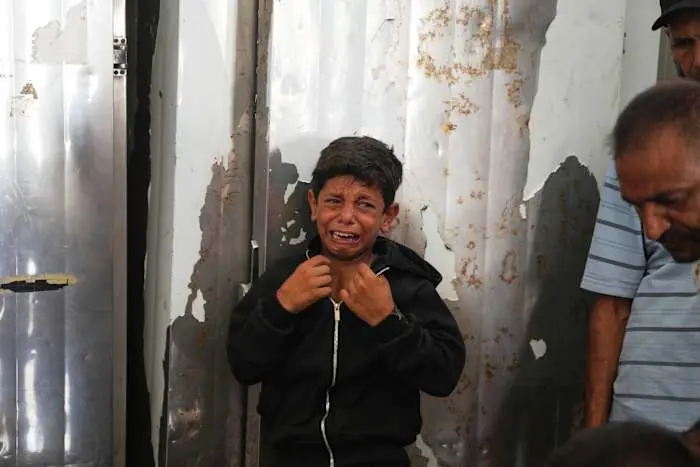
Simultaneously, in the eastern agricultural outskirts of Deir al-Balah in the central Gaza Strip, artillery fire from an Israeli tank struck and killed a local farmer. The victim’s body was transported to the Al-Aqsa Martyrs Hospital, where grieving family members and local mourners gathered for funeral proceedings, captured in poignant imagery by Associated Press photojournalists. The Israeli military issued no immediate comment regarding the tank fire incident.
The Al-Aqsa Martyrs Hospital Compound Attack
The most contentious engagement of the day occurred within the physical compound of the Al-Aqsa Martyrs Hospital itself. According to the Gaza Ministry of Health, an airstrike struck the hospital grounds, wounding three individuals and heightening panic among patients, medical staff, and displaced persons sheltering within the medical complex.
The Israeli military acknowledged the strike, stating that it targeted a "Hamas commander who planned to execute terror attacks" in close proximity to the medical facility. The IDF’s public statements emphasized that the individual in question was exploiting the hospital compound as a shield. Furthermore, the military noted that formal warnings had been communicated to medical authorities in Gaza as recently as Thursday, cautioning that medical infrastructure forfeited its protected status if utilized for military or "terrorist purposes," and warning that Israeli forces reserved the right to neutralize active threats. Officials at Al-Aqsa Martyrs Hospital did not issue an official statement addressing the strike or the military’s allegations.
Supporting Context & Metrics
The Humanitarian and Casualty Landscape in Gaza
The ongoing casualties in Gaza occur against the backdrop of a staggering cumulative toll. Despite the nominal implementation of a ceasefire framework brokered last October—which significantly curtailed the large-scale, high-intensity bombardments and ground invasions that characterized the early phases of the conflict—sporadic kinetic operations have continued unabated.
According to verified figures maintained by Gaza’s Ministry of Health, which operates under the Hamas-led governance structure but whose epidemiological data is regularly cited as generally reliable by United Nations agencies and independent humanitarian monitors:
- Cumulative Toll: At least 1,313 Palestinians have been killed by Israeli military actions since the October ceasefire framework took effect.
- Demographic Breakdown: While health authorities track aggregate mortality data, the reporting system does not consistently disaggregate civilian casualties from active combatants, a point frequently emphasized by Israeli military spokespersons to contextualize collateral damage.
- Infrastructure Strain: Medical facilities across the strip, such as Shifa and Al-Aqsa Martyrs, continue to operate under critical shortages of fuel, specialized medicine, and security, frequently bearing the brunt of urban combat dynamics.
Geopolitical Realignment and the Iranian Succession
Beyond the immediate tactical engagements in Gaza, the strategic pivot of the regional conflict remains anchored in Tehran. The assassination of historical power brokers—including senior clerical and military figures during the sweeping initial U.S.-Israeli air campaign on February 28—forced an accelerated generational and ideological handover within the Iranian theocracy.
At the center of this transformation is Supreme Leader Ayatollah Mojtaba Khamenei. Despite ascending to the highest office of religious and political authority, Khamenei has remained conspicuously absent from public view, operating within a heavily secured enclave as the state navigates its post-war reality.
To consolidate control and insulate the regime from both foreign infiltration and domestic uprisings, Khamenei has populated key security and administrative positions with hardline loyalists:
- Mohsen Rezaei: Appointed as the secretary of Iran’s Supreme National Security Council, bringing decades of IRGC command experience and hardline political maneuvering to the nation’s primary security policymaking body.
- Hossein Taeb: Appointed to lead the Basij, the expansive paramilitary volunteer street force historically utilized for domestic intelligence gathering and the violent suppression of civil unrest.
Analysts note these appointments reflect an administration preparing for a protracted standoff with the United States and its regional allies, signaling that internal dissent will be met with immediate and unyielding security measures.
Official Statements and Diplomatic Posture
The divergence in narrative between regional actors highlights the intractable nature of the current diplomatic impasse.
- The Israeli Defense Forces (IDF): Maintain that operational necessity dictates strikes against individuals utilizing civilian infrastructure—including hospitals and humanitarian zones—as cover for military planning. Israeli defense officials maintain that adherence to international humanitarian law requires the mitigation of active threats, even when those threats embed themselves within protected zones, provided prior warnings have been disseminated.
- Palestinian Health Officials and International Observers: Condemn the continued kinetic actions as violations of the existing ceasefire terms and a direct endangerment of non-combatant lives. International humanrights organizations have repeatedly emphasized that medical facilities, regardless of disputed military usage, remain protected under international conventions unless explicit, verifiable steps are taken to evacuate patients and staff under monitored conditions.
- Washington and Tehran: U.S. defense officials continue to back Israel’s operational right to target regional proxies, framing the ongoing strikes as a necessary component of dismantling the "Axis of Resistance." Conversely, Tehran’s newly empowered security apparatus has characterized the ongoing operations in Gaza and Lebanon as proof of unmitigated Western aggression, utilizing the conflict to justify internal martial crackdowns and the acceleration of asymmetric defense capabilities.
Future Outlook
As the conflict stretches past the six-month mark of its restructured phase, the trajectory of the Middle East remains fraught with volatility. In the immediate term, the localized kinetic operations in Gaza illustrate that the fragile ceasefire lacks the enforcement mechanisms necessary to prevent daily friction and loss of life. Each localized strike—such as those at the Al-Aqsa Martyrs Hospital and the urban roadways of Gaza City—risks spiraling into broader escalations that could irrevocably shatter the nominal calm.
Simultaneously, the institutionalization of hardline military and clerical rule in Iran diminishes the short-term prospect of diplomatic breakthroughs. With veterans of the Revolutionary Guard commanding the nation’s security architecture under Supreme Leader Mojtaba Khamenei, Tehran is poised to adopt an increasingly assertive regional posture coupled with domestic securitization.
Ultimately, the intersection of persistent low-intensity warfare in the Palestinian territories and the hardening political theology of the Iranian state suggests that the region remains trapped in a protracted cycle of structural instability, where sustainable peace remains secondary to immediate tactical deterrence.

0 Comments