
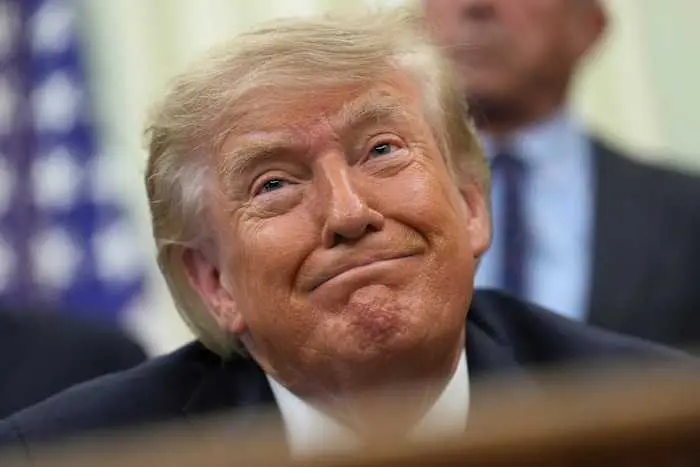

LAS VEGAS — With just over two months remaining before the high-stakes midterm elections, a profound anxiety is rippling through the upper echelons of the Republican Party. While candidates across the nation scramble to flood the airwaves and secure critical ground operations, the most powerful political financial engine in modern American history—President Donald Trump’s flagship super PAC, MAGA Inc.—remains virtually idle.
Despite boasting a colossal war chest that dwarfs major party committees, President Trump continues to sit on hundreds of millions of dollars, steadily growing his financial reserves rather than deploying them. The strategy has sparked mounting frustrations among GOP strategists, donors, and lawmakers who are desperately trying to retain control of Congress against formidable headwinds—some of which have been catalyzed by the administration itself.
As the calendar races toward Election Day, the delay in spending is no longer just a strategic curiosity; it has become a central flashpoint in contemporary American politics, raising critical questions about intra-party loyalty, the changing mechanics of campaign finance, and the ultimate utility of a lame-duck president’s financial dominance.
Executive Overview
The political landscape heading into the midterm elections presents a complex puzzle for the Republican Party. On one hand, President Trump remains an unparalleled force for driving base voter turnout, capable of commanding massive rallies and bending the party apparatus to his will. On the other hand, the administration faces historic unpopularity, weighed down by public dissatisfaction with the economy and the ongoing, protracted war in Iran—a conflict that a majority of Americans, according to recent polling, believe was not worth fighting.
These national headwinds have turned what should have been a standard midterm referendum into a defensive scramble for the GOP. Compounding the challenge is the unprecedented behavior of MAGA Inc., which closed out July with an astonishing $403 million in cash on hand. Having brought in an additional $3 million that month, the group has spent practically nothing, bypassing traditional early-investment timelines.
While Vice President JD Vance’s appearance at a campaign event in Michigan on Monday—funded by MAGA Inc.—signaled a potential shift, it remains a rare exception in an otherwise restrained spending cycle. For Republican candidates battling in fiercely contested battleground states, the looming question is whether the promised financial cavalry will arrive in time to alter the trajectory of the legislative branch, or if the funds will remain locked away in service of post-presidential influence.
Detailed Chronology: From Primary Upheavals to the General Election Countdown
To understand the current tension between President Trump and congressional Republicans, one must trace the timeline of political alignments and primary disruptions that have defined the 2026 cycle.
The Texas Earthquake
The friction between the White House and Capitol Hill is perhaps most palpable in Texas. The state transformed from a safe Republican stronghold into an unexpected battleground following a high-stakes primary cycle in which President Trump intervened to support scandal-plagued state Attorney General Ken Paxton. Trump’s backing helped Paxton oust incumbent GOP Sen. John Cornyn, a staple of the Senate establishment.
While the primary victory demonstrated Trump’s absolute sway over the party’s base, the general election math proved nightmarish for the GOP. Democratic nominee James Talarico launched a historic fundraising juggernaut, dramatically outpacing Paxton. Federal Election Commission (FEC) data revealed that Talarico brought in more than $68.5 million compared to Paxton’s $9 million. By the end of June, Talarico commanded a massive cash-on-hand advantage, holding over $21.5 million while Paxton limped along with just $1.75 million.
The disparity prompted rare, public pleas from veteran lawmakers. “We need help from the president,” Sen. John Kennedy, R-La., told Fox News over the weekend. “I’m hoping that the president is going to spend $100 or $200 million in Texas, but he hasn’t committed to it yet.”
The South Carolina Pilot and the Slow Rollout
MAGA Inc.’s operational footprint this year has been microscopic compared to its financial capacity. Its lone major financial outlay prior to late August occurred in South Carolina, where the group invested nearly $830,000 on a last-minute get-out-the-vote push. The investment was designed to secure the Republican nomination for Darline Graham, who sought to succeed her late brother, Sen. Lindsey Graham. The expenditure included roughly $774,000 dedicated to phone banks and $53,500 for targeted text messaging.
Since then, however, the financial taps have been tightly sealed. While Trump has maintained a relentless fundraising schedule—headlining an RNC fundraiser in Texas, participating in high-level MAGA Inc. strategy sessions, and hosting a donor dinner at his Virginia golf club—his super PAC has prioritized accumulation over distribution.
Recently, the group announced plans for a robust series of battleground state rallies, kicking off with Vice President Vance’s Michigan appearance. Yet, campaign vendors, advertisers, and canvassing firms report a disconnect between these high-profile events and the absence of a comprehensive, funded media and ground-game rollout.
Supporting Context & Metrics: The Anatomy of a Hoarded War Chest
A granular examination of campaign finance filings reveals the sheer magnitude of MAGA Inc.’s financial posture, as well as the steep opportunity costs associated with the current holding pattern.
- The $403 Million Reserve: At the conclusion of July, MAGA Inc.’s balance sheet stood at over $403 million, making it the single largest political war chest in the United States. It possesses more liquid capital than the National Republican Congressional Committee (NRCC), the National Republican Senatorial Committee (NRSC), and the Republican National Committee (RNC) combined.
- The Advertising Cost Curve: Political media markets operate on supply and demand. By delaying television and digital ad buys into late August and September, MAGA Inc. faces severely compressed inventory and exponentially higher ad rates. Strategists note that reserving airwaves in the spring yields significantly more gross rating points (GRPs) per dollar than scrambling for ad space weeks before election night.
- The Texas Advertising Deficit: Recognizing the crisis in the Lone Star State, MAGA Inc. went as far as testing promotional spots for Ken Paxton—including one focused on rural healthcare policy targeting Democrat James Talarico. However, these ads have languished without a television buy, leading insiders to speculate they may be relegated exclusively to low-cost digital and online channels rather than the broadcast reach required to shift statewide momentum.
- Pivot to Low-Propensity Voters: Recognizing that traditional television ad buys may be arriving too late in certain markets, aides have discussed alternative strategies. Drawing on the mechanics of presidential campaigns, MAGA Inc. teams have weighed deploying capital directly into intensive neighborhood canvassing, targeted mailers, and phone operations designed to mobilize low-propensity voters—individuals who are fiercely loyal to Donald Trump but historically fail to turn out for midterm elections.
Official Statements and Behind-the-Scenes Perspectives
The friction between anxious campaigns and a deliberate White House has played out across news networks, private strategy sessions, and public interviews.
Privately, Republican campaign vendors and consultants have expressed alarm. Speaking on the condition of anonymity to protect ongoing business relationships, multiple sources confirmed that while MAGA Inc. leadership advised firms in August to “stand by for action,” no concrete budgetary allocations or media plans have been communicated.
“Hope springs eternal,” remarked prominent Republican donor Dan Eberhart, capturing the sentiment of a donor class that frequently finds itself guessing at the executive branch’s electoral mechanics.
Conversely, the administration and its allies insist that the resources will materialize precisely when they can inflict maximum damage on the opposition. James Blair, a former White House deputy chief of staff who transitioned to manage President Trump’s midterm operations, forcefully defended the pacing of the campaign earlier this year.
“The president is going to expend substantial resources to win the midterms,” Blair stated on The Sean Spicer Show. “He cares deeply about the party winning, and anything he can do to support that he’s going to do and is already doing.”
President Trump himself has brushed aside concerns regarding the timing of his expenditures. When pressed directly by Punchbowl News about whether he intends to finance congressional races, Trump answered unequivocally: “Of course… I’m going to help Republicans.”
However, the president has also acknowledged the unique structural reality of his political operation. As a second-term, lame-duck president constitutionally barred from seeking another term in the Oval Office, Trump retains immense latitude over how his accumulated political capital is utilized. Pointing to the vast flexibility of his financial network, Trump reminded reporters of a fundamental political truth: “I can spend it on pretty much anything I want.”
Future Outlook: Power, Influence, and the Post-Presidency
As the clock ticks down to November, the standoff over MAGA Inc.’s war chest illuminates a broader evolution within the American conservative movement. Donald Trump is no longer merely the titular head of a political party; he is the custodian of an independent political and financial institution that rivals the traditional GOP apparatus.
If MAGA Inc. unleashes its $403 million reserve in the final weeks of the campaign, it could fundamentally reshape the battleground map, providing a crucial firewall for vulnerable congressional incumbents and rescuing imperiled seats like Paxton’s in Texas. Such a late-stage deluge would validate the administration’s strategy of keeping adversaries guessing while preserving maximum tactical flexibility.
However, should the funds remain largely untouched—or deployed too late to avert legislative losses—the fallout could strain relations between congressional leadership and the populist wing of the party. A diminished Republican majority, or a loss of congressional control directly attributable to a lack of resource deployment, would force a painful reckoning over party priorities.
Ultimately, keeping a commanding sum in the bank affords President Trump something beyond immediate electoral victories: long-term leverage. Even after the midterms conclude, aspiring politicians will continue to make the pilgrimage to Mar-a-Lago, seeking his endorsement, his blessing, and access to his financial network. By treating his war chest as both an electoral tool and an instrument of enduring political gravity, Trump ensures that his influence over the future of the American right will extend far beyond the immediate horizon of the legislative elections.

0 Comments