

Executive Overview
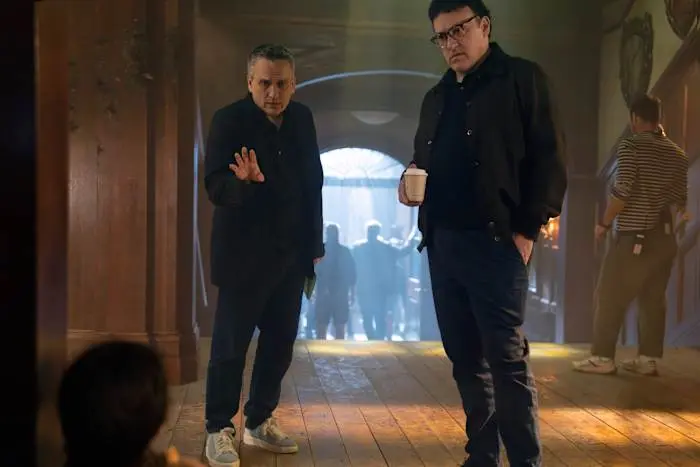
The landscape of modern blockbuster filmmaking has undergone seismic shifts over the last half-decade, but few narratives are as compelling as the homecoming of directors Joe and Anthony Russo to the Marvel Cinematic Universe (MCU). Before orchestrating the monumental box-office heights of 2019’s Avengers: Endgame—a cultural watershed that temporarily claimed the second-highest grossing spot in cinema history with a staggering $2.8 billion global haul—the duo built their reputation on the intricate choreography of sprawling ensemble casts. From their early television triumphs on comedies like Arrested Development and Community to reshaping the global superhero paradigm, the Russos have consistently demonstrated an innate aptitude for balancing chaotic interpersonal dynamics within vast casts.
Now, as they helm the highly anticipated Avengers: Doomsday (slated for theatrical release on December 18) and actively soft-prep its 2027 successor, Avengers: Secret Wars, the stakes could not be higher. Marvel Studios finds itself navigating a critical transitional era. Following the unprecedented peak of the Infinity Saga, the MCU experienced a turbulent Phase Four, Five, and Six. Beset by issues of content oversaturation, fluctuating box-office returns—exemplified by the underperformance of 2023’s The Marvels and the challenging critical reception of 2025’s Captain America: Brave New World—and behind-the-scenes structural changes, the studio is looking to its most trusted architects to recalibrate the cinematic universe.
Yet, Doomsday is far more than a simple nostalgia play. Driven by a revolutionary foundational narrative concept penned by co-writer Steve McFeeley, a massive cast bridging multiversal divides, and the shocking casting of former Iron Man star Robert Downey Jr. as the iconic villain Doctor Doom, the film represents a deliberate effort to wipe the slate clean. By drawing creative inspiration from the cinematic grammar of classic Westerns like Sergio Leone’s Once Upon a Time in the West, the Russo brothers are not merely attempting to resurrect past glories; they are daring to push the boundaries of ensemble storytelling into entirely uncharted territory.
Detailed Chronology: From Television Ensembles to Global Blockbusters
The journey of Joe and Anthony Russo to the pinnacle of Hollywood directing is deeply rooted in their upbringing in a large, tight-knit Italian family in Ohio. Growing up surrounded by a sprawling network of relatives sharing complex personalities, competing dynamics, and crowded Sunday dinners instilled in the brothers a lifelong fascination with group psychology.
"We grew up in a very large Italian family full of colorful personalities," Joe Russo reflects. "It was complex family dynamics. We all grew up on the same street; people lived in different houses. We spent dinners together on Sundays… We were always interacting with a large amount of personality and interpersonal dynamics. I think that’s how we see the world and see stories."
This foundational worldview translated seamlessly into their early television work. The brothers directed 14 episodes of the critically acclaimed, deeply eccentric cult comedy Arrested Development, followed by 34 episodes of Dan Harmon’s meta-comedy Community. These television incubators forced the directors to master the rhythms of rapid-fire dialogue, overlapping character arcs, and the delicate art of giving every member of a large ensemble their narrative due.
"For whatever reason, Joe and I have always really been drawn to ensemble storytelling," Anthony Russo notes. "Maybe it speaks to the fact that we work as a team."
That penchant for multi-character orchestration caught the attention of Marvel Studios President Kevin Feige. The Russos transitioned from television to feature films with 2014’s Captain America: The Winter Soldier, a gritty, 1970s-style political thriller that redefined the creative boundaries of the MCU. They followed this with 2016’s Captain America: Civil War, successfully juggling a massive roster of heroes before stepping up to direct the twin cinematic behemoths Avengers: Infinity War (2018) and Avengers: Endgame (2019).
Following the conclusion of the Infinity Saga, the brothers briefly stepped away from the superhero genre. Their post-Marvel trajectory included directing original streaming features—such as Apple Studios’ Cherry (2021), Netflix’s high-octane action thriller The Gray Man (2022), and the sci-fi adventure The Electric State (2025)—while successfully launching the Extraction action franchise via their production banner, AGBO. AGBO also expanded its industry footprint by producing critically acclaimed, boundary-pushing cinema, including the Best Picture Oscar-winner Everything Everywhere All at Once.
However, the gravitational pull of the MCU proved irresistible. When creative developments necessitated a massive pivot in the overarching narrative of the multiverse saga—specifically moving away from Kang the Conqueror following Jonathan Majors’ departure from the franchise—Marvel turned back to the Russos. Coached by a compelling new story pitch from writer Steve McFeeley, the brothers agreed to return, initiating a grueling, back-to-back production cycle on Doomsday and Secret Wars that ranks among the most demanding undertakings in modern filmmaking history.
Supporting Context & Metrics: Navigating the New Era of the MCU
To understand the immense pressure riding on Avengers: Doomsday, one must examine the macroeconomic and cultural shifts the entertainment industry has experienced since the Russos last walked the Marvel halls.
The Box-Office Landscape and Marvel’s Growing Pains
Avengers: Endgame stood as a monumental apex for the superhero genre, pulling in $2.8 billion worldwide and cementing the cultural dominance of Disney’s cinematic engine. (In a testament to its enduring legacy, The Walt Disney Co. has scheduled a theatrical re-release, Avengers Endgame: Encore, for September 25.)
However, the subsequent phases of the MCU revealed vulnerabilities that were previously unimaginable during the Infinity Saga. Kevin Feige has openly acknowledged that content oversaturation played a substantial role in a noticeable box-office and critical downturn. Key performance metrics underscore this shift:
- Theatrical Underperformance: 2023’s The Marvels grossed a modest $206 million globally, marking a historic low for a Marvel Studios event film.
- Critical Polarization: 2025’s Captain America: Brave New World received a "B-" CinemaScore from audiences, the lowest mark ever recorded for an MCU feature film.
- The Multiversal Standard: Conversely, alternative entries like Spider-Man: Brand New Day proved that audience appetite for high-caliber superhero events remains remarkably robust, grossing an astounding $2.3 billion worldwide and nearly rivaling Endgame.
The Production Scale of Avengers: Doomsday
Managing the scope of Doomsday requires navigating an unprecedented convergence of disparate cinematic universes. The narrative ropes together multiple factions that have historically existed in completely separate storytelling silos:
- The Core Avengers
- The Wakandans
- The New Avengers (originating from Earth-616)
- The Fantastic Four (originating from Earth-828)
- The Original X-Men
"The MCU is this massive experiment in how vast, how much scope can an ensemble really have?" Anthony Russo observes. "If we have a taste and talent for ensemble storytelling, we’re certainly pushing ourselves further than we ever have before."
Official Statements & Industry Insights
Working simultaneously on the editing and scoring of Doomsday while "soft prepping" production on Secret Wars, the Russo brothers offered rare, separate insights into the creative chaos driving their return.
"When you’re doing one of these movies, it’s the hardest thing you’ve ever done," Joe Russo states. "When you’re doing two of them, it’s almost inconceivable. But it’s the second time around we’re doing two back to back."
Addressing the monumental expectations surrounding whether Doomsday can single-handedly restore equilibrium to a fragmented fanbase, Anthony Russo emphasizes the specific, compartmentalized nature of their role within the broader machine:
"It’s a great question. It’s part of the unique challenge. The thing that Joe and I have always appreciated about our collaboration with Marvel is: Our job isn’t to answer for the entirety of the MCU. We intersect it in a very specific way. It’s that intersection which is where we can make sense of things."
This collaborative philosophy extends to the development of the script itself. Originally conceptualized under the banner of Avengers: The Kang Dynasty, the film required extensive retooling following Jonathan Majors’ legal troubles and subsequent dismissal from the franchise. Rather than treating the screenplay as an immutable blueprint, the Russos leaned into their trademark improvisational and rehearsal-driven methodology.
"We always view the script as a living organism," Joe explains. "We’re improvisation-based, rehearsal-based directors. We like to see what the actors bring to the characters, and sometimes you don’t get the actors until a few days or few weeks before you shoot them. And a lot of the time, that’s when the magic happens."
Furthermore, the decision to cast Robert Downey Jr.—the foundational pillar of the entire cinematic universe as Tony Stark/Iron Man—in the role of the villain Doctor Doom added a meta-textual layer of gravity to the production. Downey has openly admitted that his return to Marvel was entirely contingent upon the involvement of the Russos, creating a classic "band back together" dynamic that anchors the film’s emotional core.
Future Outlook: Rebuilding from Zero and Finding Inspiration in the West
As the entertainment industry prepares for the December release of Avengers: Doomsday and looks ahead to the culmination of the Multiverse Saga in Secret Wars (2027), the overarching philosophy guiding the directors is one of radical reinvention.
The brothers have consistently characterized their approach to Doomsday as going "back to zero," "starting from scratch," and engineering a "profound shift" within the MCU. Rather than coasting on the accumulated goodwill and multiversal capital of past films, the directors insist that the primary value of the project must reside in the novelty it introduces.
"We never want to coast on the capital that already exists," Anthony Russo asserts. "We want the greatest value of the film to reside in the new thing it’s bringing to the table."
To achieve this balance of grand historical scale and intimate emotional resonance, the directors have looked far beyond the traditional boundaries of comic book cinema. They cite Sergio Leone’s classic spaghetti Western, Once Upon a Time in the West, as a primary tonal and structural touchstone for Doomsday.
"Joe and I grew up fans of all types of cinema, but Westerns have always been very special to us," Anthony reflects. "Throughout cinema history, the Western has been declared dead for decades, and then you can still make one of the greatest examples of the genre."
If the Russo brothers can successfully channel the sweeping majesty, moral complexity, and patient pacing of the Western genre into a multiversal comic book epic, Avengers: Doomsday may not only right the ship for Marvel Studios—it may redefine the possibilities of blockbuster filmmaking for the decade to come.

0 Comments