
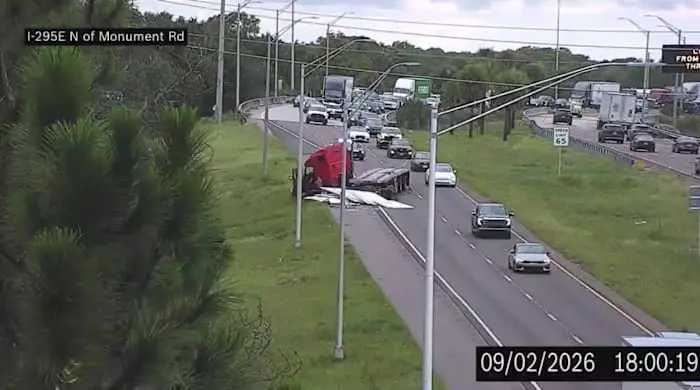

JACKSONVILLE, Fla. — A major traffic disruption materialized on Jacksonville’s East Beltway Wednesday evening after a commercial semitruck jackknifed across multiple lanes of Interstate 295, triggering severe gridlock during the tail end of the afternoon rush hour. The incident, which occurred just west of the bustling Southside Boulevard and Monument Road interchanges, immediately crippled commuter mobility and prompted a multi-agency emergency response to clear the wreckage, mitigate environmental hazards, and manage the ensuing vehicular backlog.
Authorities from the Florida Highway Patrol (FHP) and the Jacksonville Sheriff’s Office (JSO) rushed to the scene as automated traffic monitoring systems registered immediate, cascading delays. The accident underscores the vulnerability of Jacksonville’s critical freight and commuter corridors, illuminating the broader operational challenges facing municipal infrastructure when commercial vehicle accidents occur on high-volume interstate arterials.
Executive Overview
The Wednesday evening commute for thousands of Northeast Florida motorists transformed into a prolonged ordeal following a severe single-vehicle accident involving a commercial tractor-trailer on Interstate 295 eastbound. Preliminary incident reports indicate that the semitruck lost control, causing the trailer to swing perpendicular to the cab—a hazardous phenomenon known as jackknifing—effectively sealing off the right-hand lanes and severely restricting overall traffic capacity.
The disruption struck one of the most vital transportation arteries in Duval County. I-295 serves as the primary eastern bypass for Jacksonville, carrying a dense mix of local commuter traffic, cross-state commercial freight, and regional logistical transport. The timing of the mishap—coinciding with the peak of the evening rush hour—amplified its impact, resulting in tailbacks stretching for miles and forcing thousands of motorists to seek alternate routes through suburban arterial roads.
Emergency responders, including hazardous materials teams and heavy-duty towing specialists, were immediately dispatched to the scene to upright the immobilized vehicle, clear debris, and assess any potential fuel or fluid leaks. While initial assessments confirmed no fatalities resulting directly from the initial loss of control, the incident serves as a stark reminder of the delicate balance governing modern interstate mobility and the rapid ripple effects of commercial vehicle accidents on regional economies.
Detailed Chronology: Incident Unfolding and Emergency Response
Phase 1: The Initial Impact and Loss of Control
According to preliminary logs maintained by emergency dispatchers and the Florida Department of Transportation (FDOT), the incident began at approximately 4:45 p.m. on Wednesday. Weather conditions at the time featured mild visibility and dry pavement, ruling out immediate environmental factors such as heavy rain or standing water as primary catalysts. Eyewitness accounts and initial telemetry data suggest that the semitruck, traveling eastbound along I-295, experienced a sudden destabilization event just before approaching the Southside Boulevard and Monument Road exits.
As the driver attempted to decelerate or maneuver amid dense, fast-moving commuter traffic, the heavy trailer began to fishtail. The momentum of the unladen or partially loaded cargo bed overpowered the tractor’s braking system, forcing the vehicle into a classic jackknife position. The truck spun across the right lane and a portion of the center lane before coming to a dead stop, its massive frame acting as an impassable physical barrier across the asphalt.
Phase 2: Immediate Detection and First Responder Deployment
The digital footprint of the crash was registered almost instantaneously within the transportation network. Traffic cameras operated by FL511—the official traveler information system of the Florida Department of Transportation—automatically flagged the sudden drop in vehicular velocity and the complete cessation of movement in the affected lanes.
Within minutes, automated emergency notifications alerted the Florida Highway Patrol and local fire-rescue units. By 5:00 p.m., the first units arrived on the scene, immediately establishing a protective perimeter with emergency cruiser lights, flares, and traffic cones to prevent secondary collisions. Due to the size of the commercial vehicle and its obstructive position, officers quickly realized that standard patrol vehicle management would be insufficient, necessitating the urgent deployment of heavy-duty recovery assets.
Phase 3: Mitigation, Recovery, and Lane Clearance
The recovery operation proved to be a complex, multi-step engineering challenge. Jackknifed semitrucks present unique structural hazards; the angle between the cab and trailer often strains the chassis, fuel tanks can be compromised, and the sheer weight of the vehicle prevents standard tow trucks from moving it safely.
Hazmat crews inspected the roadway for spilled diesel fuel, hydraulic fluid, and engine oil—common byproducts of severe truck accidents that render asphalt dangerously slick and environmentally hazardous if allowed to enter local storm drains. Once the surface was deemed stable and treated with absorbent materials, heavy-duty tandem wreckers from a contracted regional towing service hooked into the commercial vehicle.
By early evening, technicians successfully straightened the articulation point between the cab and trailer, winching the truck onto a flatbed recovery system and dragging the debris toward the shoulder. Despite these swift mitigation efforts, residual congestion persisted for hours as the backlog of trapped vehicles slowly cleared through the bottlenecked zone.
Supporting Context & Metrics: The Anatomy of I-295 Congestion
To fully grasp the magnitude of Wednesday’s disruption, one must examine the operational metrics and geographical significance of the stretch of Interstate 295 where the accident occurred.
Traffic Volume and Arterial Significance
Interstate 295 serves as the vital ring road encircling the urban core of Jacksonville, spanning over 60 miles across Duval and Clay counties. The specific eastern segment encompassing the Southside Boulevard and Monument Road interchanges is one of the densest transportation corridors in the region. According to recent annual average daily traffic (AADT) reports published by the FDOT, this section accommodates upward of 120,000 to 140,000 vehicles daily.
Of that total, commercial freight traffic accounts for roughly 15% to 18% of the vehicle mix, reflecting Jacksonville’s status as a premier logistics hub supported by JAXPORT, regional rail yards, and numerous warehousing and distribution centers situated along the First Coast. When a single commercial vehicle blocks even a portion of this corridor during peak operational hours, the mathematical loss of lane capacity triggers exponential delays.
The Mathematics of a Lane Closure
Transportation engineers utilize the concept of "capacity drop" to model how roadway incidents impact traffic flow. Under normal conditions, a standard multi-lane interstate highway can process approximately 2,000 vehicles per lane per hour at optimal speeds.
When a semitruck jackknifes and seals off a right lane—and forces rubbernecking or evasive maneuvers in adjacent lanes—the operational capacity of that specific highway segment can plummet by 40% to 60% instantaneously. On Wednesday evening, with thousands of motorists attempting to funnel past the wreckage site, the demand heavily outstripped the available throughput, resulting in a classic shockwave propagation effect. Vehicles miles upstream were forced to come to a complete stop, creating a cascading accordion effect of delays that rippled backward faster than the traffic itself was moving.
Safety Statistics and Commercial Vehicle Vulnerability
Commercial vehicle incidents on Florida’s interstate network remain a focal point for state transportation safety boards. According to the National Highway Traffic Safety Administration (NHTSA) and Florida Highway Safety and Motor Vehicles (FLHSMV) data, heavy truck involvement in urban expressway accidents, while statistically lower in frequency than passenger car collisions, yields disproportionately severe disruptions.
Jackknifing typically occurs due to several recurring operational factors:
- Improper Braking: Sudden braking on wet or dry pavement where the trailer’s brakes lock up before the tractor’s brakes.
- Speed Discrepancies: Navigating dense traffic where speed differentials between commercial trucks and faster-moving passenger vehicles force sudden corrective steering.
- Cargo Shifts: Improperly secured internal loads that alter the center of gravity during high-speed lane changes or curve negotiations.
While investigations into the exact root cause of Wednesday’s incident remain ongoing by FHP accident reconstruction specialists, the event highlights the thin margin for error governing large-scale freight transport on commuter-heavy ring roads.
Official Statements and Institutional Responses
In the wake of the incident, local and state agencies mobilized communication channels to inform the public, manage expectations, and reiterate safety protocols for motorists navigating commercial vehicle corridors.
Florida Highway Patrol (FHP) Statement
Public affairs representatives from the Florida Highway Patrol issued timely updates via digital media channels and emergency broadcast networks. An FHP spokesperson emphasized the importance of driver cooperation during major recovery operations:
"The primary objective during any commercial vehicle accident on our interstate system is the rapid preservation of life, followed closely by the safe clearance of the roadway to restore public mobility. We urge all motorists to maintain a safe following distance from commercial trucks, particularly during high-density travel periods. When incidents like this occur, patience and adherence to emergency detour routes are critical to protecting our first responders working on the asphalt."
Florida Department of Transportation (FDOT) District 2 Response
FDOT engineers stationed in District 2—which covers Northeast Florida—monitored the incident in real-time through the Intelligent Transportation Systems (ITS) network. Through electronic message boards strategically placed along I-295, I-95, and local expressways, FDOT directed drivers toward recommended bypasses, utilizing arterial roadways such as Atlantic Boulevard, Beach Boulevard, and Girvin Road to relieve pressure on the stalled eastern beltway.
Furthermore, FDOT infrastructure analysts reiterated their ongoing commitment to expanding arterial monitoring capabilities, deploying smart-work-zone technologies, and upgrading incident management teams (Road Rangers) designed to clear minor vehicular disabled units before they escalate into major regional bottlenecks.
Local Commuter and Business Reactions
Local business associations and commuter advocacy groups expressed ongoing concern regarding the frequency of freight-related transit delays in the greater Jacksonville area. As the city continues to experience rapid population growth and commercial expansion, the friction between residential commuting patterns and industrial freight distribution lines has intensified. Chambers of commerce have repeatedly called for accelerated infrastructure enhancement, including the potential designation or physical separation of dedicated freight lanes along high-capacity bypasses like I-295.
Future Outlook: Infrastructure Resilience and Mitigation Strategies
Wednesday evening’s jackknifed semitruck incident on I-295 is not an isolated anomaly, but rather a symptom of broader structural challenges facing modern metropolitan transportation networks. As Jacksonville solidifies its position as a preeminent southeastern logistics capital, municipal planners, state legislators, and transportation engineers are forced to reevaluate how regional infrastructure can better absorb the shocks of commercial vehicle disruptions.
Technological Advancements in Traffic Management
To mitigate the impact of future incidents, FDOT and local municipal partners are heavily investing in advanced traffic management technologies. Future deployments include:
- AI-Driven Incident Detection: Utilizing artificial intelligence and computer vision algorithms integrated into traffic cameras to detect stopped vehicles, debris, or anomalous traffic patterns within seconds, bypassing the lag time of human reporting.
- Automated Variable Speed Limits: Implementing smart signage that automatically reduces legal speed limits upstream of an incident to harmonize traffic flow and prevent rear-end collisions caused by sudden braking.
- Enhanced Real-Time Telematics: Expanding public-private data partnerships with commercial fleet operators to track truck movements more granularly and communicate hazard alerts directly to in-cab navigation systems.
Policy and Driver Education Initiatives
Beyond technological interventions, safety advocates emphasize the necessity of continuous education campaigns targeting both commercial drivers and everyday motorists. For commercial carriers, stricter adherence to preventive maintenance schedules—specifically regarding brake balance, tire tread integrity, and electronic stability control systems—remains paramount.
For passenger vehicle drivers, awareness training regarding the blind spots of semitrucks ("No-Zones"), the dangers of cutting off heavy vehicles, and the mechanics of maintaining safe stopping distances can significantly lower the incidence of provocative maneuvers that trigger emergency braking and subsequent jackknifes.
Long-Term Infrastructure Planning
Looking toward the horizon, regional transportation master plans for Duval County include continuous lane-widening projects, geometric improvements to complex interchanges like Southside Boulevard and Monument Road, and the potential integration of managed lanes. These strategies aim to build structural redundancy into the I-295 corridor, ensuring that when an obstruction inevitably occurs, alternate pathways can seamlessly absorb displaced traffic without plunging the entire metropolitan area into gridlock.
As the wreckage was cleared late Wednesday night and normal traffic speeds gradually resumed along the I-295 eastbound lanes, the incident left behind a clear blueprint for what is required: a synthesis of rapid emergency response, resilient infrastructure engineering, and proactive technological vigilance to keep Jacksonville moving safely into the future.

0 Comments